
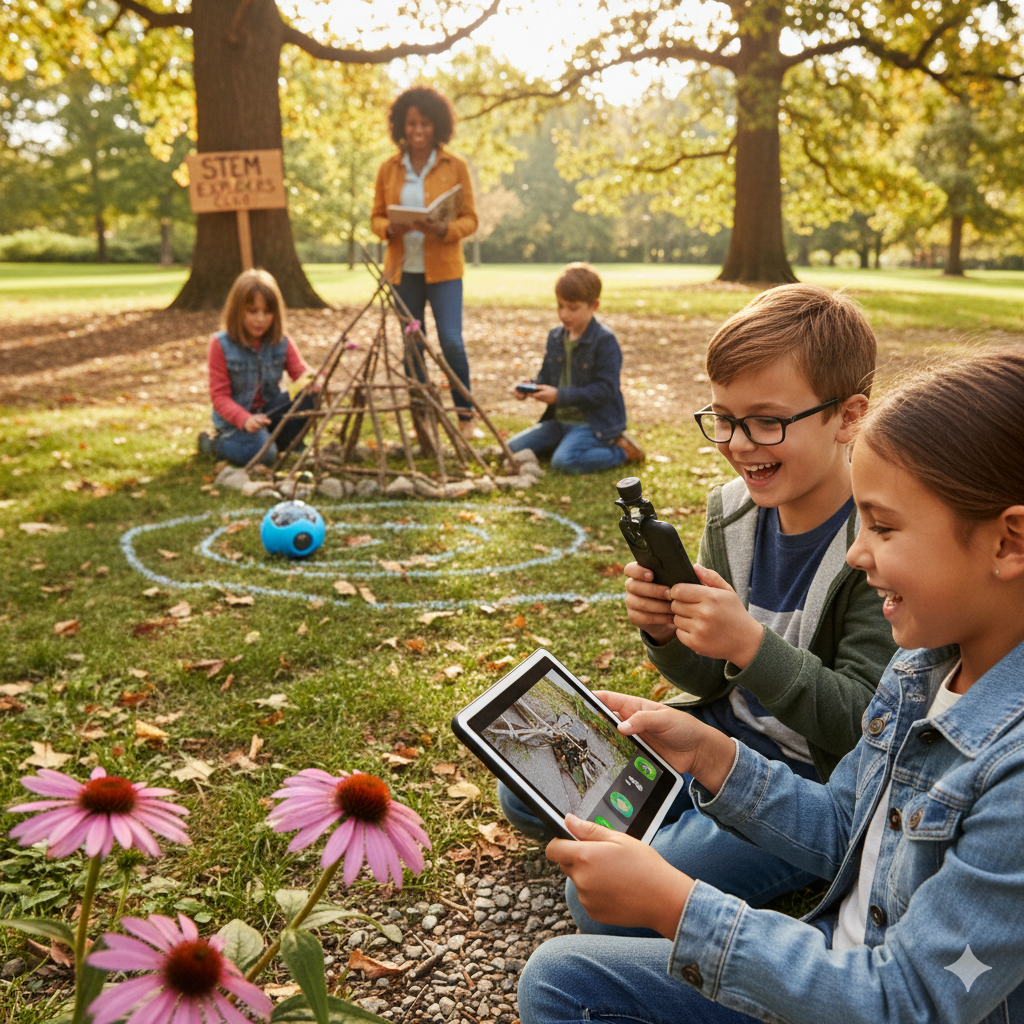
Turning Screen Time into Adventure Time
I’ll never forget the day my daughter looked up from her tablet and asked, “Can we use this outside?” That simple question changed how I think about technology and childhood. Instead of fighting the digital age, what if we used it to deepen kids’ connection with nature?
Over the past three years, I’ve tested dozens of tech activities outdoor for kids that combine technology with fresh air. Some flopped spectacularly (looking at you, wind-powered drone experiment). But many created those magical moments where learning happens without kids even realizing it.
This guide shares 25 activities I’ve personally used with children ages 5-12. They’re organized by difficulty and the type of tech involved, so you can match activities to your child’s interests and your available equipment.
Why Combining Tech and Outdoors Actually Works
Before diving into activities, let me address the elephant in the room: shouldn’t kids just put devices away when they’re outside?
In an ideal world, maybe. But we live in a reality where technology isn’t going anywhere. Teaching kids to use devices as tools for discovery rather than just entertainment creates a healthier relationship with technology overall.
When my son uses an app to identify a bird, he’s not passively scrolling—he’s actively observing, comparing features, and learning classification. The technology becomes a magnifying glass that helps him see the natural world more clearly.
Part 1: Apps That Transform Nature Walks
These activities use smartphones or tablets as field guides, turning casual outdoor time into scientific exploration.
Nature Detective Activities
| Activity | App You’ll Need | What Kids Learn | Why It Works |
|---|---|---|---|
| 1. Plant & Insect Detective | Seek by iNaturalist (free) | Species identification, biodiversity, observation skills | Kids get instant feedback—take a photo and learn what they found in seconds |
| 2. Backyard Bird Research | Merlin Bird ID (free) | Bird behavior, sound recognition, patience | Works like music identification apps kids already understand |
| 3. Night Sky Explorer | SkyView Lite (free) | Astronomy, planetary motion, constellations | Augmented reality makes invisible patterns visible |
| 4. Real Treasure Hunting | Geocaching Official App | GPS navigation, map reading, problem-solving | Combines video game quest mechanics with actual hiking |
| 5. Weather Science Station | Simple weather journal + any note-taking app | Meteorology, data patterns, prediction | Kids become meteorologists tracking real atmospheric conditions |
Parent Tip from Experience: Download these apps before heading out. Cell service in nature areas is unreliable, but most of these apps work offline after initial setup.
What Makes These Different from Regular Screen Time
When kids use these apps, they’re not consuming content—they’re creating knowledge. My daughter’s iNaturalist observations have been verified by university botanists. That level of real-world validation is powerful for building confidence and genuine interest in science.
Just like professionals use data visualization tools for business intelligence to understand complex information, these apps help kids visualize and organize what they discover in nature.
Part 2: No-Screen Coding Games
These activities teach programming concepts using only chalk, rocks, and creativity. They’re perfect for families who want STEM learning without adding more screen time.
Physical Programming Challenges
| Activity | Core Concept | What You Need | How It Works |
|---|---|---|---|
| 6. Human Robot Game | Sequential thinking, algorithms | Nothing but space | One child writes commands (“walk 3 steps forward, turn left”), another follows them exactly |
| 7. Debugging Obstacle Course | Error correction, iteration | Chalk for drawing paths | Create a path with instructions; when the “robot” fails, find and fix the broken command |
| 8. If-Then Nature Rules | Conditional logic | Chalk, small objects | Draw squares with rules: “If you see a pinecone, hop twice; if you see a leaf, spin around” |
| 9. Pattern Bracelet Loops | Functions, repetition | String and beads or natural items | Design a 3-item pattern (your function), then repeat it 5 times (your loop) |
| 10. Trail Marker Code | Binary encoding, communication | Two types of rocks or sticks | Use two different objects to represent 0 and 1, create messages in binary along a trail |
Real Experience Note: The Human Robot game creates hilarious moments. Kids quickly learn that computers need extremely precise instructions—”go forward” isn’t specific enough!
Why Physical Coding Matters
Before kids sit down to write actual code, understanding the logic behind programming makes everything easier. These games build computational thinking—the ability to break problems into steps and find solutions systematically.
Part 3: Engineering Challenges for Young Builders
These hands-on projects combine physics, design thinking, and outdoor experimentation. Expect mess, trial and error, and lots of learning.
Building and Testing Projects
11. Natural Materials Egg Drop
Kids collect sticks, leaves, moss, and grass to build a protective container for a raw egg. Drop it from increasing heights. This teaches impact absorption, structural integrity, and iterative design.
From my testing: Set clear boundaries for collection areas and give a 20-minute time limit. The constraint actually increases creativity.
12. Pizza Box Solar Oven
Build a simple solar concentrator using a pizza box, aluminum foil, and plastic wrap. Use it to melt cheese on crackers or soften chocolate. This demonstrates solar energy conversion and insulation principles.
Safety note: These get surprisingly hot. Adult supervision required, and use oven mitts when handling food.
13. Backyard Water Engineering
Near a stream or using a garden hose, challenge kids to build channels, dams, or waterwheels using natural materials. They’ll learn about water pressure, flow rates, and structural stability.
14. Wind-Powered Vehicle Race
Build small vehicles from recycled materials and power them only with wind (natural or fan-created). Kids experiment with aerodynamics, weight distribution, and friction.
15. Robot Outdoor Navigation
If you have a programmable robot (Sphero, Dash, or similar), program it to navigate outdoor terrain. Unlike smooth indoor floors, grass, dirt, and rocks require constant code adjustments.
Budget reality: These robots cost $80-150, but many libraries now loan them out. Check your local library system.
The Value of Failure in Engineering
Half the projects in this category will fail on the first attempt—and that’s the point. Engineering is iterative. When my son’s solar oven didn’t work initially, we researched why, made adjustments, and tried again. That process taught persistence more effectively than any success would have.
Part 4: Documentation and Digital Storytelling
These activities use technology as a creative tool to capture and share outdoor discoveries.
16. Five Senses Photo Challenge
Create a scavenger hunt based on sensory experiences: photograph something rough, something that makes sound, something fragrant, something colorful, something smooth. This develops observational skills and sensory awareness.
17. Nature Time-Lapse Recording
Set up a phone or tablet to record time-lapse video of slow natural processes: clouds moving, shadows shifting, flowers opening or closing, anthills in action. Watching the sped-up footage reveals patterns invisible in real-time.
18. Sound Map Creation
Sit quietly in one spot for 10 minutes. Record all the sounds you hear using a voice memo app. Then create a visual map showing where each sound came from, combining audio documentation with spatial reasoning.
19. Macro World Photography
Use a smartphone’s macro mode or an inexpensive clip-on lens to photograph tiny details: dewdrops on spider webs, insect eyes, leaf vein patterns. This reveals complexity kids normally overlook.
20. Pattern-Based Digital Art
Photograph natural patterns (spiral shells, symmetrical leaves, fractal ferns), then use a simple editing app to mirror, rotate, or repeat them, creating geometric art that explores mathematical concepts found in nature.
Making Documentation Purposeful
The key difference between these activities and aimless photo-taking is purpose. Kids are documenting to answer questions, prove observations, or create something new. My daughter’s nature journal now contains hundreds of photos organized by season, and she regularly compares them to track changes.
Part 5: Math and Data in the Real World
These activities prove that math isn’t just workbook problems—it’s a tool for understanding the world around us.
Measurement and Calculation Challenges
21. Height Estimation Challenge
Use estimation techniques and simple measuring tools to calculate tree heights, garden bed areas, or distances between objects. Compare estimates to actual measurements to improve accuracy over time.
22. Speed and Distance Racing
Create a measured racetrack (50 feet works well). Time different movement methods: running, hopping, crawling, skipping. Calculate speed for each method using distance ÷ time. This makes abstract formulas tangible.
23. Symmetry Hunt and Analysis
Find symmetrical objects in nature. Use a camera’s grid feature to check symmetry, then draw lines of symmetry on photos. This builds geometry skills through observation.
24. Micro-Ecosystem Inventory
Mark off a one-square-meter area. Count and categorize everything inside: grass blades, flowers, insects, rocks. Create a chart or graph showing the data. This combines biology with data organization.
25. Shadow Tracking Across the Day
Stand in one marked spot at three different times. Photograph and trace your shadow each time. The changing shadows demonstrate Earth’s rotation and create a visual timeline of how the sun’s position changes.
Why Real-World Math Sticks
When kids calculate their running speed or track shadow movements, they’re seeing why math matters. Abstract concepts become concrete. This is the same principle behind data analysis—finding meaningful patterns in real information, whether you’re analyzing business intelligence data or backyard ecosystems.
Practical Tips from Three Years of Testing
Start Simple Don’t try the most complex activity first. Begin with a nature identification app or the human robot game. Build confidence before attempting multi-step engineering projects.
Let Kids Lead When Possible Some of my best activity discoveries happened when kids took projects in unexpected directions. My son’s water channel experiment turned into a week-long irrigation system design. Follow their interests.
Weather Matters More Than You Think Wind affects robot navigation. Rain makes chalk games impossible. Bright sun helps solar ovens but makes phone screens hard to see. Plan activities that match forecasted conditions.
Document Your Own Journey Take photos of your kids doing these activities. Those images become portfolio pieces that show their learning journey. Plus, they’re genuinely proud seeing their outdoor STEM work displayed.
Manage Expectations Around Technology Apps crash. Batteries die. GPS gets confused. Have backup activities ready, and use technology failures as teaching moments about troubleshooting and adaptation.
 Common Questions Parents Ask Me
 Common Questions Parents Ask Me
What age should we start these activities?
I’ve successfully done simplified versions with 5-year-olds (nature apps, basic human robot games) and complex engineering challenges with 12-year-olds. Match the activity complexity to your child’s patience level and fine motor skills, not just their age.
Is this really learning or just play?
It’s both, which is exactly the point. The most effective learning happens when kids don’t realize they’re in “learning mode.” When my daughter spent two hours photographing insects, she was playing. She was also learning classification, observation, photography, and patience.
Do we need expensive equipment?
Most activities need only a smartphone and free apps. The engineering challenges use recycled materials. The most expensive item on this list is a programmable robot, which costs about what many families spend on video games—and those are often available through library lending programs.
What if we don’t live near nature?
Parks, playgrounds, and even backyards work for most activities. The shadow tracking, pattern photography, and physical coding games need minimal space. You’re looking for “outdoors,” not “wilderness.”
How do these compare to regular outdoor play?
They don’t replace unstructured outdoor play—they complement it. Some days, kids just need to run around. Other days, structured STEM activities provide focused learning opportunities. Variety matters.
Resources for Going Deeper
The National Wildlife Federation offers excellent resources for connecting kids with nature, including seasonal activity guides and wildlife identification support.
For understanding how technology can enhance rather than replace traditional learning, the Fred Rogers Center provides research-based frameworks for thoughtful technology integration in children’s lives.
Final Thoughts: Building Tomorrow’s Problem Solvers
 Final Thoughts: Building Tomorrow’s Problem Solvers
Technology isn’t going away. Nature isn’t becoming less important. Teaching kids to use one to better understand the other prepares them for a world where both technical literacy and environmental awareness are essential.
The skills developed through these activities—observation, systematic thinking, data collection, troubleshooting, persistence—transfer far beyond childhood. These are the foundational abilities needed for scientific careers, environmental stewardship, and innovative problem-solving in any field.
Start with one activity this weekend. See what captures your child’s interest. Build from there. The goal isn’t to complete all 25 activities—it’s to discover which ones spark genuine curiosity in your specific child.
Some kids will gravitate toward the engineering challenges. Others will become obsessed with identifying every plant in the neighborhood. A few will surprise you entirely, like my daughter who turned the shadow tracking activity into a multi-week art project about light and time.
The beauty of combining technology with outdoor exploration is that there’s no single right path. These are tools and frameworks—what your family builds with them is entirely your own adventure.