
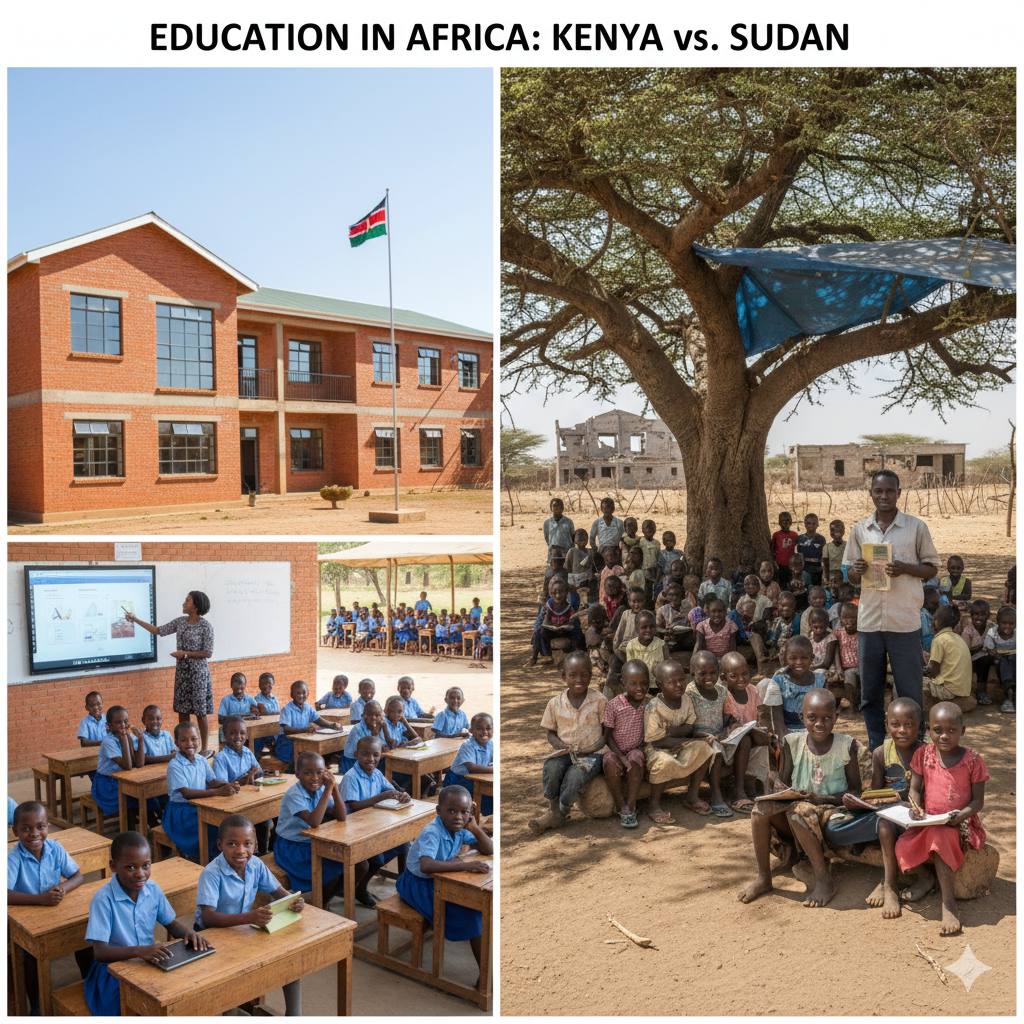
Education in Kenya has flourished through decades of stable governance, constitutional guarantees of free primary and secondary schooling, and consistent investment of approximately 5% of GDP in educational infrastructure. Kenya’s 2003 Free Primary Education policy dramatically increased enrollment rates, while ongoing curriculum reforms like the Competency-Based Curriculum improve learning outcomes. In contrast, Sudan and South Sudan face devastating educational challenges due to prolonged civil conflict, displacement of millions, destroyed school infrastructure, and government spending below 2% of GDP on education—resulting in some of the world’s lowest completion rates.
Understanding Two Very Different Educational Journeys
Picture two children born on the same day in 2015—one in Nairobi, Kenya, and another in Juba, South Sudan. By age eight, the Kenyan child would likely be in third grade, learning in a structured classroom with trained teachers and access to textbooks. The South Sudanese child, however, has less than a 50% chance of ever attending school at all.
This isn’t just about economics. While Kenya’s GDP per capita is higher, the gap in educational access far exceeds what wealth alone would predict. The real story lies in how political stability, strategic policy decisions, and sustained commitment have shaped completely different realities for students in these East African nations.
Understanding why education in Kenya has progressed while Sudan struggles reveals important lessons about what actually builds functioning education systems—and what can destroy them.
The Foundation: How Stability Shapes Everything
Every successful education system requires one fundamental ingredient before anything else can work: predictability. Students need to know their school will be there tomorrow. Teachers need consistent salaries. Parents need to believe that investing time and resources in education will pay off.
Kenya has provided this foundation, albeit imperfectly. Since independence in 1963, the country has maintained governmental continuity that allowed for long-term educational planning. Yes, Kenya has faced challenges including post-election violence, regional conflicts, and corruption. But schools have remained open, teacher salaries have been paid (though sometimes late), and educational infrastructure has steadily expanded.
Sudan tells a heartbreaking opposite story. From 1983 to 2005, civil war ravaged the southern regions. When South Sudan gained independence in 2011, many hoped for a fresh start. Instead, renewed civil conflict erupted in 2013, continuing with various intensities through today. In Sudan proper, political instability, economic sanctions, and more recent conflict starting in 2023 have repeatedly disrupted any attempts to build sustainable educational systems.
The mathematics of conflict are brutal for education. When a school gets destroyed, it’s not just the building—you lose the teachers who flee, the students who become refugees, the records that track academic progress, and the community trust that education matters. Rebuilding takes years or decades, and many communities in Sudan have experienced multiple cycles of destruction.
What This Looks Like in Practice
In Kenya’s rural areas, you’ll find schools that have operated in the same location for 30, 40, or 50 years. Buildings may be humble, resources stretched thin, but there’s institutional memory. Teachers know the curriculum, parents understand the system, and students can complete their education in one place.
In South Sudan, according to UNICEF’s education data, nearly two-thirds of children are out of school. Many schools operate only sporadically, depending on whether the area is safe, whether teachers have been paid, and whether displaced families have returned. Students may attend three different schools in three different locations, learning from different curriculums, before dropping out entirely.
The Numbers Tell a Stark Story
Let me show you how different these systems have become:
| Educational Measure | Kenya | Sudan/South Sudan |
|---|---|---|
| Government Spending | Approximately 5% of national GDP dedicated to education annually | Often falls below 2% of GDP due to economic crisis and competing security priorities |
| Primary School Enrollment | Over 90% of school-age children enrolled, with near gender parity in most regions | South Sudan: Roughly 35-40% enrollment; Sudan: Higher but still significantly below Kenya |
| Adult Literacy Rate | Approximately 82% overall, with gaps narrowing between male and female literacy | South Sudan: Around 35%, one of the world’s lowest; Sudan: Approximately 60% with major gender disparities |
| Student-Teacher Ratio | Approximately 40:1 in primary schools (still challenging but manageable) | South Sudan: Often exceeds 80:1 or 90:1; many classes with 100+ students per teacher |
These aren’t just statistics—they represent real differences in life opportunities. A literate population can access health information, participate in democracy, create businesses, and advocate for their rights. The educational gap between Kenya and Sudan isn’t just about schooling; it’s about fundamentally different national trajectories.
How Kenya Built Its Education System
Kenya’s educational progress didn’t happen by accident. It resulted from specific policy choices sustained over decades:
The 2003 Turning Point
When Kenya launched Free Primary Education in 2003, over one million children who had been out of school enrolled within the first year. This wasn’t just about removing school fees—the government committed to funding schools directly, hiring thousands of additional teachers, and building new classrooms to accommodate the surge.
The program had problems: overcrowding, resource shortages, quality concerns. But the fundamental commitment held firm. Every Kenyan child gained a constitutional right to free basic education, backed by actual budget allocations.
Constitutional Guarantees That Work
Kenya’s 2010 Constitution explicitly guarantees every child’s right to free and compulsory basic education. But unlike aspirational statements in some constitutions, Kenya’s government actually enforces this through:
- Direct funding to schools based on enrollment
- Teacher hiring and training programs run by the Teachers Service Commission
- Oversight mechanisms through the Ministry of Education
- Legal penalties for parents who don’t enroll children
The Kenya National Bureau of Statistics tracks educational indicators closely, creating accountability for progress.
Curriculum Evolution
Kenya recently transitioned from the long-standing 8-4-4 system (eight years primary, four years secondary, four years university) to a Competency-Based Curriculum designed around practical skills rather than rote memorization. Whether this improves outcomes remains to be seen, but the ability to undertake major curriculum reform demonstrates institutional capacity that Sudan currently lacks.
Technology Integration Efforts
Kenya’s Digital Literacy Programme has distributed laptops and tablets to thousands of primary schools, particularly targeting underserved areas. While implementation has faced challenges—including infrastructure limitations and maintenance issues—the vision of tech-enabled learning is becoming reality in many Kenyan classrooms.
Why Sudan’s System Has Struggled
Understanding Sudan’s educational crisis requires looking at multiple reinforcing factors:
| Challenge Area | How It Manifests | Direct Impact on Students |
|---|---|---|
| Infrastructure Destruction | Armed conflicts have damaged or destroyed thousands of school buildings; many converted to military use or shelters | Children learn in overcrowded temporary structures, under trees, or not at all; no protection from weather or basic sanitation |
| Teacher Shortages | Low or inconsistent salaries drive teachers to other work; training institutions disrupted; many qualified teachers fled as refugees | Students taught by untrained volunteers when taught at all; no continuity in instruction; learning quality severely compromised |
| Funding Crisis | Government prioritizes military spending; international sanctions limit resources; aid unpredictable | Schools lack textbooks, supplies, chalk; teacher salaries unpaid for months; buildings deteriorate without maintenance |
| Displacement | Millions internally displaced or living as refugees; families constantly moving for safety | Students change schools repeatedly, lose years of education, or give up entirely; records lost; progress impossible to track |
| Cultural Barriers | Traditional practices prioritize boys’ education; early marriage common; girls expected to help at home | Female literacy remains extremely low; generational poverty continues; maternal and child health outcomes suffer |
The Gender Gap Crisis
While Kenya has achieved approximate gender parity in primary education, the situation for girls in South Sudan is catastrophic. A widely cited statistic bears repeating: a girl in South Sudan is more likely to die in childbirth than to complete primary school.
This isn’t just about cultural attitudes—though those matter. It’s about families making impossible choices under extreme poverty. When school isn’t free (despite official policy), and when safety is uncertain, families protect and invest in boys while keeping girls home. This creates a self-reinforcing cycle where uneducated mothers have fewer resources and less agency to prioritize their daughters’ education.
The Classroom Experience: A Tale of Two Realities
What does a typical school day actually look like in each country?
In Kenya: A primary school student might wake up early, walk or take affordable transport to a permanent school building. They’ll find their classroom—perhaps crowded with 40-50 students—but there’s a trained teacher, a chalkboard, and shared textbooks. The day follows a structured curriculum. The teacher may be overworked and resources tight, but learning happens. After school, some students can access the school’s computer lab for the Digital Literacy Programme.
In South Sudan: If a child attends school at all, they might gather with 80 or 100 other students under a tree or in a structure with a tarp roof and no walls. The “teacher” may be a young person with only primary education themselves, working as a volunteer because no funds exist for salaries. There are no textbooks—students share whatever materials the teacher managed to find. Class might be interrupted by security threats, or cancelled entirely during rainy season when the learning space floods. Many students attend hungry, as school feeding programs are sporadic or nonexistent.
These aren’t exaggerations—they’re documented realities from educational assessments conducted by international organizations working in both countries.
What the Data Says About Outcomes
| Educational Outcome | Kenya’s Progress | Sudan/South Sudan’s Challenge |
|---|---|---|
| Primary Completion Rate | Approximately 85% of students who enroll complete primary education | South Sudan: Only 10-15% complete primary—among the world’s lowest rates |
| Transition to Secondary | Roughly 75% of primary graduates continue to secondary school | Most students never reach secondary level; extreme dropoff after primary (when accessible) |
| Learning Quality | Regional assessments show improving but still concerning literacy and numeracy levels | Where assessments possible, students score significantly below minimum proficiency levels |
| Teacher Qualification | Majority of teachers hold required credentials and training | Estimated 40% or more of teachers lack basic qualifications or formal training |
👉The Role of International Support
Both countries receive international education aid, but with different effects:
Kenya uses international support to supplement a functioning domestic system. Organizations like the World Bank and bilateral donors fund specific initiatives—like girls’ education programs or infrastructure in marginalized counties—that complement government efforts. According to UNESCO’s education data, this partnership model helps Kenya innovate and expand.
Sudan and South Sudan, by contrast, rely on international aid to keep any educational services running at all. UNICEF, Save the Children, and other NGOs often provide the only education available in conflict zones. This creates unpredictability—when funding cycles end or security forces aid workers out, schools close.
Common Questions About Education in Kenya and Sudan
Why hasn’t South Sudan’s independence improved education access?
Many hoped that independence in 2011 would allow South Sudan to prioritize education without interference. Unfortunately, internal power struggles erupted into civil war by 2013, destroying much of the infrastructure that existed. The young nation has spent most of its existence in conflict rather than nation-building.
Does Kenya’s education system work equally well everywhere?
No. Significant disparities exist between urban and rural areas, and between different regions. Northern counties like Turkana and Mandera have educational indicators much lower than the national average, though still far better than South Sudan. Nairobi and central Kenya have near-universal enrollment and good quality, while pastoralist communities face ongoing challenges.
What happens to refugee children from Sudan living in Kenya?
Kenya hosts hundreds of thousands of refugees from South Sudan and Sudan, primarily in camps like Kakuma and Dadaab. These children have access to education through humanitarian organizations, though quality and resources are limited compared to Kenyan national schools. Still, refugee children in Kenya receive far more consistent education than they would in their home countries’ conflict zones.
How do families in Sudan afford education if it’s officially free?
While constitutions guarantee free education, the reality is different. Schools charge “voluntary” fees for everything from registration to exams to building maintenance. These costs, though small by international standards, are prohibitive for families in extreme poverty. This is why enrollment remains so low despite official policies.
Can Kenya’s model work for Sudan?
The policy framework Kenya uses could theoretically work in Sudan, but requires the foundational element Kenya has and Sudan lacks: sustained peace. You cannot implement free primary education if schools keep getting destroyed. You cannot train teachers if they’re fleeing conflict. Kenya’s success is built on 60+ years of continuous government operation—Sudan needs to achieve basic stability first.
For Sudan and South Sudan to approach Kenya’s educational access, several conditions must be met:
Immediate Priorities:
- Achieve sustainable peace agreements with actual implementation
- Secure funding for teacher salaries to retain qualified staff
- Rebuild or construct basic school infrastructure in safe zones
- Focus initial efforts on getting girls enrolled and attending
Medium-Term Goals:
- Develop or restore national curriculum standards
- Create teacher training institutions
- Establish reliable funding mechanisms independent of aid volatility
- Build administrative systems to track students and maintain records
Long-Term Vision:
- Constitutional educational guarantees backed by budget allocations
- Infrastructure that reaches rural and marginalized populations
- Secondary and tertiary systems that provide pathways to skilled employment
- Gender parity across all educational levels
Kenya, despite its success relative to Sudan, still has significant work ahead. Improving quality, addressing regional disparities, and ensuring the new curriculum delivers on its promises remain ongoing challenges
The Bottom Line
The difference in education access between Kenya and Sudan isn’t primarily about wealth—it’s about what peace makes possible. Kenya has shown that sustained political stability, combined with genuine policy commitment and consistent funding, can create educational systems that serve the vast majority of children even in a developing economy.
Sudan’s tragedy illustrates how quickly conflict can unravel generations of educational progress, leaving millions of children without the tools they need to build better futures.
For development practitioners, policymakers, and international donors, the lesson is clear: educational aid to conflict zones must go hand-in-hand with serious peace-building efforts, or we’re simply building schools that will be destroyed before they can serve their purpose.
The children waiting for education in Sudan cannot wait for perfect conditions. But they do need basic security, committed funding, and governments willing to prioritize their future over military expenditures. Until those conditions exist, the gap between education in Kenya and Sudan will continue to represent one of the most unjust disparities in modern Africa.