
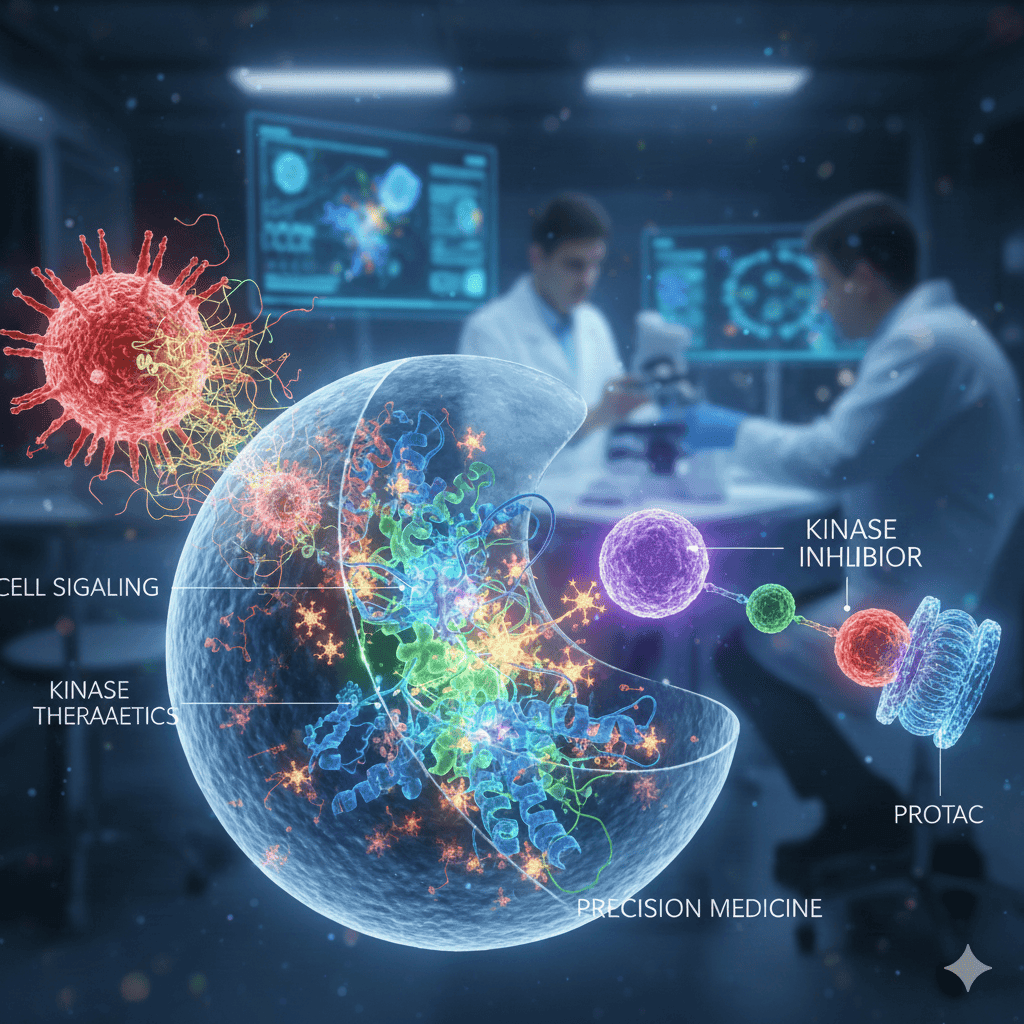
Cell signaling technology represents the scientific methods and tools used to understand how cells communicate through molecular networks. This field is revolutionizing drug development, particularly for kinase-based therapeutics—targeted treatments that have transformed cancer care and chronic disease management. With over 120 FDA-approved kinase inhibitors and emerging technologies like PROTACs, this approach offers hope for more effective, less toxic treatments across multiple diseases.
Understanding Cellular Communication: Why It Matters for Medicine
Every moment, trillions of cells in your body are talking to each other. They send signals that tell them when to grow, when to divide, when to move, and when to die. This complex communication network—called cell signaling—is what keeps you alive and healthy.
When this communication breaks down, disease happens. Cancer cells ignore “stop growing” signals. Immune cells in autoimmune diseases attack the body’s own tissues. Understanding and controlling these signals has become one of the most powerful tools in modern medicine.
Protein Kinases: The Traffic Controllers of Your Cells
Think of protein kinases as molecular switches inside your cells. These enzymes control nearly every cellular process by attaching phosphate groups to other proteins—a process called phosphorylation. This simple chemical change can turn a protein’s activity on or off, like flipping a light switch.
The human body contains approximately 538 different protein kinases, collectively called the kinome. Each one plays a specific role in managing cellular activities. When kinases malfunction—either getting stuck “on” when they should be “off,” or vice versa—serious health problems emerge.
How Diseases Hijack Cell Signaling
Many diseases occur when kinases malfunction. Here’s how different conditions relate to specific kinase problems:
Disease CategoryKey Kinase InvolvedWhat Goes WrongChronic Myeloid LeukemiaBCR-ABL1 fusion proteinCreates an always-active growth signal, causing uncontrolled white blood cell productionLung Cancer (NSCLC)EGFR (Epidermal Growth Factor Receptor)Mutations cause continuous cell division signals, forming tumorsRheumatoid ArthritisJAK (Janus Kinases)Overactive inflammation signals damage joints and tissuesHeart DiseaseROCK (Rho-associated Kinase)Abnormal regulation of blood vessel contraction increases pressure
Understanding these connections allows scientists to design drugs that specifically target the problem kinase, fixing the communication breakdown.
Frequently Asked Questions About Cell Signaling Technology
What exactly is cell signaling technology?
Cell signaling technology encompasses the research tools, laboratory methods, and analytical platforms scientists use to study how cells communicate. In drug development, it helps identify potential drug targets, understand how drugs work at the molecular level, and predict side effects before clinical trials begin.
How do protein kinases function in healthy cells?
Protein kinases act as molecular postal workers, delivering phosphate groups from ATP (the cell’s energy currency) to specific proteins. This phosphorylation event acts as a message, changing how the target protein behaves. It might activate an enzyme, alter where a protein travels in the cell, or mark a protein for destruction.
What makes kinase inhibitors effective as drugs?
Kinase inhibitors are small molecules designed to block specific kinases from working. The most common type, called ATP-competitive inhibitors, fits into the pocket where ATP normally binds. Without access to ATP, the kinase cannot transfer phosphate groups, effectively shutting down the faulty signal causing disease.
What’s the difference between ATP-competitive and allosteric kinase inhibitors?
ATP-competitive inhibitors bind directly to the active site where ATP normally attaches. They work quickly but sometimes lack selectivity because many kinases share similar ATP-binding pockets.
Allosteric inhibitors bind to a completely different spot on the kinase, causing a shape change that prevents the enzyme from working. These often provide better selectivity and fewer off-target effects because the allosteric sites are more unique to each kinase.
The Evolution of Kinase-Based Therapeutics
The story of kinase inhibitors represents one of medicine’s greatest success stories. Before 2001, cancer treatment relied heavily on chemotherapy—powerful but indiscriminate drugs that killed both cancerous and healthy cells.
Everything changed with Imatinib (Gleevec), approved for chronic myeloid leukemia. This drug specifically targeted the BCR-ABL1 fusion kinase, turning a fatal disease into a manageable chronic condition for many patients. This breakthrough proved that understanding cell signaling could lead to dramatically better treatments.
Today, over 120 kinase inhibitors have received regulatory approval worldwide, treating cancers, inflammatory diseases, and other conditions. According to the National Cancer Institute, these targeted therapies have significantly improved survival rates for multiple cancer types.
Next-Generation Strategies: Beyond Simple Inhibition
While first-generation kinase inhibitors transformed treatment, they had limitations. Cancer cells developed resistance mutations. Drugs sometimes lacked selectivity, causing side effects by blocking multiple kinases. Scientists responded by developing revolutionary new approaches.
PROTACs: Destroying Rather Than Blocking
The most exciting advancement is PROTAC technology—Proteolysis-Targeting Chimeras. Instead of just blocking a kinase’s activity, PROTACs eliminate the entire protein.
FeatureTraditional InhibitorsPROTACsMechanismBlocks the kinase's active siteLinks the target kinase to cellular destruction machineryDurationTemporary—drug must stay boundPermanent—destroys the protein entirelyResistanceMutations in binding site can cause resistanceCan overcome many resistance mutationsEfficiencyRequires constant drug presenceWorks catalytically—one PROTAC molecule can destroy many targets
PROTACs work by creating a molecular handshake between the problem kinase and an E3 ubiquitin ligase—part of the cell’s natural protein recycling system. This forces the cell to tag the kinase for destruction, solving the problem at its source.
Achieving Precision Through Covalent and Allosteric Inhibitors
With over 500 kinases in the human body, selectivity matters enormously. Hitting the right target while avoiding others reduces side effects and improves outcomes.
Covalent inhibitors form permanent chemical bonds with specific amino acids in or near the kinase active site. This irreversible binding provides sustained inhibition and can dramatically increase selectivity. Third-generation EGFR inhibitors, for example, specifically target mutant versions of EGFR found in resistant lung cancers while sparing normal EGFR.
Allosteric modulators offer an alternative approach by binding to unique regulatory sites distant from the conserved ATP pocket. Because these sites vary more between different kinases, allosteric drugs often achieve better selectivity naturally. Discovering these sites requires sophisticated screening technologies and structural biology techniques.
Computational Design and Antibody Engineering
Modern drug development increasingly relies on artificial intelligence and computational chemistry to predict how molecules will behave before they’re even synthesized.
Structure-guided design uses detailed 3D protein structures to virtually “dock” thousands of potential drug molecules, identifying the most promising candidates. This accelerates discovery and can even predict properties like brain penetration—crucial for treating brain metastases.
Antibody derivatives like nanobodies offer another route for targeting kinases on cell surfaces. These smaller molecules penetrate tissues better than full antibodies while maintaining targeting specificity, opening therapeutic possibilities for previously challenging targets.
According to research published in Nature’s Signal Transduction and Targeted Therapy, the combination of computational approaches with traditional drug discovery has significantly accelerated the kinase inhibitor development timeline.
Validating Kinase Inhibitors: The Technology Behind the Science
Creating a drug candidate is only the first step. Rigorous validation using advanced cell signaling technology confirms the drug works as intended and identifies potential problems before human testing begins.
Essential Technologies for Drug Validation
Technology PlatformPurpose in Drug DevelopmentWhy It MattersPhospho-Specific AntibodiesMeasure when kinases are active by detecting phosphorylated proteinsProvides direct evidence the drug is blocking the intended targetHigh-Content Imaging (HCI)Simultaneously tracks multiple signaling proteins in individual cellsReveals both intended effects and potential off-target impactsKinome Profiling AssaysTests drug candidates against hundreds of different kinasesIdentifies selectivity profile and predicts side effectsMass Spectrometry ProteomicsMaps all phosphorylation changes across thousands of proteinsDiscovers unexpected effects and validates mechanism of action
These sophisticated tools answer critical questions: Does the drug only affect the intended kinase? Does it maintain activity in realistic biological settings like 3D tumor models? What happens to downstream signaling pathways?
The Cell Signaling Technology company has been instrumental in developing many of the antibody-based tools that have become gold standards in kinase research and drug validation.
From Lab to Clinic: The Translation Challenge
The most promising laboratory results mean nothing if they don’t translate to patient benefit. Cell signaling technology bridges this gap by:
- Identifying biomarkers that predict which patients will respond to treatment
- Monitoring target engagement in actual tumors through biopsies
- Detecting resistance mechanisms early so treatment can be adjusted
- Optimizing dosing to maximize efficacy while minimizing toxicity
This rigorous validation process builds the trustworthiness essential for regulatory approval and clinical success.
The Future of Kinase-Based Medicine
The kinase field continues evolving rapidly, with several exciting directions emerging:
Combination Strategies and Multi-Targeted Approaches
Cancer cells are remarkably adaptable. Block one signaling pathway, and they often activate alternatives. The future involves:
- Rational combinations that simultaneously target multiple points in critical pathways
- Polypharmacology designed drugs that intentionally inhibit several key kinases to prevent escape routes
- Sequential strategies that anticipate resistance and have second-line options ready
Expanding Beyond Cancer
While oncology has dominated kinase inhibitor development, other diseases offer enormous potential:
- Neurodegenerative diseases where kinase dysfunction contributes to protein aggregation and cell death
- Infectious diseases targeting host kinases that viruses hijack for replication
- Metabolic disorders modulating kinases involved in glucose metabolism and energy homeostasis
- Fibrotic diseases blocking kinases that drive tissue scarring in liver, lung, and kidney disease
Precision Medicine Through Advanced Diagnostics
The ultimate goal is matching the right drug to the right patient at the right time. Advances in:
- Next-generation sequencing rapidly identifying actionable kinase mutations
- Liquid biopsies monitoring treatment response through blood tests
- Artificial intelligence predicting drug responses based on multi-omic patient data
These technologies are making truly personalized kinase-based therapy a reality.
Why Cell Signaling Technology Matters for Patients
For patients and families affected by serious diseases, understanding cell signaling technology offers hope grounded in science. These advances mean:
- More treatment options with different mechanisms for patients who develop resistance
- Better quality of life through targeted therapies with fewer side effects than traditional chemotherapy
- Improved survival as combination strategies and next-generation inhibitors overcome previous limitations
- Personalized approaches where genetic testing guides treatment selection
The journey from understanding how cells communicate to developing life-saving medicines demonstrates the power of basic research translated into clinical reality.
Conclusion: The Promise of Precision
Cell signaling technology represents the convergence of biology, chemistry, and medicine at its finest. By understanding the molecular conversations that control cellular behavior, scientists have created targeted therapies that specifically fix communication breakdowns causing disease.
The kinase inhibitor story—from the revolutionary approval of Imatinib to today’s sophisticated PROTACs and computationally designed molecules—shows what’s possible when we understand disease at the molecular level. With over 120 approved inhibitors and hundreds more in development, kinase-based therapeutics have established themselves as fundamental pillars of modern medicine.
Looking forward, the field’s trajectory points toward increasingly precise, effective, and personalized treatments. By continuing to invest in cell signaling technology—the tools, platforms, and knowledge that enable this research—we’re building the foundation for the next generation of therapies that will benefit millions of patients worldwide.
The switch from broadly toxic treatments to molecularly targeted precision medicine represents one of pharmaceutical science’s greatest achievements. And the best part? We’re still in the early chapters of this story, with the most exciting developments yet to come.
Medical Disclaimer: This article provides educational information about cell signaling technology and kinase-based therapeutics. It is not intended as medical advice. Patients should consult qualified healthcare providers regarding diagnosis and treatment decisions.
About the Author: This comprehensive guide synthesizes current scientific understanding of cell signaling technology and kinase therapeutics for educational purposes, drawing on peer-reviewed research and regulatory sources.
For readers interested in the business and technology aspects of drug development, visit Gloobia.com for insights on innovation, technology trends, and global health perspectives.