
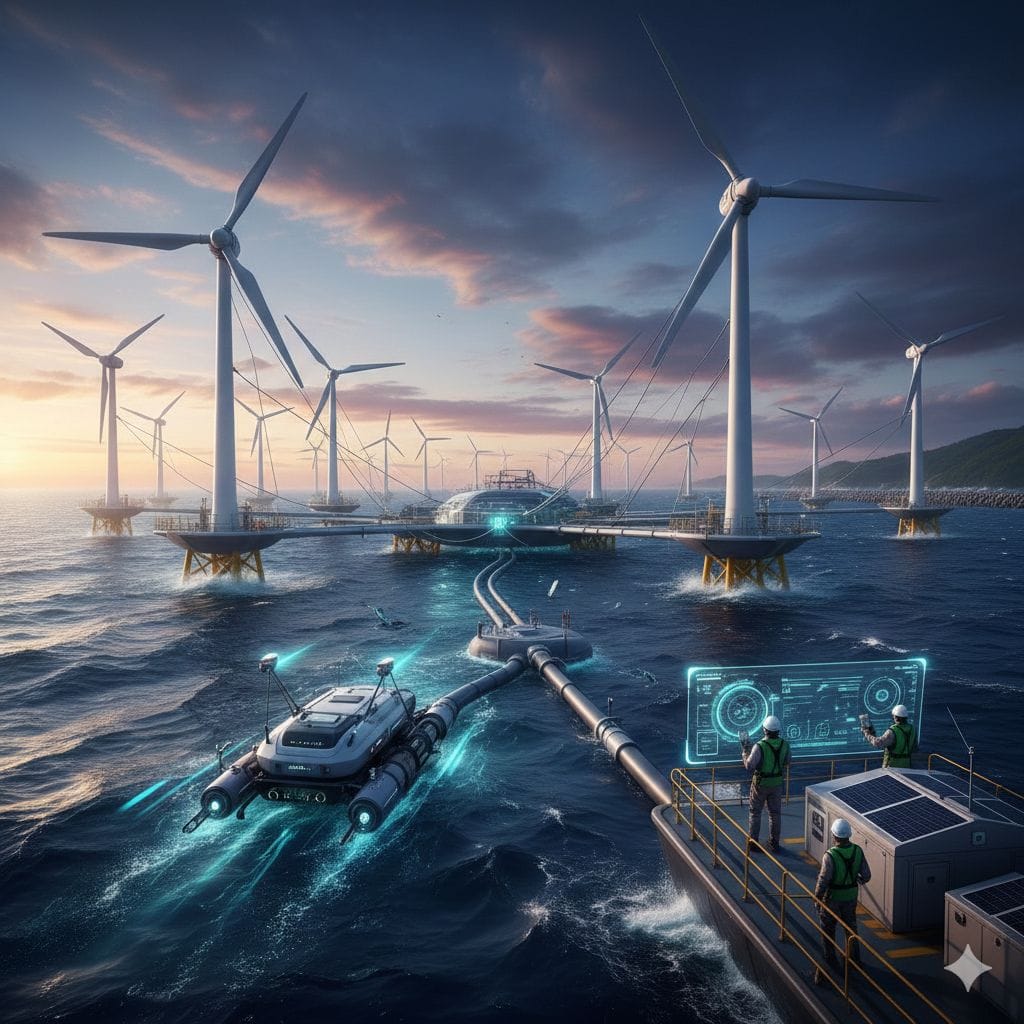
Ocean engineering is a multidisciplinary field applying mechanical, civil, and electrical engineering principles to design, build, and maintain systems operating in marine environments—including offshore platforms, subsea pipelines, coastal defenses, and underwater robots. Career paths include offshore wind engineer ($65k-$85k entry-level, $140k-$200k+ senior), coastal engineer, subsea engineer, and ROV technician. The field addresses renewable energy, climate adaptation, and deep-sea exploration with strong job growth projected.
Understanding the Blue Frontier of Engineering
More than 70% of Earth’s surface lies beneath ocean water, yet we’ve explored less than 5% of this vast underwater realm. While space exploration captures headlines, the ocean represents an equally challenging frontier that directly impacts human survival—from food security and climate regulation to renewable energy and natural resources.
Ocean engineering stands at the intersection of technology and environmental necessity. These specialized engineers don’t just study the sea—they create the infrastructure, vehicles, and systems that allow humanity to safely harness ocean resources, protect coastal communities, and explore depths where pressure exceeds what most materials can withstand.
If you’re considering a career that combines cutting-edge technology, environmental impact, and excellent compensation, ocean engineering deserves your attention. Let me show you exactly what this field involves, where the opportunities lie, and how the profession is evolving.
What Exactly is Ocean Engineering?
Ocean engineering applies traditional engineering disciplines—mechanical, civil, electrical, and structural engineering—to the unique challenges of the marine environment.
These professionals design and oversee everything from massive offshore oil platforms and wind farms to tiny sensors monitoring ocean health. They account for extreme conditions that land-based engineers never face: corrosive saltwater, crushing deep-sea pressure, unpredictable wave forces, marine organism growth on structures, and complete darkness below shallow depths.
The core mission: Create systems that can survive and function effectively in one of Earth’s harshest environments while minimizing environmental impact.
Clearing Up the Confusion: Three Related but Different Fields
People often confuse ocean engineering with related maritime professions. Here’s how they actually differ:
| Field | Primary Focus | What They Create |
|---|---|---|
| Ocean Engineering | Stationary and floating structures in ocean environments; interaction between engineering systems and the sea | Offshore platforms, coastal protection systems, subsea infrastructure, underwater research instruments |
| Marine Engineering | Mechanical and electrical systems that power vessels and keep them running | Ship propulsion systems, power generation equipment, pumping systems, onboard machinery |
| Naval Architecture | Ship and submarine design—the vessel’s form, stability, and hydrodynamic performance | Hull shapes, vessel stability analysis, ship structural design, submarine configurations |
Simple way to remember: Naval architects design the ship itself, marine engineers design what makes it move, and ocean engineers design the structures and systems the ship interacts with or visits in the ocean.
The Major Specializations Within Ocean Engineering
Ocean engineering encompasses several distinct focus areas, each addressing different challenges and opportunities in the marine environment.
1. Coastal Engineering: Protecting Communities from the Sea
Coastal engineers serve as the front line of defense against rising seas and intensifying storms driven by climate change.
What they do:
- Design breakwaters, seawalls, and jetties that protect harbors and shorelines from erosion
- Plan beach nourishment projects that restore damaged coastlines
- Model storm surge behavior to create resilient infrastructure
- Develop living shorelines using natural materials that protect while supporting ecosystems
Why it matters now: With sea levels rising and extreme weather events intensifying, coastal communities worldwide need sophisticated engineering solutions. This specialization offers both job security and meaningful environmental impact.
Real-world example: After Hurricane Sandy devastated New York’s coastline in 2012, coastal engineers designed innovative barrier systems and wetland restoration projects protecting millions of residents from future storms.
2. Offshore Structural Engineering: Building in Extreme Conditions
These engineers design and maintain the massive structures anchored to or floating in the open ocean—often in water hundreds or thousands of feet deep.
Key responsibilities:
- Engineer foundation systems for offshore oil and gas platforms
- Design floating wind turbine foundations for deep-water renewable energy
- Analyze structural fatigue from constant wave action and saltwater corrosion
- Create mooring systems keeping floating structures positioned accurately
The challenge: Structures must withstand hurricane-force winds, 50-foot waves, and corrosive saltwater for decades without accessible maintenance.
3. Ocean Hydrodynamics and Acoustics: Understanding Water’s Behavior
This specialization focuses on the physics governing how water moves and how sound travels underwater.
Hydrodynamics applications:
- Predict how waves and currents affect platform stability
- Design vessel hulls that move efficiently through water
- Model tsunami behavior for early warning systems
Acoustics applications:
- Develop advanced sonar for seafloor mapping
- Create underwater communication systems for remotely operated vehicles
- Design marine mammal monitoring systems that detect whales near shipping lanes
Why it’s unique: Water’s properties differ dramatically from air—sound travels 4-5 times faster underwater, light penetrates only shallow depths, and pressure increases by one atmosphere every 33 feet of depth.
4. Marine Robotics and Autonomous Systems: The Rapidly Growing Frontier
This emerging specialization represents the future of ocean exploration and intervention.
Core technologies:
- ROVs (Remotely Operated Vehicles): Tethered robots controlled from surface vessels for deep-sea inspection, pipeline maintenance, and research sampling
- AUVs (Autonomous Underwater Vehicles): Independent robots that navigate and collect data without cables, ideal for vast seafloor mapping missions
- Hybrid systems: Vehicles combining autonomous navigation with human oversight for complex tasks
Career trajectory: This specialization commands premium salaries due to the combination of engineering, programming, and specialized marine knowledge required.
Just as engineering technology careers are evolving across multiple disciplines, marine robotics represents one of the fastest-growing specializations with applications spanning defense, commercial, and research sectors.
Ocean Engineering Career Paths and Opportunities
The field offers diverse career options across government, private industry, consulting, and research sectors.
Top Career Options in Ocean Engineering
| Job Title | Primary Responsibilities | Industry Sectors |
|---|---|---|
| Offshore Wind Engineer | Design installation methods and structural foundations for ocean-based wind farms | Renewable energy companies, environmental consulting |
| Coastal Engineer | Create shoreline protection systems and manage erosion control projects | Army Corps of Engineers, coastal consulting firms, municipal governments |
| Subsea Engineer | Design, install, and maintain underwater pipelines, control systems, and production equipment | Oil and gas, offshore renewable energy, subsea mining operations |
| ROV Pilot/Technician | Operate sophisticated underwater robots for inspection, maintenance, and research missions | Marine survey companies, research institutions, offshore energy |
| Naval Architect | Focus on ship design, stability analysis, and hydrodynamic performance optimization | Shipbuilding companies, defense contractors, consulting firms |
| Ocean Renewable Energy Specialist | Develop wave and tidal energy conversion systems | Renewable energy startups, established energy companies, research labs |
Realistic Salary Expectations
Ocean engineering offers strong compensation reflecting the specialized knowledge and challenging work conditions.
| Experience Level | Annual Salary Range (USD) | Factors Affecting Pay |
|---|---|---|
| Entry-Level (0-3 years) | $65,000 – $85,000 | Degree quality, internship experience, geographic location, specialization choice |
| Mid-Career (5-10 years) | $95,000 – $140,000 | Professional Engineer (PE) license, project management experience, high-demand specializations (robotics, renewables) |
| Senior/Project Lead (10+ years) | $140,000 – $200,000+ | International experience, subsea expertise, leadership roles, specialized certifications |
Salary factors to consider:
- Location premium: Offshore roles requiring extended time at sea often include substantial bonuses
- Sector variation: Renewable energy and defense typically pay higher than traditional consulting
- International opportunities: Norway, UK, Australia, and Singapore offer competitive packages for experienced engineers
- Certification impact: Professional Engineer (PE) license can increase earning potential 15-25%
Future Technologies Shaping Ocean Engineering
The profession is evolving rapidly as global challenges create new demands and opportunities.
1. Floating Offshore Renewable Energy: The Next Power Revolution
While shallow-water wind farms have become common, the future lies in deeper waters where winds blow stronger and more consistently.
Current innovations:
Floating wind platforms: Engineers are developing massive floating structures—some larger than football fields—that anchor wind turbines in water over 200 feet deep. These use innovative mooring systems and require solving unprecedented challenges in motion stability and power transmission.
Tidal energy systems: Underwater turbines capture predictable tidal flows, offering consistent renewable power unlike solar or wind. The engineering challenge involves creating systems that survive years underwater while remaining accessible for maintenance.
Wave energy converters: Surface and submerged devices that transform wave motion into electricity. Engineers must balance energy capture efficiency with survivability during extreme storms.
Industry outlook: The offshore wind sector alone expects to create 77,000 jobs by 2030, with ocean engineers central to this expansion.
2. Intelligent Autonomous Underwater Systems
The underwater robotics field is transitioning from simple remotely controlled vehicles to sophisticated AI-powered systems.
Emerging capabilities:
Swarm robotics: Multiple small autonomous vehicles working collaboratively to map vast seafloor areas, inspect pipeline networks, or monitor environmental conditions far more efficiently than single larger vehicles.
Digital twin technology: Creating virtual replicas of offshore platforms or subsea infrastructure using real-time sensor data. Engineers can simulate maintenance scenarios, predict failures, and plan interventions without sending humans into hazardous environments.
Machine learning integration: Autonomous vehicles that learn to identify pipeline anomalies, classify seafloor geology, or detect environmental changes without human interpretation of every data point.
3. Sustainable Ocean Food Production
Meeting global food demands while reducing land-based agriculture’s environmental impact requires industrial-scale ocean farming.
Engineering challenges:
Deep-water aquaculture systems: Designing submersible fish cages that can dive below the surface during storms, include automatic feeding systems, and maintain water quality in open-ocean conditions.
Kelp and seaweed farms: Creating large-scale cultivation systems for this fast-growing food and biofuel source while ensuring structures withstand ocean forces.
Integrated multi-trophic systems: Engineering farms where multiple species (fish, shellfish, seaweed) coexist in ways that reduce waste and improve sustainability.
Educational Pathways and Required Skills
Success in ocean engineering starts with the right educational foundation and skill development.
Academic Requirements
| Education Level | Typical Duration | What You Learn | Career Impact |
|---|---|---|---|
| Bachelor’s Degree | 4 years | Core engineering principles, marine-specific courses (hydrodynamics, coastal processes), design projects | Entry-level positions, engineering technician roles |
| Master’s Degree | 1-2 years | Specialized knowledge in areas like marine robotics, offshore structures, or coastal management | Advanced positions, research roles, 15-20% salary premium |
| Professional Engineer (PE) License | After 4+ years experience | Demonstrated competency through examination | Required for consulting, government contracts, significant salary increase |
| PhD | 4-6 years | Research expertise, specialized innovation | Academic positions, advanced R&D roles, industry research leadership |
Common undergraduate degrees leading to ocean engineering careers:
- Ocean Engineering (most direct path)
- Mechanical Engineering with marine focus
- Civil Engineering with coastal specialization
- Naval Architecture and Marine Engineering
Essential Technical Skills
Core engineering knowledge:
- Fluid mechanics and hydrodynamics
- Structural analysis and material science
- Thermodynamics and heat transfer
- Electrical systems and control theory
Computational competencies:
- CAD software: SolidWorks, AutoCAD, or Rhino for 3D design
- Finite Element Analysis (FEA): ANSYS or similar for structural simulations
- Computational Fluid Dynamics (CFD): Software predicting how water flows around structures
- Programming: Python, MATLAB, or C++ for data analysis and system control
Marine-specific knowledge:
- Oceanography fundamentals (waves, tides, currents)
- Marine corrosion science and mitigation strategies
- Environmental regulations and permitting processes
- Safety protocols for offshore operations
Soft skills that matter:
- Project management for complex, multi-year installations
- Interdisciplinary communication (working with biologists, environmental scientists, business managers)
- Problem-solving creativity—ocean environments present unique, unpredictable challenges
- Risk assessment in high-stakes scenarios
Major Employers and Industry Sectors
Ocean engineers find opportunities across diverse sectors, each offering different work environments and focuses.
Industry Breakdown
| Sector | Example Organizations | Work Environment | Growth Outlook |
|---|---|---|---|
| Renewable Energy | Ørsted, Equinor, Vestas, RWE, Siemens Gamesa | Mix of office design work and offshore site visits | Excellent—rapid expansion globally |
| Oil & Gas | Shell, ExxonMobil, Schlumberger, TechnipFMC | Extended offshore rotations, high compensation | Stable but transitioning toward renewables |
| Government/Defense | U.S. Navy, Army Corps of Engineers, NOAA, Coast Guard | Stable employment, pension benefits, security clearance opportunities | Steady demand for coastal protection and naval systems |
| Consulting Firms | Arup, WSP, Mott MacDonald, specialized marine consultancies | Project-based, client interaction, varied challenges | Strong growth in climate adaptation consulting |
| Robotics & Technology | Kongsberg Maritime, Ocean Infinity, Teledyne, Bluefin Robotics | Cutting-edge technology, innovation-focused | Excellent—expanding defense and commercial applications |
| Research Institutions | Woods Hole Oceanographic, Scripps Institution, NOAA labs | Academic environment, publication focus, grant-funded | Stable with limited positions |
For comprehensive information about ocean engineering education and career preparation, the Marine Technology Society offers excellent resources and networking opportunities.
Frequently Asked Questions About Ocean Engineering
Is ocean engineering a promising career choice?
Yes, ocean engineering offers excellent career prospects driven by renewable energy expansion, climate change adaptation needs, and continued deep-sea exploration. The field combines strong salaries (mid-career professionals average $95k-$140k), job security, and meaningful work addressing global environmental challenges. Demand for specialized ocean engineers is projected to grow significantly through 2030.
Do ocean engineers need to know how to swim?
No, swimming isn’t required for most ocean engineering positions. The majority of work happens in office environments designing systems, analyzing data, or managing projects. Some field positions involving offshore work may require basic water safety training, but strong swimming ability isn’t a prerequisite for the career.
What’s the difference between ocean engineering and oceanography?
Oceanography is a scientific discipline studying the ocean itself—its chemistry, biology, geology, and physical properties. Ocean engineering is an applied field that uses engineering principles to design and build structures, vehicles, and systems that operate in the ocean. Oceanographers discover knowledge about the sea; ocean engineers create technology to use that knowledge.
Which companies hire ocean engineers?
Ocean engineers work across multiple industries: renewable energy companies (Ørsted, Equinor), oil and gas corporations (Shell, ExxonMobil), government agencies (Navy, Army Corps of Engineers, NOAA), consulting firms (Arup, WSP), and technology companies (Kongsberg Maritime, Ocean Infinity). The field offers diverse employer options depending on your interests and specialization.
Do ocean engineers actually work on ships?
Not typically in the traditional sense. Ocean engineers primarily design and analyze systems from shore-based offices or manage projects from land. However, they may spend time on research vessels or work platforms during installation, testing, or survey phases of projects they’ve designed. Extended sea duty is more common for marine engineers who maintain ship machinery.
What’s the work-life balance like in ocean engineering?
It varies significantly by role. Office-based design and analysis positions offer standard 40-hour weeks with good work-life balance. Offshore positions often operate on rotation schedules (like 2 weeks on/2 weeks off) where you work long days while offshore but have extended time off afterward. Project management roles may require travel but typically maintain reasonable hours.
Is a graduate degree necessary for ocean engineering?
Not essential but beneficial. You can start a successful career with a bachelor’s degree in ocean engineering or a related field. However, a master’s degree opens doors to specialized roles (particularly in research and advanced design), typically increases starting salaries by 15-20%, and may be necessary for senior technical positions. Many engineers work for several years before pursuing graduate education.
Making Your Decision: Is Ocean Engineering Right for You?
Ocean engineering suits people who thrive on:
Complex problem-solving: Every project presents unique challenges requiring creative engineering solutions. Standard approaches often don’t work in marine environments.
Environmental impact: Your work directly affects climate adaptation, renewable energy deployment, and ocean ecosystem protection.
Multidisciplinary collaboration: You’ll work alongside oceanographers, environmental scientists, business managers, and construction teams.
Continuous learning: Ocean technology evolves rapidly, requiring ongoing skill development throughout your career.
Physical and computational work: The field balances theoretical analysis with practical, hands-on problem-solving.
This career may not suit you if:
- You prefer routine, predictable work environments
- You need immediate feedback—ocean projects span years from design to completion
- You dislike the possibility of occasional travel or offshore work
- You want a field with established, unchanging methodologies
Taking the First Steps Toward an Ocean Engineering Career
Ready to explore this field further? Here’s your action plan:
For high school students:
- Focus on advanced math (calculus) and physics
- Seek summer programs at marine laboratories or oceanographic institutions
- Research universities with ocean engineering programs
- Consider joining robotics clubs or engineering competitions
For college students:
- Pursue internships with offshore energy companies, coastal consulting firms, or research institutions
- Join professional organizations like the Marine Technology Society or Society of Naval Architects and Marine Engineers
- Work on ocean-related senior design projects
- Consider research assistantships in marine laboratories
For career changers:
- Evaluate how your current engineering background transfers to marine applications
- Consider graduate programs that accept students from related engineering disciplines
- Network with ocean engineers through professional societies
- Look for entry-level or technician positions to gain industry exposure
Ocean engineering stands at a pivotal moment. As climate change intensifies coastal threats, renewable energy demands grow, and technology enables deeper exploration, the need for skilled ocean engineers has never been greater.
This isn’t just a career—it’s an opportunity to shape how humanity interacts with the planet’s most vital resource. The ocean’s future depends on engineers willing to tackle its unique challenges with innovation, dedication, and respect for the marine environment.
The blue frontier awaits those ready to dive in.