
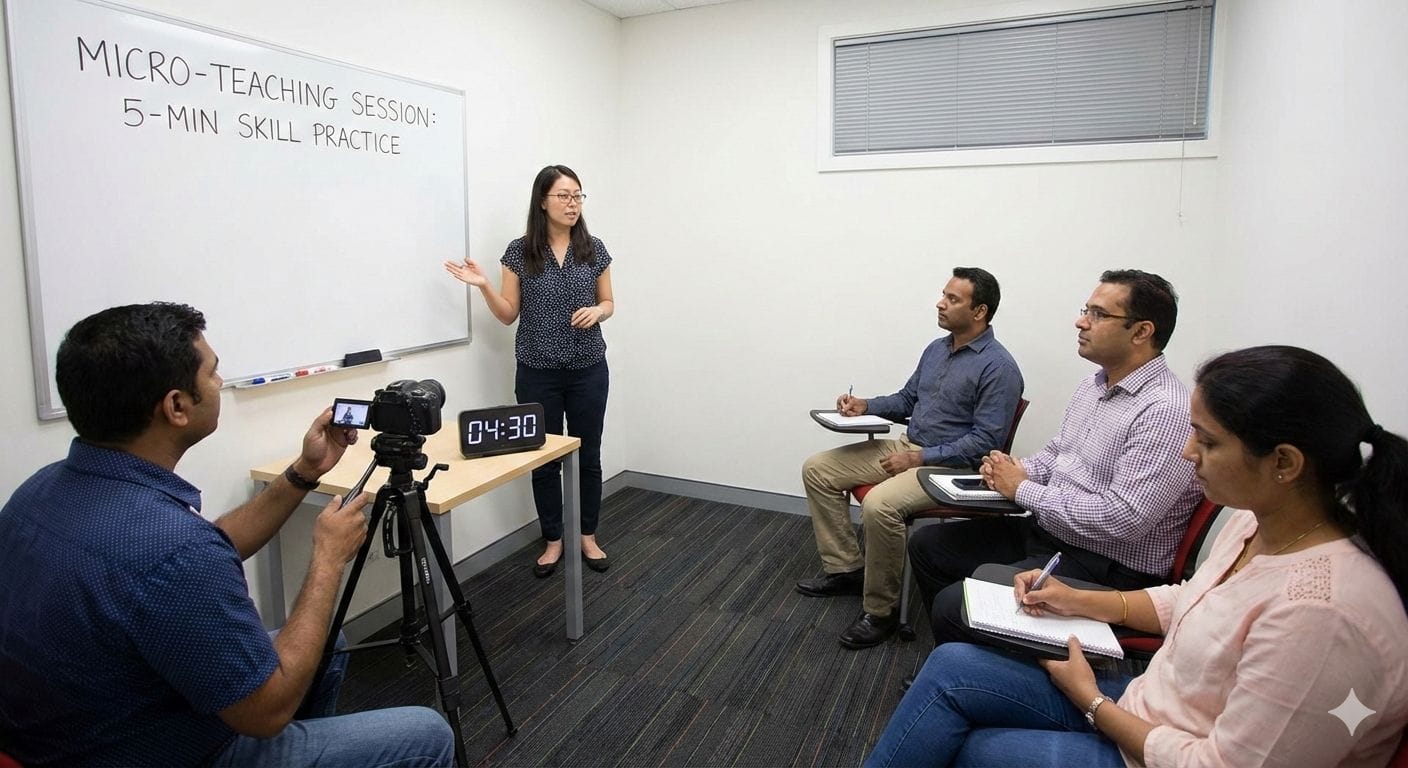
Micro teaching is a structured teacher training method where educators deliver focused 5-10 minute lessons to small groups (5-10 people) to practice specific teaching skills. The process follows a cycle: Plan → Teach → Receive Feedback → Revise → Re-teach → Final Evaluation. Core skills include set induction (engaging openings), probing questions (deepening understanding), clear explanations, stimulus variation (maintaining attention), and reinforcement (encouraging participation). Developed at Stanford University in 1963, micro teaching reduces complexity by isolating individual teaching techniques for improvement.
Understanding Micro Teaching: A Practical Definition
Micro teaching transforms the overwhelming challenge of becoming an effective educator into manageable, bite-sized learning opportunities. Instead of throwing new teachers into full classrooms and hoping they figure it out, this method breaks teaching down into specific skills you can practice, observe, and refine.
Think of micro teaching as the practice simulator for educators—similar to how pilots train in flight simulators before flying actual planes. You work in a controlled, low-stakes environment where making mistakes becomes a valuable learning opportunity rather than a classroom disaster.
The core concept: You teach a brief lesson (typically 5-10 minutes) to a small group of peers or students (usually 5-10 people) while focusing on mastering one specific teaching technique. Someone observes or records your session, then provides immediate constructive feedback you can use to improve.
This isn’t about delivering perfect mini-lessons covering complete topics. It’s about isolating and perfecting individual teaching behaviors—like asking better questions, explaining concepts more clearly, or maintaining student engagement through varied presentation techniques.
The Complete Micro Teaching Cycle Explained
Micro teaching succeeds because it follows a systematic improvement process. Each cycle reinforces learning and builds teaching competence progressively.
The Six-Phase Improvement Process
| Phase | What Happens | Duration | Key Focus |
|---|---|---|---|
| 1. Planning | Select specific topic and single teaching skill to practice; create focused lesson plan | 30-60 minutes | Choose content you know well so you can concentrate on technique |
| 2. Teaching | Deliver lesson to small group while being observed or recorded | 5-10 minutes | Execute planned teaching skill with full attention to mechanics |
| 3. Feedback | Receive specific critiques from observers; review video recording if available | 10-15 minutes | Listen for concrete, actionable improvements rather than general praise or criticism |
| 4. Re-Planning | Modify lesson plan based on feedback, addressing identified weaknesses | 20-30 minutes | Make specific adjustments to improve targeted skill |
| 5. Re-Teaching | Deliver revised lesson incorporating improvements | 5-10 minutes | Demonstrate ability to apply feedback in practice |
| 6. Final Evaluation | Assess whether improvements addressed original shortcomings | 10-15 minutes | Measure progress and identify any remaining areas for development |
Why the cycle works: The immediate feedback loop prevents bad habits from solidifying. In traditional teaching environments, you might repeat the same mistake for months before anyone observes and corrects it. Micro teaching catches and fixes problems immediately.
Practical timeline: A complete cycle typically takes 90-120 minutes, allowing multiple teachers to practice different skills in a single training session. Some programs complete 3-4 cycles in one day, rapidly accelerating skill development.
Essential Micro Teaching Skills with Real Examples
Success in micro teaching requires mastering specific behavioral techniques. Let me show you the most critical skills with concrete examples you can implement immediately.
1. Set Induction: Capturing Attention from the Start
The opening 30-60 seconds determine whether students engage or mentally check out. Set induction creates that crucial hook.
Purpose: Connect new material to existing knowledge while generating curiosity and motivation to learn.
Poor approach: “Today we’re going to study gravity. Open your textbooks to page 47.”
Effective micro teaching example:
[Teacher simultaneously drops a textbook and a single sheet of paper from shoulder height]
“Everyone just watched these items fall. Why did the book hit the ground first? Raise your hand if you think you know… Excellent guesses! Today we’ll discover why your intuition might be partially correct—and why astronauts on the moon saw something completely different.”
Why it works: The physical demonstration creates visual interest, the question engages thinking immediately, and the moon reference adds intrigue.
2. Probing Questions: Deepening Understanding
Many teachers accept surface-level answers and move on. Probing questions guide students from partial understanding to complete comprehension.
Purpose: Encourage critical thinking by building on initial responses rather than accepting incomplete answers.
Weak questioning:
- Teacher: “What are mammals?”
- Student: “Animals with fur.”
- Teacher: “Correct! Next topic…”
Effective probing sequence:
- Teacher: “What are mammals?”
- Student: “Animals with fur.”
- Teacher: “Good start. So if an animal has fur, it’s definitely a mammal?”
- Student: “Yes?”
- Teacher: “What about whales? Do whales have fur?”
- Student: “No… but they’re mammals…”
- Teacher: “Exactly! So what makes a whale a mammal if not fur? What else defines mammals?”
- Student: “They give birth to live babies and feed them milk?”
- Teacher: “Perfect! So we need more than just one characteristic to define mammals accurately.”
The technique: Use follow-up questions that introduce exceptions, ask for additional characteristics, or request real-world applications.
3. Clear Explanation: Making Complex Ideas Accessible
Explanation involves more than stating facts—it requires logical structure, accessible language, and explicit connections between ideas.
Purpose: Transform abstract or complex concepts into understandable knowledge using analogies, examples, and logical sequencing.
Poor explanation: “Photosynthesis is when plants use sunlight to make glucose from carbon dioxide and water through chlorophyll.”
Effective micro teaching example:
“Think of a plant leaf as a tiny factory. The factory needs three things to operate:
- Raw materials – Carbon dioxide from air and water from soil
- Power source – Sunlight energy
- Machinery – Chlorophyll (the green stuff) inside leaf cells
When the factory runs, it produces sugar (glucose) as its product and releases oxygen as waste. That’s photosynthesis—a factory powered by sunlight, converting air and water into food.”
Key elements: The factory analogy makes abstract chemistry concrete, numbered structure creates logical flow, and simple language replaces technical jargon.
4. Stimulus Variation: Maintaining Attention
Human attention naturally wanes when exposed to monotonous stimulation. Stimulus variation combats this through intentional changes in presentation.
Purpose: Keep students mentally engaged by varying voice, movement, gestures, and teaching aids.
| Variation Type | Poor Practice | Effective Technique |
|---|---|---|
| Voice | Speaking in monotone at consistent volume | Varying pitch, pace, and volume; using strategic pauses for emphasis |
| Movement | Standing fixed behind podium entire session | Moving purposefully between classroom areas; approaching students while teaching |
| Gestures | Hands in pockets or arms crossed | Using descriptive hand movements; pointing to visual aids; expressive facial reactions |
| Visual Focus | Staring at notes or ceiling | Making eye contact with different students; scanning entire group |
| Teaching Aids | Text-only presentation | Mixing board work, props, digital media, and physical demonstrations |
Practical example: When teaching about rising action in storytelling, start speaking normally, then gradually increase pace and volume as you describe tension building, suddenly pause at the climax moment, then slow down for resolution. Your voice physically demonstrates the concept.
5. Reinforcement: Encouraging Participation
Reinforcement strengthens desired behaviors by acknowledging and rewarding them. This increases likelihood students will participate again.
Purpose: Build confidence and encourage continued engagement through positive acknowledgment.
Types of reinforcement:
| Reinforcement Category | Examples | When to Use |
|---|---|---|
| Verbal Positive | “Excellent thinking!”, “That’s exactly right!”, “Great observation!” | After correct answers or insightful comments |
| Verbal Corrective | “You’re on the right track—can you elaborate?”, “Close! Consider this aspect…” | When answer is partially correct |
| Non-Verbal | Nodding, smiling, thumbs up, writing student’s name/answer on board | To acknowledge participation without interrupting flow |
| Delayed | “Remember when Sarah made that great point about…” | To reinforce earlier contributions and show you value their input |
Important principle: Reinforce participation and effort, not just correctness. Students who risk wrong answers are learning more than those staying silent.
Just as building smart microlearning systems requires understanding how to break complex learning into digestible components, micro teaching breaks the complex act of teaching into learnable skills.
Traditional Teaching vs. Micro Teaching: Key Differences
Understanding these distinctions clarifies why micro teaching serves as such an effective training tool.
| Aspect | Traditional Classroom Teaching | Micro Teaching Training |
|---|---|---|
| Class Size | 25-40 students | 5-10 observers |
| Lesson Duration | 40-90 minutes | 5-10 minutes |
| Content Coverage | Complete units, multiple topics, comprehensive material | Single concept, often simplified |
| Skill Focus | Multiple simultaneous skills (explanation, management, assessment, timing) | One specific skill isolated for improvement |
| Feedback Timing | Delayed weeks/months, often only through test results | Immediate—within minutes of teaching |
| Observation | Rarely observed except during evaluations | Always observed and usually recorded |
| Pressure Level | High—affects student learning and grades | Low—safe practice environment |
| Iteration Speed | Slow—can’t easily re-teach same lesson | Fast—re-teach revised lesson same day |
| Primary Goal | Student learning and content mastery | Teacher skill development |
The training advantage: Micro teaching removes the overwhelming complexity of managing large classes while teaching full curricula. You can focus entirely on perfecting one technique at a time without worrying about classroom management, time constraints, or covering required material.
For comprehensive approaches to tracking learning progress and skill development, modern educational technology provides tools that complement traditional training methods like micro teaching.
Proven Best Practices for Maximum Improvement
Having facilitated hundreds of micro teaching sessions, I’ve identified practices that consistently produce the best results.
1. Always Record Your Sessions
Why it matters: Your perception of your own teaching differs dramatically from reality. Self-awareness develops when you observe yourself objectively.
What you’ll discover:
- Verbal tics you didn’t know you had (“um,” “like,” “okay”)
- Body language conveying unintended messages (crossed arms, fidgeting, lack of eye contact)
- Voice patterns (speaking too fast when nervous, dropping volume at sentence ends)
- Timing issues (rushing through explanations, spending too long on minor points)
Implementation: Use smartphones, tablets, or laptops. You don’t need professional equipment—the goal is self-observation, not broadcast quality.
2. Focus on ONE Skill Per Session
The temptation: Trying to demonstrate you’re a “complete teacher” by incorporating multiple skills simultaneously.
The reality: Divided attention prevents mastery. If you’re trying to practice probing questions while also focusing on stimulus variation and reinforcement, you’ll likely execute all three poorly.
The solution: Choose one skill. If practicing “clear explanation,” don’t worry if your questioning technique is weak or you forget to reinforce answers. Those skills come in future sessions.
3. Establish Psychologically Safe Feedback Culture
Poor feedback: “That was really good!” or “You seemed nervous.”
Effective feedback: “You made eye contact with the right side of the room frequently but never looked at the left side. Next time, consciously scan the entire group.” or “Your explanation’s logic was clear, but you used the term ‘mitosis’ without defining it first—that lost the audience.”
Feedback guidelines:
| Principle | Why It Works | Example |
|---|---|---|
| Specific | Vague comments don’t guide improvement | “Your voice dropped at sentence ends” vs. “speak up” |
| Behavioral | Focus on observable actions, not assumed feelings | “You stood behind the desk the entire time” vs. “you seemed uncomfortable” |
| Actionable | Suggest concrete changes | “Move to three different positions in the room” |
| Balanced | Note strengths alongside areas for improvement | “Your analogy was excellent; now work on eye contact” |
| Timely | Provide feedback while session is fresh in memory | Within 5-10 minutes of teaching |
4. Choose Familiar Content
Why simple content matters: If you’re struggling to remember facts or formulas, you can’t focus on teaching technique. Your cognitive load is already maxed out before addressing the skill you’re practicing.
Ideal topics: Content you could explain easily to a friend—simple enough that it requires minimal mental effort to recall, allowing full attention on delivery technique.
Example: If you’re an elementary education student practicing “set induction,” teach about basic shapes or colors rather than complex mathematical theories. The content simplicity lets you concentrate entirely on creating that engaging opening hook.
Similar to how education systems must balance content complexity with pedagogical effectiveness, micro teaching succeeds by intentionally reducing content complexity during skill development.
Ready-to-Use Micro Teaching Topic Ideas
Need inspiration for your next session? Here are proven topics organized by subject area.
Subject-Specific Micro Teaching Topics
| Subject Area | Beginner-Friendly Topics | Intermediate Topics |
|---|---|---|
| Science | Water cycle basics, Parts of a plant, States of matter | Newton’s First Law, Cell structure and function, Food chains and ecosystems |
| Mathematics | Identifying shapes, Understanding fractions, Basic addition strategies | Pythagorean Theorem, Calculating percentages, Introduction to algebra |
| English/Language Arts | Using punctuation marks, Parts of speech basics, Sentence structure | Metaphors vs. similes, Subject-verb agreement, Analyzing character motivation |
| Social Studies | Reading map symbols, Understanding timelines, Defining democracy | Causes of World War I, Supply and demand basics, Comparing government systems |
| Foreign Language | Basic greetings, Common verbs (to be, to have), Numbers 1-20 | Past tense formation, Asking questions, Cultural customs comparison |
Selection criteria:
- ✓ Can be meaningfully taught in 5-10 minutes
- ✓ Requires minimal prerequisite knowledge
- ✓ Allows demonstration of your target skill
- ✓ Familiar enough that you won’t struggle with content recall
Adapting Micro Teaching for Virtual Environments
Online teaching has transformed education, and micro teaching has evolved accordingly. Virtual micro teaching develops digital-specific skills increasingly critical in modern classrooms.
Digital-Specific Skills to Practice
| Virtual Teaching Skill | Why It’s Critical | Micro Teaching Focus |
|---|---|---|
| Screen Sharing Clarity | Confusing shared screens lose students immediately | Practice clear, organized screen layouts; pointing tools; switching between applications smoothly |
| Camera Presence | Online teaching relies more heavily on facial expressions and energy | Practice maintaining engaging eye contact with camera; expressive gestures visible in frame |
| Chat Interaction | Text chat enables different participation styles | Monitoring and responding to chat while teaching; using chat for quick checks for understanding |
| Breakout Room Management | Small group work requires new facilitation skills | Giving clear instructions before breaking out; timing; regrouping effectively |
| Technical Troubleshooting | Every teacher needs basic tech problem-solving | Maintaining teaching flow when tech fails; having backup plans ready |
Platform options: Zoom, Google Meet, Microsoft Teams—all support the recording and small-group features necessary for virtual micro teaching.
For insights on how digital learning platforms track and improve educational outcomes, explore AR reading test methodologies that demonstrate technology-enhanced assessment approaches.
Measuring Success in Micro Teaching
How do you know if micro teaching sessions are actually improving teaching effectiveness? Track these indicators.
Individual Progress Markers
Session-to-session improvement:
- Fewer instances of targeted weaknesses in re-teach phase
- More natural incorporation of practiced skills
- Increased confidence visible in body language and voice
- Positive feedback from observers noting specific improvements
Long-term skill integration:
- Practiced skills appear naturally in subsequent sessions focusing on different skills
- Ability to consciously deploy multiple skills in longer teaching demonstrations
- Peer feedback shifts from basic technique to nuanced refinement
Program-Level Success Indicators
For training institutions:
- Reduced anxiety reports from student teachers entering real classrooms
- Improved supervisor evaluations during student teaching placements
- Higher confidence levels measured pre/post micro teaching programs
- Decreased time-to-competency for new teachers
Frequently Asked Questions About Micro Teaching
Who created micro teaching and when?
Micro teaching was developed by Dwight W. Allen and colleagues at Stanford University in 1963. They designed it to bridge the gap between educational theory studied in universities and actual classroom practice. The method spread rapidly through teacher education programs worldwide due to its effectiveness in developing practical teaching skills.
Is micro teaching only useful for brand new teachers?
No, experienced educators benefit significantly from micro teaching. Veteran teachers use it to adopt new instructional technologies (interactive whiteboards, educational apps), transition to new pedagogical approaches (inquiry-based learning, flipped classrooms), or refine skills they’ve identified as weak areas. The controlled environment allows experimentation without risking student learning outcomes.
What’s the optimal length for a micro teaching lesson?
Most experts recommend 5-10 minutes. This duration is long enough to meaningfully demonstrate a teaching skill but short enough to allow multiple practice cycles in a single training session. Some highly focused sessions might use 3-5 minute lessons when practicing very specific techniques like asking a single probing question or writing a clear board example.
Can micro teaching happen online effectively?
Absolutely. Virtual micro teaching has become increasingly common and effective. Teachers record sessions via video conferencing platforms, focusing on digital-specific skills like screen sharing clarity, virtual engagement techniques, and managing online discussions. The recording and feedback process works identically to in-person sessions, with added benefit of easily sharing recordings for review.
How many practice cycles are needed to master a teaching skill?
This varies by skill complexity and individual aptitude, but most teachers need 3-5 complete cycles (teach-feedback-revise-reteach) to demonstrate competency in a single skill. Complex skills like Socratic questioning might require more cycles, while simpler techniques like reinforcement might be grasped more quickly. The key is repeated practice with feedback until the skill becomes automatic.
What happens if I make mistakes during micro teaching?
Mistakes are expected and valuable—that’s the entire point of the practice environment. Unlike real classrooms where mistakes affect student learning, micro teaching creates a safe space where errors become learning opportunities. The feedback phase specifically identifies what went wrong so you can correct it in the re-teach phase. Making mistakes in micro teaching prevents making them with actual students.
Do I need special equipment for micro teaching?
Minimal equipment is required. Essential items include: a recording device (smartphone or camera), a small teaching space (even a living room works), a small group of peers or volunteers, and basic teaching materials relevant to your topic (whiteboard, handouts, props). Sophisticated equipment isn’t necessary—the focus is on technique, not production value.
Implementing Micro Teaching in Your Institution
For educational institutions considering formal micro teaching programs, here’s a practical implementation framework.
Required resources:
- Dedicated practice space (can be regular classroom)
- Recording equipment (basic cameras or smartphones sufficient)
- Feedback rubrics aligned with target teaching skills
- Trained observers who provide constructive feedback
- Scheduling system for multiple practice cycles
Program structure options:
| Model | Description | Best For |
|---|---|---|
| Intensive Workshop | Full-day or multi-day focused training | Pre-service teachers before student teaching |
| Semester Integration | Weekly micro teaching sessions throughout term | Education degree programs |
| Professional Development | Monthly sessions for practicing teachers | In-service teacher improvement |
| Peer Coaching | Teachers practicing with colleague observers | Ongoing professional growth |
For additional resources on effective teacher training and educational methodology, the Association for Teacher Education provides research-based best practices and professional development opportunities.
Beyond the Basics: Advanced Micro Teaching Applications
Once foundational skills are mastered, micro teaching can address sophisticated teaching challenges.
Advanced skill areas:
- Differentiating instruction for diverse learners within a single lesson
- Managing difficult classroom scenarios (disruptions, disagreements)
- Integrating assessment seamlessly into instruction
- Facilitating student-led discussions rather than teacher-centered presentations
- Using technology tools to enhance rather than distract from learning
Specialized applications:
- Training teachers for specific contexts (special education, English language learners, gifted programs)
- Developing subject-specific pedagogy (lab safety in science, mathematical thinking development)
- Cultural responsiveness and inclusive teaching practices
For comprehensive guidance on modern educational approaches and teacher development, explore resources at the International Society for Technology in Education.
Taking Action: Your Next Steps
Ready to implement or participate in micro teaching? Here’s your practical action plan.
For individual teachers:
- Identify one specific teaching skill you want to improve
- Find 3-5 colleagues willing to participate in practice sessions
- Plan a simple 5-minute lesson on familiar content
- Record yourself teaching
- Request specific feedback on your target skill
- Revise and re-teach within the same week
For teacher education programs:
- Audit current teacher preparation curriculum for practice gaps
- Allocate dedicated time and space for micro teaching
- Train faculty in effective observation and feedback techniques
- Develop skill-specific rubrics for consistent evaluation
- Integrate micro teaching throughout program, not just in single course
For professional development coordinators:
- Survey teachers about skills they want to develop
- Organize peer practice groups by interest or need
- Provide structured feedback frameworks
- Schedule regular practice sessions with built-in reflection time
- Track skill development over time to demonstrate program impact
The Lasting Impact of Micro Teaching
Micro teaching remains relevant decades after its creation because it addresses a fundamental truth about skill development: Complex abilities improve through deliberate practice of component skills in controlled environments.
Whether you’re a pre-service teacher gaining confidence before your first classroom, an experienced educator adopting new instructional strategies, or an administrator implementing professional development, micro teaching offers a proven pathway to teaching excellence.
The method succeeds not by adding more content knowledge but by perfecting the delivery mechanisms that make that knowledge accessible to students. It transforms teaching from an overwhelming collection of simultaneous demands into a series of masterable skills developed systematically over time.
Start small. Practice deliberately. Accept feedback gracefully. Improve continuously.
That’s the micro teaching philosophy—and it works.
