
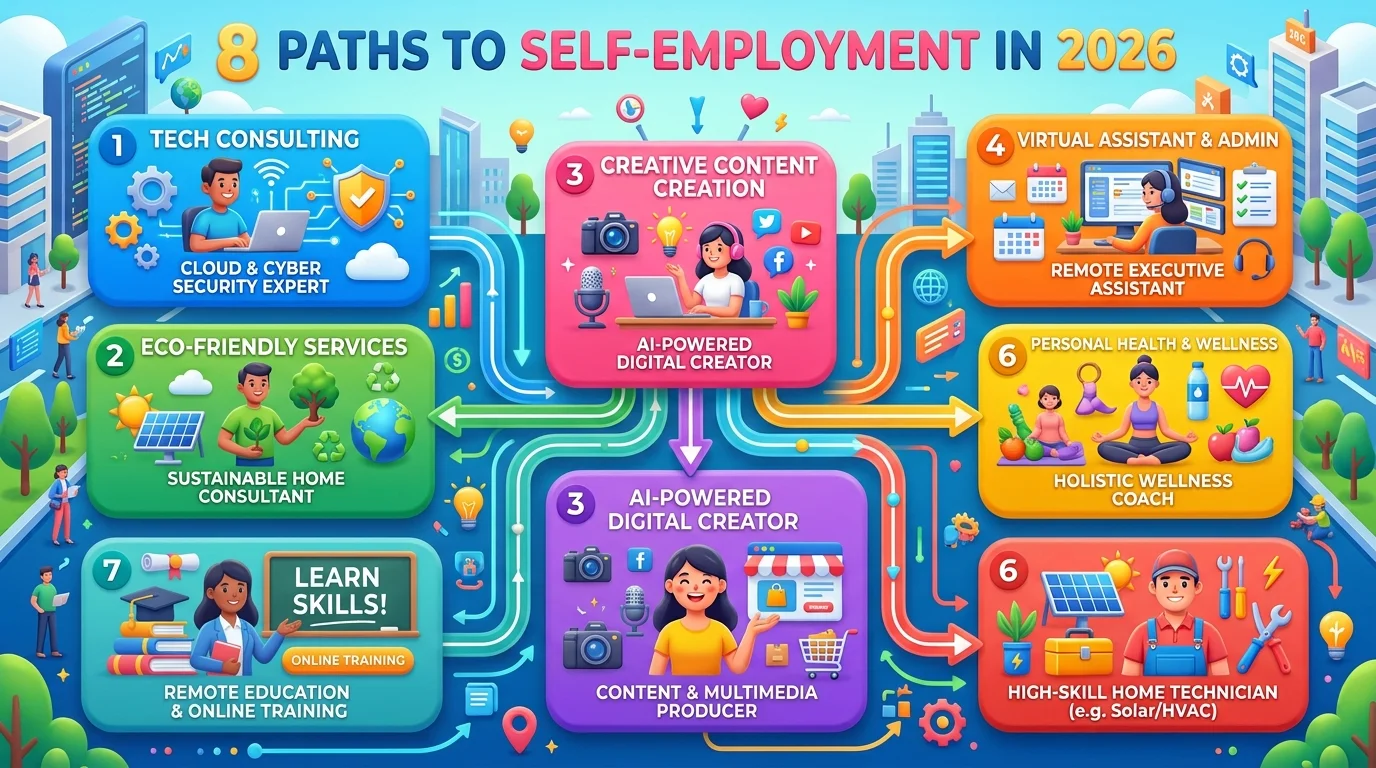
The world of work is changing rapidly. More people than ever are ditching the 9-to-5 job and starting their own thing. If you’re reading this, you might be one of them. The good news? Starting your own business in 2026 doesn’t require a huge amount of money or years of experience anymore.
Technology has made it possible for anyone with determination to build something meaningful. You can work from your home, reach customers worldwide, and keep expenses low. The barrier to entry has dropped significantly compared to even five years ago.
But here’s the thing – not every business idea works for everyone. Your skills, interests, and the time you can commit matter. That’s why we’ve put together this guide covering seven real self-employed businesses that beginners can actually start without breaking the bank.
We’ll walk you through each idea, show you the money side of things, explain what’s good and what’s challenging, and help you figure out if it’s right for you.
1. Digital Marketing Services – Turn Your Online Skills Into Income
Digital marketing is everywhere. Every business – big or small – needs help with their online presence. This could mean managing social media, running ads, improving their Google search rankings, or creating email campaigns.
As a digital marketing freelancer or agency owner, you’d be solving real problems for businesses trying to reach their customers online. It’s one of the most valuable services you can offer right now.
Why Digital Marketing Works for Beginners
You can start small. Maybe you help one or two local businesses first. Build your experience and results, then charge more and take on bigger clients. The best part? Your clients see the results in real numbers – more website visitors, more inquiries, more sales.
The Money Side: What You Could Earn
| Aspect | What to Expect |
|---|---|
| Starting Investment | ₹20,000 to ₹80,000 (courses, tools, website) |
| First 3 Months Income | ₹10,000 to ₹40,000 per month |
| After Establishing | ₹80,000 to ₹2,50,000+ monthly |
| Time to First Client | 4-8 weeks with active marketing |
What’s Good About This Business
- Businesses always need this: No matter how the economy changes, companies need to reach customers online. That’s not going away.
- Work from anywhere: All you need is a laptop and internet. Work from home, a café, or while traveling.
- Clients stay for months: Many businesses sign retainer agreements, giving you steady money each month.
- Multiple income streams: You can do freelance projects, monthly retainers, and even create digital marketing courses.
The Challenges You’ll Face
- Competition is real: Lots of people offer digital marketing services. You need to show why you’re different.
- Constant learning required: Algorithms change, new platforms appear, best practices shift. You’ll spend time keeping up.
- Results take time: Most clients don’t see massive results in week one. You need patience and good communication.
- Proof matters: Beginners without a portfolio might struggle to land first clients. You may need to do initial work cheaply to build case studies.
How to Get Started
Start by choosing one area: social media marketing, SEO, paid ads, or email marketing. Become really good at that one thing. Take a course, do some free work for friends or small businesses, document the results, then use those examples to attract paying clients.
2. Writing and Content Creation – Get Paid for Your Words
Every website, blog, email newsletter, and social media account needs content. Words are everywhere online. Businesses pay writers to create blog posts, landing pages, sales copy, and social content because good writing brings in customers.
If you can write clearly and understand what businesses need, this could be your path.
The Content Writing Opportunity
Content writers aren’t just bloggers. You could write:
- Blog articles for websites (like this one)
- Product descriptions for e-commerce stores
- Email sequences that sell
- Social media captions and posts
- Website copy that converts
- Technical documentation
- White papers for B2B companies
Each of these has different pay rates. Learn to do several types, and you increase your earning potential.
Your Potential Income
| Metric | Reality Check |
|---|---|
| Initial Setup Cost | ₹0 to ₹30,000 (optional courses) |
| Rate per Piece (Starting Out) | ₹1,000 to ₹5,000 per article |
| Rate per Piece (Experienced) | ₹10,000 to ₹50,000+ per article |
| Monthly Potential (Part-time) | ₹20,000 to ₹60,000 |
| Monthly Potential (Full-time) | ₹80,000 to ₹1,50,000+ |
Advantages of Writing Work
- Easiest to start: No fancy tools needed. Just you and a computer.
- Flexible scheduling: Write early morning, late night, or weekends. Your choice.
- No inventory or shipping: You’re not selling physical stuff. Every project is pure profit after time.
- Build your skills: Each piece you write makes you better. Your rates can increase as your quality improves.
- Remote possibility: Hundreds of content agencies and websites hire remote writers.
The Difficult Parts
- Starting is slow: Your first few clients might come through networking or taking lower rates.
- Writing quality varies: Knowing how to write well and knowing what clients need are different skills.
- Inconsistent income: Unless you land retainer clients, income can jump around month to month.
- Deadline pressure: Some clients want quick turnarounds, which means stress.
Action Steps to Begin
Join platforms like Upwork or Fiverr to start, or reach out to local businesses directly. Write samples in different styles. When you land clients, deliver excellent work and ask for referrals. Build a portfolio site showing your best pieces.
3. Home-Based Food Business – Turn Your Kitchen Into a Money Maker
Food is personal. People love supporting small businesses that make fresh, quality food. If you’re good at cooking or baking, you can turn your kitchen into a revenue stream without opening a restaurant.
Apps like Swiggy, Zomato, and local delivery platforms make it easier than ever to reach hungry customers. Some people start by taking orders from friends, then grow to Instagram followers, then delivery apps.
Types of Food Businesses You Could Start
- Home bakery: Cakes, cookies, bread, pastries delivered fresh
- Prepared meals: Lunch boxes, meal preps, diet-specific meals
- Specialty items: Homemade pasta, pickles, sauces, jams
- Dietary-specific: Keto meals, vegan options, protein-focused foods
- Cultural cuisine: Dishes from your cultural background that aren’t common locally
The Investment and Income Picture
| Item | Amount |
|---|---|
| Initial Setup (licenses, containers, equipment) | ₹30,000 to ₹1,50,000 |
| Cost Per Unit (varies by food type) | ₹50 to ₹300 |
| Selling Price Per Unit | ₹200 to ₹800+ |
| Monthly Earnings Potential | ₹40,000 to ₹1,50,000 |
Why This Business Makes Sense
- Low overhead: You use your existing kitchen. No restaurant rent.
- High demand: People always need to eat. Especially for convenient, quality food.
- Build loyal customers: Good food creates repeat customers who recommend you.
- Scalable: Start with 5 orders a day, grow to 50. You control the pace.
- Profitable margins: Food typically has good profit margins if you price correctly.
What Makes This Challenging
- Regulations exist for a reason: You’ll need food handler certification, proper licenses, and sometimes health inspections. Rules vary by location.
- Food spoils: You can’t just make extra and hope to sell it tomorrow.
- Time-intensive: Food businesses often mean early mornings and weekend work.
- Consistency matters: One batch of bad food affects your reputation forever.
- Delivery coordination: Ensuring hot food stays hot during delivery can be tricky.
How to Test Your Idea
Start small. Make food for friends and family, get feedback, and charge a small amount. Then try Instagram to take orders. When you’re confident, apply for proper licenses and partner with delivery apps. Move fast only when you’ve proven people will buy.
4. Online Teaching and Tutoring – Share Knowledge, Earn Money

Schools and universities aren’t the only places learning happens anymore. Students want tutoring in specific subjects. Adults want to learn new skills. Professionals want certificates in emerging fields.
If you know something well and can explain it clearly, you can be a teacher online.
What You Could Teach
- Academic subjects: Math, science, languages, English
- Professional skills: Coding, graphic design, digital marketing, writing
- Languages: English, Spanish, Mandarin for non-native speakers
- Fitness and wellness: Yoga, fitness training, nutrition
- Creative skills: Music, painting, photography, dance
- Business skills: Leadership, sales, negotiation, public speaking
Income Potential
| Scenario | Monthly Income |
|---|---|
| Part-time tutoring (10-15 hours/week) | ₹25,000 to ₹60,000 |
| Full-time tutoring (30-40 hours/week) | ₹80,000 to ₹1,50,000 |
| Group courses (20 students, monthly) | ₹50,000 to ₹2,00,000 |
| Pre-recorded courses (passive income) | ₹10,000 to ₹1,00,000+ |
Startup Costs
| Expense | Cost |
|---|---|
| Good webcam and mic | ₹3,000 to ₹8,000 |
| Lighting setup | ₹2,000 to ₹5,000 |
| Course platform subscription | ₹500 to ₹2,000 monthly |
| Website (optional) | ₹5,000 to ₹15,000 one-time |
| Total Starting Cost | ₹10,000 to ₹30,000 |
Advantages
- Meaningful work: You’re genuinely helping people improve their lives.
- Flexible hours: One-on-one tutoring lets you set your own schedule.
- Passive income option: Record your lessons once, sell forever through platforms like Udemy.
- Build authority: Online teachers become known experts in their field.
- Scalable: One-on-one tutoring eventually becomes group classes or recorded courses.
Difficulties
- Requires expertise: You can’t fake knowledge. Students know if you don’t really understand the topic.
- Different learning styles: What works for one student might not click with another.
- Technology issues: Internet drops, audio problems, and platform glitches happen.
- Marketing challenge: Getting students requires visibility and often spending on ads.
- Time zone problems: Tutoring live classes means working odd hours if you have international students.
Getting Started
Choose your subject carefully. Set up on a platform like Unacademy, Vedantu, or Chegg first – they handle marketing and payment. Once you have reviews and experience, you can attract direct clients who pay more.
5. Online Reselling and Dropshipping – Sell Without Storing Inventory
Dropshipping is selling products you don’t actually hold. A customer buys from you, you buy from a supplier, and they ship to the customer. You keep the difference.
It sounds simple, and the startup is low. But it’s also more competitive than people think.
How Dropshipping Actually Works
- You set up an online store
- You list products (with product photos from your supplier)
- A customer orders from your store
- You order the same product from your supplier
- Your supplier ships to the customer
- You keep the profit
Investment Breakdown
| Cost | Amount |
|---|---|
| Store setup (Shopify, WooCommerce) | ₹500 to ₹2,000 monthly |
| Domain name | ₹500 to ₹1,500 yearly |
| Initial inventory to test | ₹5,000 to ₹20,000 |
| Marketing and ads | ₹5,000 to ₹30,000+ monthly |
| Realistic Starting Budget | ₹20,000 to ₹50,000 |
Earning Potential
| Milestone | Timeline | Revenue |
|---|---|---|
| First sales | Week 2-4 | ₹1,000 to ₹5,000 |
| Profitable month | Month 2-3 | ₹15,000 to ₹40,000 |
| Scaling phase | Month 4-6 | ₹50,000 to ₹1,50,000+ |
Why People Choose Dropshipping
- Minimal capital needed: You don’t buy products until someone orders.
- No storage space needed: Products go straight from supplier to customer.
- Location independent: Run your store from anywhere.
- Test products easily: Try new products without big risk.
- Automated fulfillment: Once set up, orders ship automatically.
The Real Challenges
- Thin profit margins: Most dropshipping products have 20-30% profit margins. You need volume.
- Supplier reliability issues: Delays, poor quality, or communication problems reflect on your business.
- Shipping costs: International shipping can be expensive, eating into profits.
- Heavy competition: Everyone’s selling the same stuff from the same suppliers.
- Returns and disputes: Customers expect easy returns. You absorb these costs.
- Platform fees: Marketplaces take commissions (15-40%) off each sale.
Success Strategy
Don’t just drop-ship anything. Find a niche – specific products that appeal to a defined audience. Become known for quality in that niche. Use platforms like Amazon, Flipkart, or Meesho as starting points because they handle customer trust. Once you have sales data, you can potentially start your own store.
6. Print-on-Demand and Custom Merchandise – Sell Designs, Not Inventory
Imagine selling t-shirts, mugs, hoodies, and phone cases with custom designs – without ever holding the merchandise. That’s print-on-demand.
You create designs or use design tools, list them for sale, and when someone buys, a factory prints and ships it. You never touch the product.
What You Can Sell
- T-shirts and apparel
- Mugs and drinkware
- Phone cases and laptop skins
- Home décor items
- Hats and beanies
- Tote bags and backpacks
- Hoodies and sweatshirts
- Posters and wall art
The Numbers
| Aspect | Details |
|---|---|
| Setup cost | ₹5,000 to ₹25,000 |
| Average product cost (to you) | ₹150 to ₹400 |
| Average selling price | ₹300 to ₹800 |
| Profit per item | ₹100 to ₹400 |
| Monthly income (100 sales) | ₹10,000 to ₹40,000 |
| Monthly income (500 sales) | ₹50,000 to ₹2,00,000 |
Why This Works
- Truly zero inventory: Manufacturer only makes items that are ordered.
- Creative freedom: Your design is your brand. Unique designs stand out.
- Multiple sales channels: Sell on your website, Instagram, TikTok, marketplace sites.
- Passive income potential: Popular designs keep selling with no extra effort.
- Low risk: Test dozens of designs without losing money on unsold stock.
- Scalable immediately: If a design sells 10 pieces, it can sell 1,000.
What Makes It Hard
- Design skills needed: Or money to hire designers. Bad designs don’t sell.
- Highly competitive: Thousands of people doing the same thing.
- Marketing is crucial: You’re not just selling a t-shirt; you’re selling your brand.
- Slow shipping: Print-on-demand isn’t instant. Customers wait 1-2 weeks typically.
- Limited design space: Each product has size limits for designs and colors.
- Platform commissions: Print-on-demand companies take substantial cuts (30-50%).
How to Start Right
Choose a specific audience: dog lovers, fitness enthusiasts, specific fan communities, professions, hobbies. Create 5-10 designs specifically for them. Start selling on Etsy, then build your own Shopify store. Use Printful, Merch by Amazon, or Teelaunch to handle fulfillment.
7. Online Coaching and Consulting – Share Your Expertise for Premium Rates
You don’t need to be famous to be a coach or consultant. You need real experience and the ability to help people solve specific problems and reach specific goals.
People pay good money for expert guidance in areas where they want to improve.
Types of Coaching You Could Offer
- Career coaching: Help people land better jobs or transition careers
- Fitness coaching: Design personalized workout and nutrition plans
- Business coaching: Help entrepreneurs scale their companies
- Financial coaching: Teach people to manage money, invest, build wealth
- Life coaching: Help with mindset, goals, relationships, happiness
- Skill coaching: Teach writing, public speaking, negotiation, productivity
- Academic coaching: Help students develop study skills and confidence
- Marketing consulting: Advise businesses on strategy
Income Reality
| Format | Monthly Income |
|---|---|
| 1-on-1 coaching (5 clients × ₹3,000/month) | ₹15,000 to ₹50,000 |
| Group coaching (20 people × ₹2,000/month) | ₹40,000 to ₹1,00,000 |
| Full-time practice (mixed) | ₹1,50,000 to ₹5,00,000+ |
Startup Investment
| Item | Cost |
|---|---|
| Website and branding | ₹10,000 to ₹30,000 |
| Coaching platform (Calendly, Kajabi) | ₹500 to ₹2,000 monthly |
| Certification (optional but helpful) | ₹20,000 to ₹1,50,000 |
| Marketing and initial ads | ₹10,000 to ₹50,000 |
| Total starting | ₹40,000 to ₹1,00,000 |
Advantages of Coaching
- High value perceived: People who hire coaches are serious about results.
- Premium pricing: Coaching commands higher rates than hourly services.
- Recurring revenue: Most clients stay for 3-6 months or longer.
- Flexible delivery: Online meetings mean geography doesn’t matter.
- Referral business: Happy clients refer friends and colleagues.
- Group model scales: You can serve more people in group sessions.
The Difficulties
- Credibility needed: People want to know why they should trust you.
- Results matter: Coaching is about transformation. You need to deliver.
- Personal brand required: Success depends on your reputation and visibility.
- Marketing effort: You’re not just a coach; you’re a marketer too.
- Emotional labor: Coaching requires patience and strong communication.
- Competition: Established coaches already have followers.
Launch Your Coaching Practice
Start by establishing expertise. Write articles, share insights on LinkedIn, create YouTube videos. Help a few people for free or low cost to build testimonials. Once you have proof of results, charge premium rates. Platforms like Kajabi or Teachable help you sell coaching packages and group programs.
How These Business Ideas Compare: Side-by-Side
| Business Type | Starting Cost | Monthly Earnings Potential | Time to First Income | Difficulty Level |
|---|---|---|---|---|
| Digital Marketing | ₹20,000-80,000 | ₹80,000-2,50,000+ | 4-8 weeks | Medium-High |
| Content Writing | ₹0-30,000 | ₹20,000-1,50,000+ | 2-4 weeks | Low-Medium |
| Food Business | ₹30,000-1,50,000 | ₹40,000-1,50,000 | 4-12 weeks | Medium-High |
| Online Tutoring | ₹10,000-30,000 | ₹25,000-1,50,000+ | 2-6 weeks | Medium |
| Dropshipping | ₹20,000-50,000 | ₹15,000-1,50,000+ | 4-12 weeks | Medium-High |
| Print-on-Demand | ₹5,000-25,000 | ₹10,000-2,00,000+ | 2-8 weeks | Low-Medium |
| Coaching | ₹40,000-1,00,000 | ₹15,000-5,00,000+ | 4-16 weeks | High |
Choosing Your Business: A Simple Framework
Step 1: Match With Your Skills What are you already good at? What do people ask you for help with? Your existing skills give you an immediate advantage.
Step 2: Consider Your Available Time Can you commit 10 hours per week? 30 hours? Different businesses require different time investments initially.
Step 3: Look at Your Financial Situation How much can you invest upfront? Some businesses start with just a laptop. Others need initial inventory or equipment.
Step 4: Think About Your Personality Do you like direct interaction with people? Or prefer working solo? Some businesses are customer-facing; others aren’t.
Step 5: Be Realistic About Timeline Most self-employment takes 3-6 months to generate meaningful income. Can you survive on reduced income during this period?
Essential Tools and Resources to Help You Start
Regardless of which business you choose, several tools can accelerate your success:
- Websites and stores: Shopify, WordPress, Wix make creating an online presence simple
- Automation: Zapier connects different apps, automating repetitive tasks
- Communication: Zoom or Google Meet for video calls with clients
- Design: Canva offers templates for social media, flyers, graphics
- Scheduling: Calendly or Acuity Scheduling book appointments automatically
- Payment processing: Stripe, Razorpay, or PayPal handle customer payments
- Email marketing: Mailchimp or Brevo help you stay in contact with customers
If you want to explore how AI tools can enhance your business operations, read our guide on the best AI tools for businesses. Many of these tools can save you time and improve efficiency as you scale.
Frequently Asked Questions
Which business is truly easiest for a complete beginner?
Content writing and online tutoring have the lowest barrier to entry. You need minimal investment and can start quickly. However, easy to start doesn’t always mean easy to scale. Expect to spend months building your client base and reputation.
Can I do multiple of these businesses at once?
Absolutely. Many entrepreneurs start one business while building another. Content writing pairs well with coaching (write about your niche while building a coaching practice). Dropshipping works alongside print-on-demand. However, don’t spread yourself too thin initially.
How long before I see real money?
Most people see their first income in 2-6 weeks but meaningful income (replacing a part-time job) in 3-6 months. Full-time income replacement usually takes 6-12 months of consistent effort.
Do I need formal training or certification?
For tutoring, coaching, and food businesses, certification or specific credentials help but aren’t always required. For digital marketing and writing, your portfolio matters more than credentials. For food, you’ll need food handler certification for regulatory reasons.
What’s the most profitable option?
Coaching and consulting typically command the highest rates. However, they also require the most credibility-building. Dropshipping and print-on-demand offer passive income potential but have lower per-unit profit margins. Your highest profit usually comes from selling your time and expertise.
What’s the biggest mistake beginners make?
Trying to do everything at once. Pick one business, learn it deeply, build real income, then expand. Most successful self-employed people started with one thing and got good at it before branching out.
Can I really work from home and make good money?
Yes, absolutely. Thousands of people earn ₹1 lakh+ monthly from home-based businesses. The location doesn’t matter as much as your skill development, customer acquisition, and consistency.
Final Thoughts: Your Path Forward
Self-employment in 2026 isn’t a pipe dream. It’s a real, achievable goal for anyone willing to learn, work, and adapt. The businesses we’ve covered here share a common advantage: they’re built on universal human needs. Businesses always need marketing. People always need to learn. Everyone wants convenience.
Your job is to pick one, start small, and focus on delivering real value to your first customers. That’s how self-employment becomes sustainable.
Start by asking yourself: “What problem do I enjoy solving?” or “What do people already ask me for help with?” Your answer is usually the direction to explore.
The perfect time to start is never. But right now is pretty good.
External Resources and References
For more information about building your self-employed business, these authoritative resources are worth exploring:
- Small Business Administration (SBA) Resources – Comprehensive guides and support for entrepreneurs
- E-Kranti Portal – Indian government support for digital entrepreneurs
- HubSpot’s Digital Marketing Guide – In-depth strategies for marketing professionals