
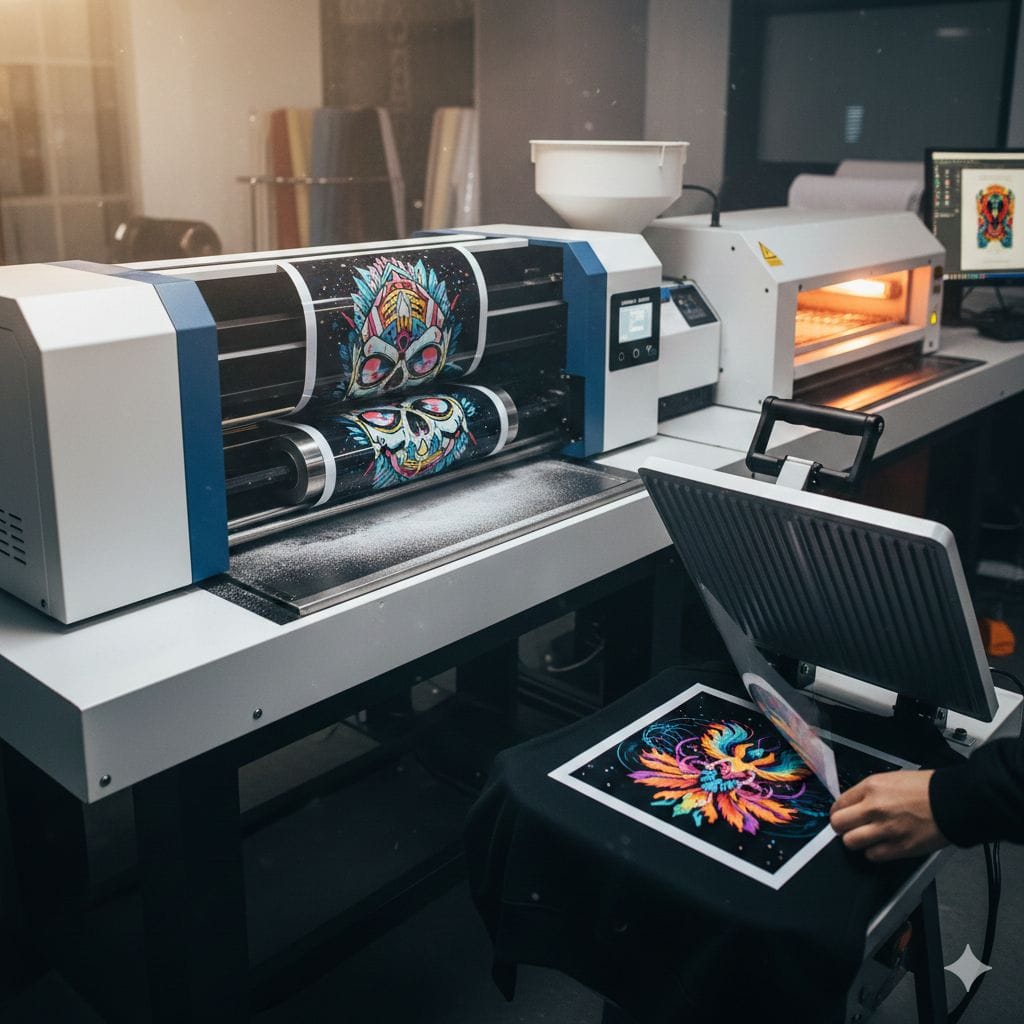
DTF printing (Direct-to-Film) is a modern heat transfer method that prints designs on special PET film, applies adhesive powder, cures it with heat, then transfers to fabric using a heat press. It works on all fabric types without pre-treatment, costs $0.75-$2.15 per print, and requires $3,500-$20,000+ initial investment depending on scale. Perfect for custom apparel businesses seeking versatility and vibrant, durable prints on cotton, polyester, and blended materials.
What Exactly is DTF Printing?
DTF printing represents a breakthrough in garment decoration technology. Unlike older methods, this technique creates transfers on specialized film before applying them to clothing.
The process works by printing your artwork onto a transparent PET film sheet, covering it with special hot-melt adhesive powder, heating it to solidify, then using a heat press to permanently bond the design onto your garment. The beauty of this method lies in its universal compatibility—it adheres beautifully to cotton, polyester, nylon, canvas, and virtually any textile you can imagine.
What makes DTF stand out is its ability to produce photographic-quality images on dark fabrics without the complicated pre-treatment steps that plague other printing technologies.
How the DTF Printing Process Actually Works
Understanding each phase of DTF printing helps you appreciate why this technology has become so popular among custom apparel makers.
The Six-Stage DTF Workflow
| Stage | What Happens | Equipment Needed |
|---|---|---|
| 1. Design Preparation | Your artwork gets processed through specialized RIP software that manages color profiles and creates the crucial white ink layer that sits beneath your colors | RIP Software (AcroRIP, Digital Factory, etc.) |
| 2. Film Printing | The printer applies CMYK colors first, immediately followed by a dense white ink layer on top—all printed onto clear PET transfer film | DTF Printer with white ink channel |
| 3. Powder Coating | While ink remains wet, thermoplastic adhesive powder gets spread evenly across the design; excess powder shakes off automatically | Powder shaker machine |
| 4. Heat Curing | The coated film travels through a heating chamber where temperatures around 160-170°C melt the powder, fusing it with the ink to create a solid transfer ready for application | Conveyor dryer or curing oven |
| 5. Press Application | The cured transfer positions on your garment and gets pressed at 150-170°C for 10-15 seconds under firm pressure, activating the adhesive | Commercial heat press |
| 6. Film Removal | After cooling (or sometimes immediately), you peel away the PET film, leaving your finished design permanently bonded to the fabric | None—manual step |
This systematic approach ensures consistent results whether you’re printing one shirt or one hundred.
Breaking Down DTF Printing Costs for 2026
Money matters when starting any printing business. Let’s examine the real investment required at different operational scales.
Initial Equipment Investment by Business Size
| Business Scale | What You Get | Investment Range | Best Suited For |
|---|---|---|---|
| Starter Setup | Modified desktop printer or compact A3/A4 system, manual powder application, basic heat press | $3,500 – $7,000 | Testing the market, home-based print-on-demand, hobby projects |
| Growth Stage | Professional 24-inch roll printer, dedicated curing system, quality commercial heat press | $10,000 – $20,000 | Established online stores, contract printing services |
| Production Level | 36-inch+ wide-format printer with automated powder and curing tunnel integration | $20,000 – $50,000+ | High-volume operations, established apparel brands |
Understanding Your Cost Per Print
Profit margins depend heavily on consumable costs. Here’s what each print actually costs you in materials:
| Material | Cost Per Standard Print (10″x12″) | Notes |
|---|---|---|
| DTF Inks | $0.50 – $1.50 | White ink consumes most of your budget since it creates the opaque foundation layer |
| PET Film Sheets | $0.15 – $0.40 | Buying film rolls in bulk dramatically reduces this expense |
| Adhesive Powder | $0.10 – $0.25 | Applied in thin layers; quality powder improves wash durability |
| Total Material Cost | $0.75 – $2.15 | Does not include labor, electricity, or equipment depreciation |
Pro Strategy: Create gang sheets by arranging multiple designs on one large film sheet. This technique reduces waste and can cut your cost per square inch by 40-60%.
When managing multiple print jobs, understanding proper print settings and collation becomes essential for efficient workflow management.
Why Choose DTF Printing? The Key Advantages
Business owners switching to DTF printing cite these compelling benefits:
Universal Fabric Compatibility – Cotton, polyester, poly-cotton blends, nylon activewear, treated leather—DTF transfers bond to all of them equally well.
Zero Pre-Treatment Needed – Skip the time-consuming spray-and-cure process that DTG printing requires on dark garments.
Exceptional Color Brightness – The white ink foundation makes colors appear vibrant and true even on black or dark-colored fabrics.
Superior Wash Durability – Properly applied DTF transfers withstand 50-60+ wash cycles without cracking, peeling, or significant color fade.
Profitable Small Batches – No setup fees or minimum orders mean you can profitably print single custom items for customers.
Photographic Detail Capability – Reproduce complex gradients, photographs, and intricate artwork that would be impossible or expensive with traditional screen printing.
DTF vs Other Printing Methods: Making the Right Choice
Comparing DTF and Direct-to-Garment (DTG) Printing
| Factor | DTF Technology | DTG Technology | Advantage Goes To |
|---|---|---|---|
| Compatible Fabrics | Works on everything—cotton, polyester, nylon, blends | Performs best on 100% cotton only | DTF Printing |
| Preparation Required | None—print and press | Must spray pre-treatment solution on dark shirts | DTF Printing |
| Feel on Garment | Slight texture similar to quality vinyl | Ink absorbs into fabric for softest feel | DTG Printing |
| White Ink Performance | Brilliant opacity on dark colors | Good but requires pre-treatment | DTF Printing |
| Best Application | Polyester sportswear, mixed fabrics, maximum versatility | Premium cotton t-shirts where soft hand-feel matters most | Depends on need |
Bottom Line: Choose DTF when you need to print on diverse fabric types, especially polyester and performance wear. Select DTG when working exclusively with cotton garments where the softest possible finish matters more than versatility.
Comparing DTF and Traditional Screen Printing
| Factor | DTF Technology | Screen Printing | Advantage Goes To |
|---|---|---|---|
| Color Complexity | Unlimited colors, full photographic detail | Each color requires separate screen; complex designs get expensive | DTF Printing |
| Production Speed | Fast digital file preparation | Lengthy screen creation and registration | DTF Printing |
| Minimum Order Economics | Profitable starting at 1 piece | Only cost-effective above 50-100 identical pieces | DTF for small runs |
| Large Volume Pricing | Moderate per-piece cost | Extremely low per-piece cost at scale | Screen Printing for bulk |
| Longevity Track Record | Excellent modern durability | Decades-proven wash durability | Screen Printing (slight edge) |
Bottom Line: DTF excels for short runs, complex multi-color designs, and photographic prints. Screen printing remains king for massive bulk orders (200+ pieces) of simple designs.
For more information on commercial printing technologies and industry standards, visit the Specialty Graphic Imaging Association.
Essential Maintenance for DTF Printers
Proper maintenance determines whether your DTF printer becomes a profitable asset or an expensive headache.
Daily and Weekly Maintenance Checklist
Every Single Day:
- Run nozzle check patterns to verify all channels fire correctly
- Execute automatic printhead cleaning cycle
- Physically shake or stir white ink reservoirs to prevent pigment settling
- Wipe down the capping station to remove dried ink buildup
Weekly Tasks:
- Deep clean printhead assembly
- Check and clean the wiper blade mechanism
- Inspect film feed rollers for powder residue
- Verify powder shaker continues distributing evenly
Environmental Controls: Maintain workspace humidity between 40-60%. Low humidity causes ink to dry in printheads, while excessive humidity prevents proper powder adhesion.
Common Problems and Quick Solutions
| Problem You’re Seeing | Why It’s Happening | How to Fix It |
|---|---|---|
| Ink bleeding or “tunneling” | Transfer wasn’t fully cured before pressing | Increase curing temperature to 165°C or extend curing time to 100-120 seconds |
| Transfer feels rough/plasticky | Excessive powder application | Adjust powder shaker settings; consider finer-grade powder |
| Design won’t stick properly | Insufficient heat press temperature or pressure | Verify press reaches 160-170°C; increase pressure to “firm” setting |
| White patches or missing areas | Clogged printhead nozzles (usually white ink) | Run deep cleaning cycle; manually clean capping station and wiper |
| Colors look washed out | Insufficient white ink underbase | Increase white ink density in RIP software settings |
DTF Printing: Your Questions Answered
Q: How many washes will a DTF print survive?
A properly applied DTF transfer typically lasts 50-60+ wash cycles with minimal fading or cracking. Many exceed the usable life of the garment itself. Durability matches or exceeds quality screen prints.
Q: Can I print on dark polyester with DTF?
Absolutely—this is where DTF truly shines. The white ink base layer provides perfect opacity, making colors pop brilliantly on dark polyester, nylon, and performance fabrics that give DTG and sublimation serious problems.
Q: Does the powder make DTF printing messy?
Manual powder application can be somewhat messy, but modern automated powder shaker systems contain everything within the machine. Professional setups are remarkably clean.
Q: Do I need a special heat press for DTF transfers?
No special heat press is required, but you need a quality commercial-grade press with accurate temperature control and even heat distribution. Standard household irons cannot provide the consistent pressure and temperature needed.
Q: What temperature and time settings work best?
Most DTF transfers apply successfully at 150-170°C (300-330°F) for 10-15 seconds under medium-firm pressure. Many professionals use a two-press method: initial 10-second press, peel the film, then a final 5-second press to seal.
Q: Can beginners learn DTF printing easily?
Yes. While there’s a learning curve for optimizing settings, the basic process is straightforward. Most beginners produce sellable prints within their first few attempts.
The Future of DTF Technology in 2026
The DTF printing industry continues advancing rapidly. Manufacturers now develop biodegradable PET films addressing environmental concerns. Water-based adhesive powder formulations promise more sustainable operations.
We’re seeing exciting hybrid machines that combine DTF and DTG capabilities in single units, giving businesses ultimate flexibility. Some can automatically switch between soft-hand DTG cotton prints and versatile DTF transfers without manual reconfiguration.
The technology’s combination of low setup costs, exceptional versatility, and professional-quality output makes DTF printing the most accessible entry point for entrepreneurs building custom apparel businesses in 2026.
Whether you’re launching a print-on-demand store, expanding an existing screen printing operation, or starting a custom sportswear line, DTF printing offers the perfect balance of quality, versatility, and profitability.
The future of custom garment printing is here—and it’s printed on film.
Pingback: What is Sublimation Printing: The Ultimate Beginner's Guide (How It Works) - Gloobia