

When you start building a web application, the framework you select shapes everything that comes after—your development timeline, infrastructure costs, team productivity, and long-term maintenance burden.
Python has become the world’s most versatile programming language because it balances simplicity with raw power. Unlike languages that force you into one way of thinking, Python lets developers choose frameworks that fit their exact needs.
The problem? With seven major frameworks to choose from (and dozens more minor ones), how do you know which one is right for your situation?
This guide cuts through the confusion. We’ll examine Django, FastAPI, Flask, Tornado, Pyramid, Falcon, and CherryPy in detail—not just listing features, but showing you real scenarios where each framework shines. Whether you’re building a content management system, shipping an AI backend service, or launching a startup MVP, you’ll find the clear answer by the end.
Quick Comparison: Framework Selection at a Glance
| Framework | Primary Purpose | Best Project Size | Learning Difficulty | Speed Rating | Team Size |
|---|---|---|---|---|---|
| Django | Complete web applications | Medium to Large | Moderate | High | 3-10 people |
| FastAPI | REST APIs and services | Small to Medium | Moderate | Very High | 1-5 people |
| Flask | Custom lightweight projects | Small to Medium | Easy | High | Solo to 3 people |
| Tornado | Real-time and live apps | Small to Medium | Moderate-High | Very High | 1-3 people |
| Pyramid | Enterprise custom solutions | Large | Moderate-High | High | 5-20 people |
| Falcon | High-speed API services | Small to Medium | Moderate | Very High | 1-3 people |
| CherryPy | Simple internal tools | Small | Easy | Moderate | Solo to 2 people |
Understanding Python Web Frameworks: What They Do
A Python web framework acts as a structured foundation for building internet-connected applications. Think of it as a toolkit that handles repetitive tasks automatically.
Instead of writing code from scratch to:
- Route incoming web requests to the right handler
- Manage database connections and queries
- Authenticate users and manage sessions
- Validate form submissions
- Protect against common security vulnerabilities
- Render HTML templates with dynamic data
You get all of these capabilities built-in (or easily added). This lets your team focus on the unique business logic that makes your application valuable.
The Seven Top Python Web Frameworks Explained
1. Django: The Industrial-Strength Choice

What It Is: A full-stack framework that comes “batteries included.” Django assumes you’ll need admin interfaces, database tools, user authentication, and form handling—so it provides them all from day one.
When to Use It:
- Building e-commerce platforms with thousands of products
- Creating content management systems for publishers
- Developing SaaS applications with user accounts
- Launching marketplace platforms
- Enterprise applications with complex business logic
Key Capabilities:
- Object-relational mapping (ORM) that simplifies database work
- Built-in admin panel (save weeks of UI development)
- Automatic security features against injection, CSRF, XSS attacks
- Template engine for server-side HTML rendering
- Built-in user authentication and permissions system
- Mature ecosystem with thousands of third-party packages
What Makes It Stand Out: Django applications can often be deployed within days once your team understands the framework’s patterns. The built-in admin interface alone cuts development time dramatically.
The Trade-off: Projects that don’t need Django’s full feature set often feel “heavy.” You’re carrying features your application never uses, which impacts memory consumption and startup time for very simple services.
Real-World Scale: Instagram, Spotify, Pinterest, and Dropbox all started with or currently use Django. It scales to billions of requests per day when properly deployed.
2. FastAPI: The Modern Performance Leader

What It Is: A relatively new framework (released 2018) built specifically for building rapid, high-performance APIs with automatic documentation.
When to Use It:
- Creating REST APIs for mobile applications
- Building AI/machine learning service backends
- Developing microservices in cloud environments (AWS Lambda, Google Cloud)
- Shipping real-time data services
- Building WebSocket-based communication systems
Key Capabilities:
- Automatic API documentation (built-in Swagger UI)
- Request validation through Python type hints
- Asynchronous request handling (handles many simultaneous requests efficiently)
- Auto-generated OpenAPI schemas for client developers
- Response serialization (converts Python objects to JSON automatically)
- Built for cloud-native deployment patterns
What Makes It Stand Out: FastAPI combines performance comparable to Go and Node.js with Python’s readability. A single developer can build and maintain APIs that handle millions of daily requests. Documentation is generated automatically—no manual documentation to maintain.
The Trade-off: The ecosystem is smaller than Django. You’ll find fewer third-party packages, which means more custom development for non-API features.
Real-World Usage: Companies like Uber, Microsoft, and Netflix use FastAPI for backend services. It’s the fastest-growing Python framework by adoption metrics.
3. Flask: The Flexible Minimalist

What It Is: A lightweight framework that gives you core routing and templating, then lets you choose everything else. It’s the “assemble your own” approach.
When to Use It:
- Starting your first Python web project
- Building internal admin dashboards
- Creating websites with simple database needs
- Learning web development fundamentals
- Prototyping ideas quickly
Key Capabilities:
- Simple request routing
- Jinja2 template rendering
- Cookie and session management
- Built-in development server
- Extensive extension ecosystem (Flask-SQLAlchemy, Flask-Login, etc.)
- Minimal learning curve
What Makes It Stand Out: Flask’s philosophy is “do one thing well.” This simplicity means beginners understand every line of code. You’re not fighting framework magic to accomplish something unusual.
The Trade-off: For larger applications, you’ll spend time choosing and integrating third-party packages—database ORM, form handling, user authentication. Each decision multiplies your dependency management burden.
Real-World Usage: Uber initially used Flask for internal tools. Many startups use Flask for MVPs before moving to Django as they scale.
4. Tornado: The Real-Time Specialist
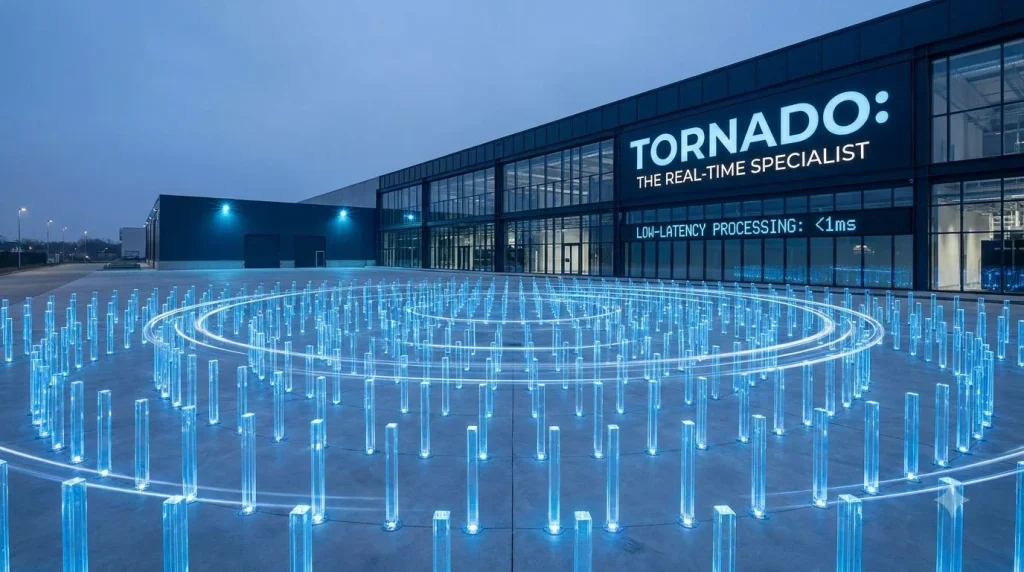
What It Is: An asynchronous framework designed to handle thousands of simultaneous connections efficiently. Originally created by Facebook for serving large numbers of concurrent users.
When to Use It:
- Building live chat applications
- Creating real-time dashboards (sports scores, stock tickers)
- Developing WebSocket-based systems
- Building streaming applications
- Applications that need thousands of simultaneous users
Key Capabilities:
- Non-blocking I/O (handles many connections without consuming resources per connection)
- Native WebSocket support
- Built-in HTTP server
- Asynchronous request handling
- Excellent concurrency performance
- Streaming response support
What Makes It Stand Out: If your application’s core value proposition is handling thousands of simultaneous real-time connections, Tornado does this more efficiently than most alternatives. A single Tornado process handles thousands of concurrent users where Django might struggle with dozens.
The Trade-off: The community is smaller. You’ll find fewer tutorials and fewer developers with Tornado experience. The asynchronous programming model is more complex than synchronous frameworks.
Real-World Usage: Still used by companies requiring massive real-time data streaming and live communication features.
5. Pyramid: The Enterprise Flexibility Champion
What It Is: A mature framework designed to scale from micro-projects to massive enterprise applications without framework constraints limiting you.
When to Use It:
- Large enterprise projects with custom requirements
- Applications where flexibility is more important than convention
- Projects expected to run for 10+ years with changing requirements
- Building modular systems with independent components
- Custom configuration-heavy applications
Key Capabilities:
- Pluggable database support (not locked into one ORM)
- Flexible URL routing patterns
- Request-scoped resource access
- Multiple template engine support
- Comprehensive security system
- Exceptional documentation quality
What Makes It Stand Out: Pyramid doesn’t force you into specific patterns. Unlike Django (which says “here’s the way”), Pyramid says “here’s a solid foundation—build how you need.” This flexibility prevents you from outgrowing the framework.
The Trade-off: This flexibility requires more upfront architectural planning. Beginners often find the choices overwhelming compared to Django’s opinionated structure.
Real-World Usage: Used by organizations with long-term applications requiring customization (government agencies, large financial institutions, custom software companies).
6. Falcon: The Performance-First API Builder

What It Is: A lightweight framework focused exclusively on building ultra-fast REST APIs with minimal overhead.
When to Use It:
- Building APIs serving millions of requests daily
- Creating microservices in resource-constrained environments
- Shipping backend services where response latency matters financially
- Building API gateways
- High-frequency backend services
Key Capabilities:
- Extremely lightweight (core framework is minimal)
- HTTP/1.1 compliant
- Clean RESTful API design
- Resource-oriented architecture
- Excellent performance per CPU core
- Cloud deployment readiness (works great on serverless platforms)
What Makes It Stand Out: Falcon’s obsession with performance means your API serves more requests using less server capacity. For high-volume APIs, this translates directly to lower infrastructure costs.
The Trade-off: Falcon is API-only. Want to serve HTML pages or build a complete web application? You’ll need additional tools. The ecosystem is smaller than Django or Flask.
Real-World Usage: Used by OpenStack, RackSpace, and other companies requiring extreme API performance and efficiency.
7. CherryPy: The Underrated Simple Server

What It Is: One of the oldest Python web frameworks, offering object-oriented request handling and a built-in application server.
When to Use It:
- Building lightweight internal business tools
- Creating simple web interfaces for backend services
- Shipping small, self-contained applications
- Learning object-oriented web development
- Quick prototypes needing a running server
Key Capabilities:
- Built-in HTTP server (no separate web server needed)
- Object-oriented approach to request handlers
- Cookie and session support
- Simple configuration
- Lightweight deployment (single Python file can be a complete web application)
- Stable API (hasn’t changed radically in years)
What Makes It Stand Out: CherryPy applications are self-contained—single Python files can serve complete web applications with no additional deployment complexity. Ideal for tools your team maintains internally.
The Trade-off: The community is smaller and less active. You’ll find fewer tutorials than Flask. Most new projects choose Flask over CherryPy for similar use cases.
Real-World Usage: Still used for internal tools and small applications, though newer projects usually gravitate toward Flask or FastAPI.
Framework Comparison: Features That Matter
| Feature | Django | FastAPI | Flask | Tornado | Pyramid | Falcon | CherryPy |
|---|---|---|---|---|---|---|---|
| Built-in Database ORM | Yes (Django ORM) | No | No | No | No | No | No |
| Admin Interface | Complete | No | No | No | No | No | No |
| Built-in Authentication | Full system | No | No | No | No | No | No |
| Performance (req/sec) | 1,000-3,000 | 5,000-10,000 | 2,000-5,000 | 5,000-8,000 | 1,500-3,500 | 8,000-15,000 | 1,000-2,000 |
| Memory Usage | High | Low | Low | Low | Medium | Very Low | Low |
| Async Support | Partial | Native | Limited | Native | No | No | No |
| Learning Curve | 3-4 weeks | 2-3 weeks | 1-2 weeks | 3-4 weeks | 3-4 weeks | 2-3 weeks | 1-2 weeks |
| Community Size | Very Large | Large | Very Large | Small | Small | Small | Very Small |
| Production Maturity | Excellent | Excellent | Good | Excellent | Excellent | Excellent | Good |
Real-World Selection Scenarios
Scenario 1: Launching an E-Commerce Platform
Your Situation: You’re building an online store with products, shopping carts, checkout, inventory tracking, and customer accounts.
Recommended Framework: Django
Why: Django’s built-in admin interface lets you manage products without building custom admin tools. The ORM simplifies inventory queries. Built-in user authentication handles customer accounts securely. Django’s security features protect sensitive payment information. The framework has proven scalability—large e-commerce sites run on Django.
Timeline: 8-12 weeks for MVP → launch
Scenario 2: Building a Machine Learning Service Backend
Your Situation: You’ve trained ML models and need an API that accepts data, processes through models, and returns predictions. You expect 100,000 daily API requests.
Recommended Framework: FastAPI
Why: FastAPI handles concurrent requests efficiently without consuming resources per request. Automatic documentation means data scientists using your API see available endpoints without asking. Type hints validate incoming data automatically. It’s cloud-deployment ready—works perfectly on serverless platforms and cuts hosting costs.
Timeline: 2-3 weeks to production
Scenario 3: Building Internal Admin Dashboard for Your Team
Your Situation: Your engineering team needs a web interface to manage users, review logs, and trigger operations. Security matters, but it’s internal-only.
Recommended Framework: Flask
Why: Flask’s simplicity means a single developer builds the dashboard while maintaining other projects. You choose your database (or use none). The extension ecosystem provides quick solutions for user login, forms, and data display. Deployment is straightforward—single Python file on a internal server.
Timeline: 1-2 weeks
Scenario 4: Building a Live Sports Scoreboard
Your Situation: Users connect to your platform and receive real-time score updates. You expect 10,000 simultaneous viewers during major games.
Recommended Framework: Tornado
Why: Tornado handles 10,000 concurrent connections efficiently on single hardware. Native WebSocket support means real-time updates push to users instantly. Memory footprint per connection is minimal. You can run the entire application on modest hardware.
Timeline: 4-6 weeks
Scenario 5: Building a Custom Enterprise System
Your Situation: You’re creating a specialized application for a large organization. Their requirements are unique—existing frameworks seem too opinionated.
Recommended Framework: Pyramid
Why: Pyramid doesn’t force you into specific patterns. You customize architecture to match your organization’s needs exactly. The framework gets out of your way while providing solid foundational tools.
Timeline: 12-16 weeks (includes substantial customization)
Performance Comparison: What Numbers Really Mean
Framework performance varies dramatically based on what you’re measuring. Here’s the reality:
Request Throughput (requests per second):
- Falcon: 8,000-15,000 requests/second
- FastAPI: 5,000-10,000 requests/second
- Tornado: 5,000-8,000 requests/second
- Flask: 2,000-5,000 requests/second
- Django: 1,000-3,000 requests/second
- Pyramid: 1,500-3,500 requests/second
- CherryPy: 1,000-2,000 requests/second
What This Means In Practice: For APIs serving 100,000 daily requests (about 1.2 requests/second average), all frameworks perform adequately. But for 10 million daily requests, your framework choice dramatically impacts hosting costs. Falcon needs fewer servers than Django for identical load.
Memory Consumption Per Running Process:
- Falcon: 30-40 MB
- FastAPI: 40-60 MB
- Flask: 35-50 MB
- Tornado: 45-65 MB
- Django: 80-150 MB
- Pyramid: 60-100 MB
- CherryPy: 35-55 MB
For cloud deployments where you run multiple process copies, memory consumption multiplies across many running instances.
Cost Considerations for Different Frameworks
The framework you choose affects your total cost of ownership in ways beyond performance:
Infrastructure Costs:
- FastAPI/Falcon apps run on smaller cloud instances = lower monthly bills
- Django apps need more powerful servers = higher monthly costs
- Cost difference: 30-60% over a year for scaling projects
Development Time:
- Flask: 30-40% faster initial development
- Django: 15-20% slower initial development, but maintenance faster at scale
- FastAPI: 40-50% faster for API-only projects
Developer Hiring:
- Django: Abundant developer pool (easy hiring)
- Flask: Good developer pool (easier hiring)
- FastAPI: Growing pool (moderate difficulty)
- Tornado/Pyramid/Falcon: Smaller pool (harder hiring)
Maintenance and Scaling:
- Django: Easy to scale horizontally (more servers)
- FastAPI: Extremely easy to scale (needs fewer servers)
- Flask: Scales well but requires architectural planning
Making Your Decision: A Simple Framework Selection Guide
Choose Django if:
- ✓ Building complete web applications (not just APIs)
- ✓ Your team has Django experience
- ✓ You want the fastest path to a working web application
- ✓ Your project needs built-in admin, authentication, and security
- ✓ You’re hiring team members (large job market)
Choose FastAPI if:
- ✓ Building REST APIs (primary use case)
- ✓ Performance is a primary concern
- ✓ You want automatic API documentation
- ✓ You need cloud-native deployment
- ✓ You’re scaling to millions of daily API requests
Choose Flask if:
- ✓ You’re learning web development
- ✓ Building simple internal tools
- ✓ You want minimal framework constraints
- ✓ You prefer choosing every component
- ✓ You’re building an MVP quickly
Choose Tornado if:
- ✓ Your application’s core value is real-time features
- ✓ You need to handle thousands of concurrent users
- ✓ You’re building live communication systems
- ✓ Your team understands asynchronous programming
Choose Pyramid if:
- ✓ You’re building custom enterprise systems
- ✓ Flexibility matters more than convention
- ✓ Your application needs non-standard architecture
- ✓ You have experienced Python architects
Choose Falcon if:
- ✓ Building APIs with extreme performance requirements
- ✓ Minimizing infrastructure costs is critical
- ✓ You need an ultra-lightweight API layer
- ✓ You’re building microservices
Choose CherryPy if:
- ✓ Building very simple internal applications
- ✓ You need a self-contained server
- ✓ Minimal dependencies are important
Deployment Considerations: Where Hosting Costs Matter
When you’re ready to launch, framework choice affects hosting expenses significantly.
Serverless Cloud Functions (AWS Lambda, Google Cloud Functions): Best frameworks: FastAPI, Flask, Falcon (lightweight = lower execution time = lower costs) Avoid: Django (startup time too slow for function execution model)
Traditional VPS/Cloud Servers (AWS EC2, DigitalOcean, Linode): Best frameworks: All frameworks work well Cost varies: Django needs more powerful instances; FastAPI/Falcon need less powerful instances
Containerized Deployment (Docker, Kubernetes): Best frameworks: FastAPI, Flask, Falcon (smaller container images = faster scaling) Acceptable: Django (works fine, just larger containers)
Development and Storage Infrastructure: For applications like Gloobia that scale content across multiple services, consider using cloud storage solutions to handle media files and assets efficiently. This separates your static content from application servers, improving performance regardless of framework choice.
Frequently Asked Questions
Q: Can I migrate from Flask to Django later? A: Yes, but it requires significant work. Flask and Django have different architectural assumptions. Better to start with the framework you’ll likely need.
Q: Is FastAPI safe for production? A: Absolutely. Major companies use FastAPI in production. The security features are solid.
Q: Will Django still be relevant in 2027 and beyond? A: Yes. Django’s long-term support cycle means security updates continue for years. It remains the top framework for large applications.
Q: How many developers know each framework? A: Django and Flask have the largest communities. FastAPI is growing rapidly. Tornado, Pyramid, Falcon, and CherryPy have smaller but dedicated communities.
Q: Can beginners use FastAPI? A: Yes, but the async concepts are more complex than Flask. Flask remains the easiest starting point.
Q: What about security differences? A: Django has the most built-in security features. FastAPI and Flask require more manual security implementation. All frameworks are secure when properly implemented.
Q: Which framework is best for AI applications? A: FastAPI has become the standard for AI/ML backends due to performance and rapid iteration capability.
Final Recommendation
The “best” Python web framework in 2026 doesn’t exist as a universal answer. Your best framework matches your project requirements perfectly:
- Most projects benefit from Django. Its complete feature set and mature ecosystem handle 80% of use cases faster than alternatives.
- Performance-focused and API projects benefit from FastAPI. It’s replacing Django for new projects that prioritize speed and cloud deployment.
- Learning and experimentation benefit from Flask. Understanding Flask deeply teaches you how web frameworks actually work.
- Specialized projects benefit from Tornado, Pyramid, Falcon, or CherryPy when their specific strengths align with your requirements.
The best framework is the one you understand, your team can maintain, and that solves your exact problem without unnecessary complexity.