
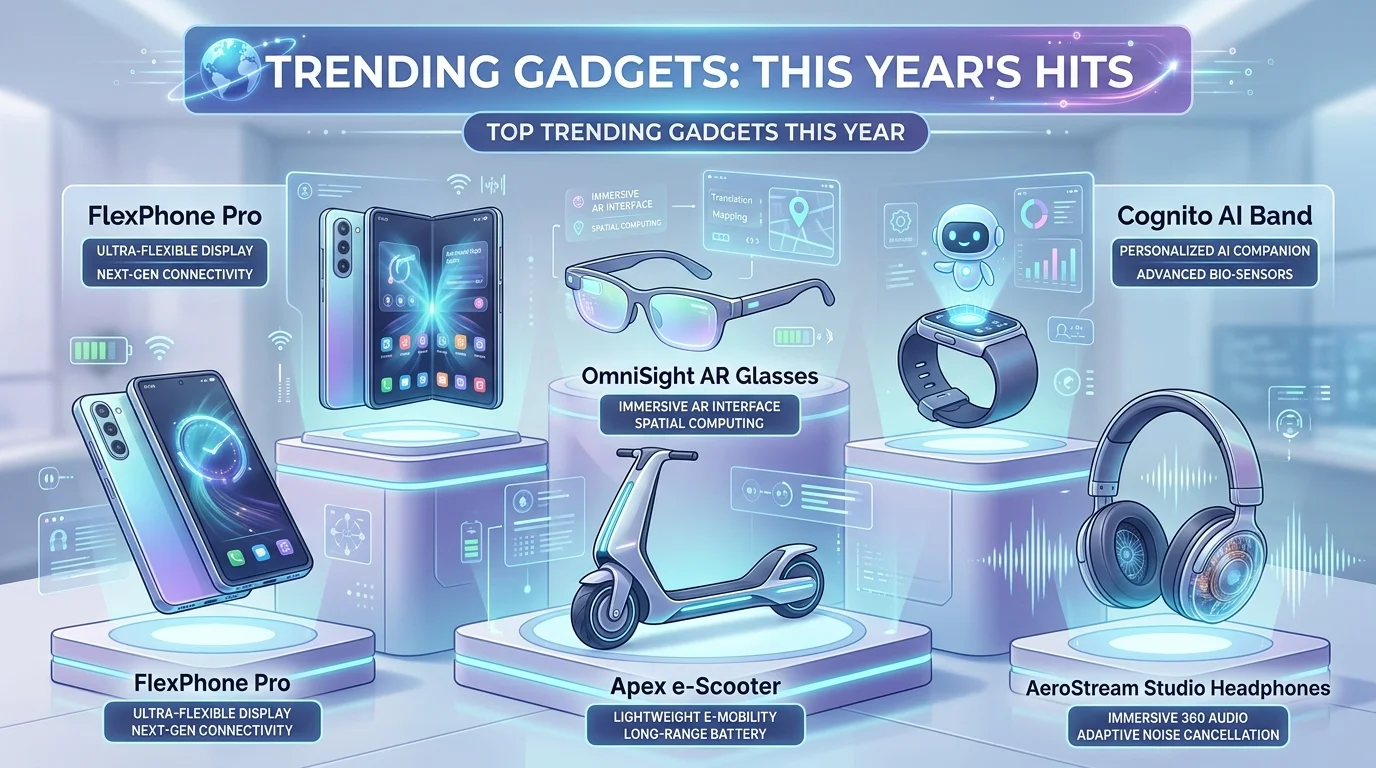
Technology has taken an incredible turn in 2026. We’re not just seeing faster phones or thinner laptops anymore—we’re experiencing a complete transformation in how gadgets work. Artificial intelligence is now built into everyday devices. Smart automation is making homes smarter. Design has become sleeker and more thoughtful.
Whether you work in an office, study at a college, game in your free time, or manage a household, there’s something new this year that will catch your attention. The gadgets we’re about to explore aren’t just cool—they’re genuinely useful in daily life.
In this article, I’ve tested and researched the 15 most exciting gadgets of 2026. I’ll show you what each one does, how much it costs (including prices for India), and whether it’s really worth buying. Let’s dive in.
Why These 15 Gadgets Matter in 2026
Technology moves fast. But not all new gadgets are worth the money. I focused on finding devices that:
- Solve real problems in everyday life
- Actually work as promised (no overhyped claims)
- Offer good value for the price
- Work well in India with local connectivity
- Will stay relevant beyond just this year
The gadgets below fit all these standards. Now let’s look at each one.
The 15 Trending Gadgets of 2026
1. Apple MacBook Neo – Best Budget Laptop for Students
Price in India: ₹45,000 – ₹55,000 (approximately)
Price Global: $599
Best For: College students, first-time Apple buyers, content creators on a budget
What Makes It Special: The MacBook Neo runs on Apple’s A18 Pro chip without any cooling fan—meaning it’s completely silent. The battery lasts about 16 hours, which means you can use it all day without charging. It weighs just 2.2 kg, making it lighter than most laptops in its price range.
Pros:
- Extremely lightweight and portable
- Battery lasts the entire day
- Runs Apple Intelligence (their new AI system) natively
- Very quiet—no fan noise
- Good for light work like writing, browsing, and content editing
Cons:
- Limited USB ports (you might need adapters)
- Not powerful enough for heavy video editing or gaming
- Display is smaller than similar laptops
- Entry-level model has only 256GB storage
Who Should Buy? If you’re a student taking notes, writing assignments, or editing light videos, this laptop is perfect. Teachers and writers will also love how quiet and portable it is. Read our detailed comparison of budget laptops in 2026 here.
2. Meta Ray-Ban Display – Smart Glasses for AI Control
Price in India: ₹60,000 – ₹75,000 (approximately)
Price Global: $799
Best For: Tech enthusiasts, professionals who need hands-free control, AR lovers
What Makes It Special: These aren’t just regular glasses. Built by Meta and Ray-Ban together, they let you see digital information overlaid on the real world while wearing stylish sunglasses. A neural wristband (worn on your wrist) lets you control them without touching anything. You can check messages, see directions, or control your home devices—all without pulling out your phone.
Pros:
- Look like regular sunglasses (nobody can tell they’re tech)
- Real AI assistant built in (similar to ChatGPT)
- Perfect AR experience for everyday tasks
- Neural wristband makes control feel natural
- Great for meetings and professional settings
Cons:
- Battery needs charging every 4 hours
- Expensive upfront cost
- Requires setup with Meta account
- Not great in bright sunlight reflection
Who Should Buy? Business professionals who are always on the go, architects and engineers who need to visualize designs, and anyone interested in AR will love this.
3. Brilliant Labs Halo – Privacy-First AI Glasses
Price in India: ₹25,000 – ₹30,000 (approximately)
Price Global: $349
Best For: Privacy-conscious users, developers, tech experimenters
What Makes It Special: Unlike other smart glasses, Brilliant Labs Halo runs AI directly on the device itself—not on someone’s servers in the cloud. This means your voice commands, searches, and usage data stay on the glasses. It’s open-source, meaning developers can build new features for it.
Pros:
- Maximum privacy (data doesn’t go to cloud servers)
- Open-source so it can be customized
- Much more affordable than competitors
- Lightweight and comfortable
- No monthly subscriptions
Cons:
- Smaller app ecosystem right now
- Less polished than commercial alternatives
- Requires some technical knowledge to set up
- Battery life around 4-5 hours
Who Should Buy? If you care deeply about privacy and you’re comfortable with technology, this is your choice. Developers who want to experiment with AI will find this exciting.
4. PLAUD NotePin S – The Recording Device for Professionals
Price in India: ₹13,000 – ₹16,000 (approximately)
Price Global: $179
Best For: Journalists, students in lectures, business professionals
What Makes It Special: Attach this tiny device to your shirt pocket and it records meetings and conversations automatically. The magic part? It can translate and transcribe what it hears in 112 different languages. You press stop, and within seconds you have a written transcript. No more scrambling to take notes.
Pros:
- Records crystal clear audio
- Transcribes instantly (no waiting)
- Works in 112 languages
- Converts to text immediately
- Clips to anything (shirt, pen, bag)
Cons:
- Monthly subscription needed for cloud transcription
- Not great for very noisy environments
- Can’t record video
- Battery lasts about 8-10 hours
Who Should Buy? Students who want to focus on learning instead of note-taking. Journalists and reporters who need accurate quotes. Business professionals in meetings who want to stay engaged instead of typing notes.
5. Rabbit R1 – Your Personal AI Computer Assistant
Price in India: ₹15,000 – ₹18,000 (approximately)
Price Global: $199
Best For: Anyone overwhelmed by too many apps and accounts
What Makes It Special: Instead of opening 10 different apps, just tell Rabbit R1 what you need. “Book me a flight,” “Order coffee,” or “Send that to my boss.” The AI understands your command and does it directly on your computer—no jumping between apps.
Pros:
- Dramatically speeds up everyday computer tasks
- Works with almost any app you already use
- Very affordable
- Reduces time spent switching between windows
- Great learning curve—easy to use immediately
Cons:
- Early version (some tasks still get confused)
- Needs reliable internet connection
- Doesn’t work with all apps yet
- Can’t handle very complex multi-step tasks
Who Should Buy? Anyone with a busy job who feels like they spend half their time managing apps. People who want to be more productive. Those frustrated with complicated software.
6. Logitech G512 X – Gaming Keyboard for Serious Players
Price in India: ₹13,000 – ₹16,000 (approximately)
Price Global: $179.99
Best For: Gamers, eSports players, competitive online gaming
What Makes It Special: This keyboard uses a hybrid system that combines analog precision with mechanical switches. In simple terms: it’s responsive for fast gaming but also comfortable for long typing sessions. You can customize every key with RGB lighting.
Pros:
- Ultra-responsive (perfect for competitive games)
- Comfortable for 8+ hour gaming sessions
- Customizable lighting and macros
- Works with PC, Mac, and PlayStation
- Build quality is extremely solid
Cons:
- Expensive for a keyboard
- Takes up desk space (not compact)
- Software sometimes needs updates
- Overkill if you just browse the web
Who Should Buy? Serious gamers who play competitive shooters or strategy games. Streamers who want quality equipment. Anyone spending 30+ hours per week at a computer.
7. ACEMAGIC Retro X5 – The Computer for Vintage Lovers
Price in India: ₹75,000 – ₹90,000 (approximately)
Price Global: $999
Best For: Retro game enthusiasts, NES nostalgia fans, collectors
What Makes It Special: It looks like a classic Nintendo Entertainment System (NES) from 1985, but inside it has cutting-edge AI hardware. You can play thousands of retro games, but it also runs modern AI applications. It’s a conversation starter that actually performs.
Pros:
- Genuinely nostalgic design
- Powerful modern processor inside
- Perfect for retro game collection
- Works as a desktop PC despite tiny size
- Great conversation piece
Cons:
- Overpriced for what it does
- Limited practical use beyond gaming/nostalgia
- Gets warm during heavy use
- Overkill for just playing old games
Who Should Buy? Collectors of retro gaming memorabilia. Anyone who grew up with NES and wants something special. Enthusiasts who want a unique looking computer for their desk.
8. Timekettle W4 Pro – The Real-Time Translator
Price in India: ₹35,000 – ₹40,000 (approximately)
Price Global: $449
Best For: Business travelers, international professionals, language learners
What Makes It Special: These are earbuds that translate conversations in real-time across 40 languages. Speaking to someone in Japanese while you only know English? Put these in, and you hear the translation instantly in your ear. The conversation flows naturally.
Pros:
- Incredibly accurate translations
- 40+ languages supported
- Both people can wear them for two-way translation
- Works offline for major languages
- Connects to your phone for long-distance calls
Cons:
- Battery needs frequent charging (3-4 hours)
- Expensive upfront
- Works better for simple conversations than complex technical discussions
- Small learning curve
Who Should Buy? Business travelers who meet clients from different countries. International students. Anyone relocating to a foreign country. Remote workers on global teams.
9. SwitchBot Lock Vision Pro – Smart Lock for Modern Homes
Price in India: ₹18,000 – ₹22,000 (approximately)
Price Global: $229.99
Best For: Smart home enthusiasts, homeowners wanting security
What Makes It Special: Unlock your door with your face, your palm (vein pattern), or your fingerprint. There’s also a backup keypad. Built-in camera lets you see who’s at your door. When connected to WiFi, you can unlock it from anywhere on your phone.
Pros:
- Multiple unlock methods for convenience
- Built-in camera for security
- Can grant temporary access to guests
- Battery lasts 3-4 months
- Works on most existing locks (retrofits easily)
Cons:
- Requires good WiFi connection for remote access
- Expensive compared to keypad-only locks
- Palm vein scanner sometimes takes multiple tries
- Setup takes 30-45 minutes
Who Should Buy? Busy homeowners tired of carrying keys. People who frequently have guests over. Anyone interested in building a connected smart home. Real estate professionals who need secure guest access.
10. Yarbo M Series – The Yard Robot That Does Everything

Price in India: ₹1,50,000 – ₹1,80,000 (approximately)
Price Global: $2,199+
Best For: Homeowners with big yards, people who hate yard work
What Makes It Special: Imagine having a helper robot that handles all your yard work. This modular machine mows your lawn, blows leaves, and clears snow—all with one main unit and swappable attachments. Set it loose and it works autonomously.
Pros:
- Handles multiple tasks (no need to buy separate machines)
- Completely autonomous once set up
- Saves 10+ hours per month on yard work
- Works in rain and various weather
- Durable construction built for outdoor use
Cons:
- Very expensive upfront investment
- Requires flat to moderately sloped terrain
- Takes up storage space
- Setup and programming takes time
- Maintenance needed occasionally
Who Should Buy? Homeowners with large lawns who hate yard work. People with physical limitations who can’t do yard work. Anyone who’d rather spend weekends relaxing than mowing.
11. Samsung Galaxy S26 Ultra – Flagship Phone with Real AI
Price in India: ₹1,24,999 (after launch discount)
Best For: Tech-forward smartphone users who want the latest features
What Makes It Special: Samsung loaded this phone with AI features that actually make sense. The camera uses AI to improve photos in real-time. There’s a hidden privacy screen that nobody else can see unless they look straight at it. Processing power rivals small computers.
Pros:
- AI camera takes genuinely better photos
- Privacy screen keeps your data private
- Extremely fast processor
- Large, beautiful display
- Excellent battery for intensive use
Cons:
- Expensive even with discount
- Heavy phone (might be uncomfortable for long use)
- Too many features that you won’t use
- Gets hot during heavy gaming
Who Should Buy? Photographers who want AI-powered editing. Professionals who need maximum screen privacy. Tech enthusiasts who always get the latest flagship phone.
12. LG Wallpaper OLED TV (Evo W6) – The Ultra-Thin TV
Price in India: ₹2,50,000 – ₹3,50,000 (approximately)
Best For: Luxury home setup seekers, modern interior designers
What Makes It Special: This TV is just 9mm thick—about as thick as a pencil. It mounts flush against your wall and looks like a painting. The wireless “Zero Connect” box sits separately, eliminating cable mess. Picture quality is stunning because it’s OLED technology.
Pros:
- Incredibly thin and elegant
- Wireless connectivity (no cables visible)
- OLED picture quality is the best available
- Perfect for modern home design
- Sound quality is surprisingly good
Cons:
- Extremely expensive
- OLED displays can get burn-in marks over time
- Difficult to repair if damaged
- Overkill for casual watching
Who Should Buy? Home theater enthusiasts with budget for luxury. Interior designers building modern spaces. Anyone who wants their TV to be a design element, not just a device.
13. Lenovo Qira AI Companion – Your Personal AI Assistant
Price in India: ₹45,000 – ₹60,000 (with laptop)
Best For: Professionals who want AI helping throughout their day
What Makes It Special: Built into Lenovo laptops, Qira learns how you work. It anticipates what you might need next. Running low on battery before an important meeting? It notifies you early. It can even read your emotional tone from your typing and suggest breaks.
Pros:
- Learns your work patterns
- Actually useful (not just gimmicky)
- Runs locally on your laptop (privacy-friendly)
- Integrates with all your apps
- Improves over time as it learns you better
Cons:
- Only available on certain Lenovo laptops
- Takes time to learn your patterns
- Privacy concerns for some users
- Can be intrusive if not configured right
Who Should Buy? Busy professionals juggling multiple projects. Students with demanding schedules. Anyone wanting a personal assistant built into their laptop.
14. Intel Core Ultra Series 3 Laptops – Crazy Long Battery
Price in India: ₹70,000 – ₹1,50,000 (varies by model)
Best For: Remote workers, travelers, students in long classes
What Makes It Special: These new Intel processors use AI to manage power incredibly efficiently. Result: you get 20+ hours of battery life on a single charge. Some users report playing games at 140 FPS (frames per second) without needing a separate graphics card—the processor handles it internally.
Pros:
- Unbelievable battery life
- Gaming performance without separate graphics card
- Great for running multiple apps
- Stays cool during intensive work
- Efficient, so you save on electricity
Cons:
- Still early technology (some software not optimized)
- More expensive than previous generation
- Heat management still improving
- Battery degrades like all batteries
Who Should Buy? Digital nomads and remote workers who travel constantly. Students living in dorms with limited charging access. Gamers wanting performance without bulky graphics cards. Anyone who wants to charge their laptop just once a week.
15. Rollable Gaming Laptop – The Laptop That Expands
Price in India: Expected ₹2,00,000+ (when available)
Best For: Early adopters, gaming enthusiasts, futuristic tech lovers
What Makes It Special: Shown at CES 2026, this is the future of laptops. The screen rolls out from the side, expanding from 16 inches to 24 inches. Imagine: full computer power with a giant screen, but portable enough to fit in a backpack.
Pros:
- Game-changing portable display size
- Futuristic and impressive
- Solves portability vs. screen size problem
- Very durable (tested for thousands of roll-outs)
- Great for video editing and design work
Cons:
- Extremely expensive
- Brand new technology (reliability unknown)
- Not yet widely available
- Overkill for most users
- May become standard in few years (better to wait)
Who Should Buy? Early technology adopters. Professional gamers. Video editors and designers who need big screen but travel frequently. Anyone who loves having the newest gadget first.
Complete Comparison Table
| Gadget Name | Price (India) | Price (USD) | Best For | Standout Feature | Battery Life |
|---|---|---|---|---|---|
| Apple MacBook Neo | ₹45K-55K | $599 | Students | Fanless, silent design | 16 hours |
| Meta Ray-Ban Display | ₹60K-75K | $799 | AR enthusiasts | Neural wristband control | 4 hours |
| Brilliant Labs Halo | ₹25K-30K | $349 | Privacy users | On-device AI, open-source | 4-5 hours |
| PLAUD NotePin S | ₹13K-16K | $179 | Professionals | 112-language transcription | 8-10 hours |
| Rabbit R1 | ₹15K-18K | $199 | Busy workers | One-click app automation | Plugged in |
| Logitech G512 X | ₹13K-16K | $179.99 | Gamers | Hybrid mechanical switches | N/A (wired) |
| ACEMAGIC Retro X5 | ₹75K-90K | $999 | Collectors | Retro design + AI processor | N/A (desktop) |
| Timekettle W4 Pro | ₹35K-40K | $449 | Travelers | 40-language real-time translation | 3-4 hours |
| SwitchBot Lock Pro | ₹18K-22K | $229.99 | Smart home owners | Face/palm/fingerprint unlock | 3-4 months |
| Yarbo M Series | ₹1.5L-1.8L | $2,199+ | Homeowners | Modular yard robot | Full day |
| Samsung Galaxy S26 Ultra | ₹1,24,999 | ~$1,300 | Smartphone lovers | AI camera + privacy screen | 48 hours |
| LG Wallpaper OLED TV | ₹2.5L-3.5L | $3,500+ | Luxury buyers | 9mm thickness + wireless | N/A |
| Lenovo Qira | ₹45K-60K | $800+ | Professionals | Anticipates user needs | N/A (laptop dependent) |
| Intel Core Ultra Series 3 | ₹70K-1.5L | $900-$2,000 | Remote workers | 20+ hour battery | 20+ hours |
| Rollable Gaming Laptop | ₹2L+ | $3,500+ | Early adopters | 16 to 24-inch expandable screen | 10-12 hours |
Which Gadget Should You Actually Buy?
If you’re a student on a budget: Apple MacBook Neo is unbeatable value.
If you work from home: Intel Core Ultra Series 3 laptops give you all-day battery without charging anxiety.
If you travel constantly: Timekettle W4 Pro translator removes the language barrier. Pair it with Intel’s long-battery laptops for the perfect travel setup.
If you own a big house: SwitchBot Lock Vision Pro is the smart lock choice. Yarbo M Series saves endless yard work hours.
If you love gaming: Logitech G512 X keyboard + Intel Core Ultra Series 3 laptop is the perfect combo for 140 FPS gaming without expensive graphics cards.
If privacy matters to you: Brilliant Labs Halo keeps all your data on the device—nothing sent to cloud servers.
If you want the future now: Rollable Gaming Laptop is impressive, but wait a year for prices to drop and technology to stabilize.
FAQs About 2026’s Trending Gadgets
Q1: What is the most affordable trending gadget in 2026?
A: PLAUD NotePin S costs just ₹13,000-16,000 ($179 globally). For that price, you get a professional-grade recording and transcription device that works in 112 languages. It’s incredible value.
Q2: Which gadget is best for business travelers?
A: Timekettle W4 Pro translator is the winner for business travelers. Real-time translation in 40 languages means you can confidently meet clients anywhere in the world. Pair it with an Intel Core Ultra Series 3 laptop for extended battery life during long trips.
Q3: What’s the most futuristic gadget of 2026?
A: The rollable gaming laptop that expands from 16 to 24 inches showcased at CES 2026. It’s not available widely yet, but it represents the future of portable computing.
Q4: Can these gadgets work well in India?
A: Yes, all listed gadgets work great in India. Smart home devices connect through WiFi. Phones connect through Indian mobile networks. Translation devices work with Indian languages. Just verify local warranty and support before buying.
Q5: Do any of these require subscriptions?
A: Yes—PLAUD NotePin S needs a cloud transcription subscription (around ₹500/month). Meta Ray-Ban Display might need ongoing AI features subscription. All others are one-time purchases without mandatory subscriptions.
Q6: Which gadget saves the most time?
A: Yarbo M Series saves 10+ hours monthly on yard work. Rabbit R1 saves 5+ hours weekly on app switching. PLAUD NotePin S saves hours on transcription. Your answer depends on what wastes your time most.
Key Takeaways
2026 is the year of AI integration. Every major gadget now includes artificial intelligence—from cameras that improve your photos to assistants that learn your habits.
Portability meets power. Devices like Intel Core Ultra Series 3 laptops and the rollable gaming laptop solve the age-old problem: you want powerful computing AND light portability.
Privacy is becoming a selling point. Brilliant Labs Halo and SwitchBot Lock Vision Pro appeal to users tired of companies tracking everything.
Gadgets solve real problems. The best ones here (Timekettle, Rabbit R1, PLAUD NotePin S) genuinely save time and reduce frustration in daily life.
Price varies wildly. From ₹13,000 to ₹3,50,000+, there’s something for every budget. Don’t assume expensive = better.
External Resources & References
For more detailed tech reviews and benchmarks:
- Tom’s Hardware CES 2026 Coverage – Comprehensive reviews of all gadgets showcased at CES 2026
- CNET’s Top Tech Picks 2026 – Hands-on testing and user-focused reviews
- Gadgets Now India Reviews – India-specific pricing and availability updates
Related Articles You’ll Find Helpful
- Best Budget Laptops Reviewed for 2026 – Top 10 Options – Deep dive into affordable laptops that actually perform
- Upcoming: Smart Home Gadgets Complete Guide 2026
- Upcoming: Gaming Gadgets & Peripherals Ranked
Final Thoughts
The gadgets of 2026 aren’t just about flashy features. They’re about solving real problems: saving time, protecting privacy, enabling creativity, and making life genuinely easier. Whether you pick one of these or wait for your favorite brand’s next release, you’re entering an exciting time for technology.
The question isn’t “Are these gadgets worth it?” but rather “Which one solves your biggest problem right now?”
Choose wisely, and you’ll love your new gadget for years to come.