
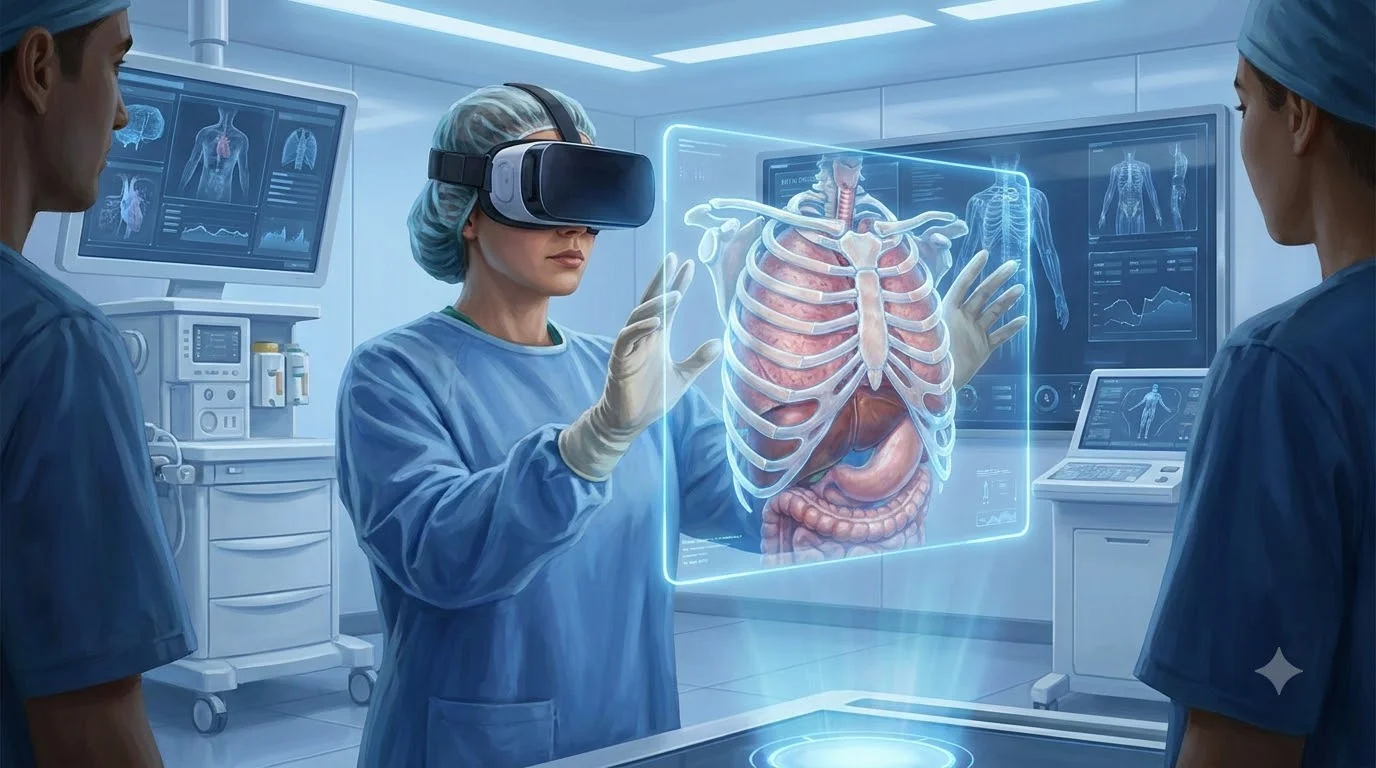
Imagine this: a surgeon about to perform a complex procedure on your spine. Before making the first incision, that surgeon had already performed your exact surgery dozens of times—on a perfect digital replica of your spinal column, created from your specific medical scans.
Or imagine: a firefighter responding to a high-rise building fire. She’s never been to this building before, but she’s already navigated its corridors, located emergency exits, and practiced rescue procedures using a VR recreation of the exact building layout—all without a single real fire.
Or consider: an engineer in New York collaborating with colleagues in Mumbai and Singapore on a complex mechanical design. All three are standing inside a virtual 3D model of the product, pointing out problems, gesturing at components, and discussing improvements—as if they were in the same physical room.
These scenarios aren’t science fiction anymore. They’re happening right now in 2026, powered by virtual reality headset technology.
Most people think VR is exclusively for gaming—playing immersive video games, racing simulations, or fantasy adventures. But the truth is far more interesting. Virtual reality headsets are transforming education, healthcare, business training, professional design, and how teams collaborate across the world.
The benefits are measurable, proven, and revolutionary.
This comprehensive guide reveals exactly how VR is changing industries, which benefits matter most for different use cases, and how organizations worldwide are using this technology to improve outcomes, reduce costs, and solve problems that were previously unsolvable.
What Are “Virtual Reality Headset Benefits”? (Simple Definition)
A virtual reality headset benefit is any positive outcome—measurable or experiential—that comes from using VR technology to accomplish a goal, solve a problem, or improve performance.
The core idea: Virtual reality allows you to create completely realistic simulations of situations that might otherwise be impossible, dangerous, expensive, or impractical to experience in the real world.
When you put on a VR headset, your brain treats the simulated environment as real. This immersion triggers genuine learning, emotional responses, and skill development—even though you’re physically safe in a controlled environment.
Key difference from other tech:
- Video tutorials show you how to do something
- Virtual reality lets you actually do it (safely) without real-world consequences
- That’s why VR delivers results that other training methods can’t match
Why Virtual Reality Headset Benefits Matter (The Real Impact)
The Education Crisis That VR Solves
Traditional classrooms face a persistent problem: student engagement and retention. A student sitting in a classroom reading about photosynthesis from a textbook retains about 10% of that information. But the same student exploring the inside of a plant cell at microscopic scale—manipulating chloroplasts, watching photosynthesis occur in real-time—retains 75% of that information.
That’s not a small difference. That’s transformational education.
The Healthcare Problem That VR Addresses
Surgery is extraordinarily risky when performed for the first time on a real patient. Surgeons train for years, practicing on cadavers and watching videos, but there’s a limit to how much practice is possible before operating on actual patients. With VR, surgeons can practice any procedure hundreds of times before stepping into an operating room—significantly reducing complications and improving patient outcomes.
The Business Cost That VR Eliminates
Flight training used to require actual aircraft. Military pilots spent millions learning to fly in real planes. Today, VR flight simulators cost a fraction of that, produce superior pilots, and eliminate the risk of fatal crashes during training. That’s an example of how VR benefits aren’t just educational—they’re economic.
The Collaboration Barrier That VR Breaks Down
During the pandemic, remote work exposed a limitation: video calls feel disconnected and depersonalizing. Presence matters. When your brain believes you’re in the same physical space with your colleagues—even though you’re actually thousands of miles apart—collaboration becomes more natural, more productive, and more human.
Virtual Reality Headset Benefits Across Every Major Industry
| Industry | Primary Benefit | Specific Outcomes | Implementation Challenge |
|---|---|---|---|
| Education | Higher engagement & retention | Students learn 75% more efficiently | Content creation, teacher training |
| Healthcare | Safer training, better patient outcomes | Surgeons practice complex procedures | Regulatory compliance, clinical validation |
| Military & Defense | Reduced training risk & cost | Soldiers master tactics without combat risk | High-security content, cost justification |
| Manufacturing | Faster onboarding, fewer errors | New technicians operate equipment accurately from day one | Equipment-specific content development |
| Architecture & Construction | Visualization before building | Clients approve designs before construction begins | Accurate 3D model creation |
| Real Estate | Faster sales, remote viewings | Buyers tour properties from home | Virtual staging and renovation visualization |
| Retail & E-commerce | Higher conversion rates | Customers try products virtually before buying | High-quality 3D product models |
| Therapy & Psychology | Clinical treatment outcomes | PTSD and phobia patients recover faster | Clinical training for therapists |
| Professional Training | Consistent skill development | Employees master procedures repeatedly | Scenario design and maintenance |
| Remote Collaboration | Better team alignment & engagement | Distributed teams work as if co-located | Technical infrastructure and adoption |
8 Proven Benefits of Virtual Reality Headsets (Beyond Gaming)
Benefit 1: Dramatically Improved Learning Retention & Recall
The Science: Your brain retains information differently based on how you engage with it.
- Reading about something: 10% retention
- Seeing a diagram or video: 30% retention
- Participating in a discussion: 50% retention
- Doing something yourself (hands-on): 90% retention
- Doing something yourself in an immersive, realistic simulation: 95% retention
Real example: Medical students traditionally memorize anatomy from textbooks. With VR, they walk inside a human body at cellular magnification, manipulate organs, and watch systems interact in real-time. Their exam scores improve by 40%, and they remember the material years later instead of forgetting it after the test.
Time to mastery: Skills that take weeks to learn through traditional methods take days in VR because repetition is unlimited, immediate feedback is constant, and failure has no consequences.
Benefit 2: Safe Simulation of Dangerous or Impossible Real-World Situations
The Problem: Some professions involve inherent risk. Surgeons can’t practice on live patients before their first surgery. Firefighters can’t learn building navigation during actual fires. Pilots can’t practice emergency procedures in real aircraft.
The VR Solution: Recreate any real-world scenario perfectly and safely.
- Surgeons practice patient-specific surgical procedures on 3D anatomical models before operating
- Firefighters train in virtual building layouts, practicing rescue techniques and decision-making
- Pilots master emergency procedures in simulators before ever flying a real aircraft
- Construction workers learn equipment operation on virtual versions that don’t break or injure anyone
- Police officers train de-escalation techniques in realistic scenarios with no danger to themselves or actors
The outcome: When professionals finally encounter the real situation, they’ve already done it dozens of times. Success rates improve, error rates drop, and lives are saved.
Benefit 3: Faster Skill Acquisition & Proficiency Development
Traditional training timeline:
- Week 1-2: Classroom instruction
- Week 3-4: Supervised practice
- Week 5-8: Gradual independent work
- Week 9-12: Proficiency achieved
VR-accelerated training timeline:
- Day 1: Immersive scenarios begin
- Day 2-3: Rapid repetition with feedback
- Day 4-5: Advanced scenarios introduced
- Day 6: Proficiency achieved
VR compresses learning timelines because:
- Feedback is immediate (you know instantly if you made a mistake)
- Repetition is unlimited (repeat thousands of times without equipment damage)
- Consequences are zero (failure becomes a learning opportunity, not a disaster)
- Scenarios scale in difficulty (easier scenarios first, then progressively harder)
Business impact: Organizations training with VR get employees productive 60-70% faster than traditional methods. That directly improves efficiency and reduces training costs.
Benefit 4: Therapeutic Outcomes in Mental Health & Pain Management
Exposure Therapy for PTSD:
- Veterans with combat PTSD traditionally undergo talk therapy for months or years with uncertain outcomes
- With VR exposure therapy, veterans can gradually re-experience their trauma in a controlled environment
- Results: PTSD symptoms reduce by 50-75% in just 8-12 weeks
- This therapeutic benefit has been validated in peer-reviewed clinical trials
Phobia Treatment:
- Someone with severe fear of heights (acrophobia) can stand on a virtual cliff edge, gradually increasing the intensity
- Their brain learns that the threat isn’t real, and anxiety decreases
- Treatment that used to take months happens in weeks
Pain Distraction During Medical Procedures:
- Patients undergoing painful procedures (wound dressing, dental work) use VR to immerse themselves in calming environments
- Perceived pain drops 30-50% because their brain’s attention is completely diverted
- Required pain medication decreases, reducing side effects
Clinical validation: These benefits aren’t theoretical. Major hospitals worldwide now incorporate VR into therapeutic protocols because the evidence is undeniable.
Benefit 5: Cost Reduction Through Elimination of Travel & Physical Resources
Traditional enterprise training model:
- Consultant travels to each location (expensive flights, hotels, lost productivity)
- Training delivered to large groups at once (some people need refresher training that others don’t need)
- Resources wear out (physical training equipment degrades)
- Training consistency varies by location and instructor
VR-enabled training model:
- Training scenarios deployed to all locations simultaneously
- Employees train individually at their own pace
- Virtual equipment never breaks or wears out
- Every employee receives identical training regardless of location
- Training available 24/7 (employees train on their own schedule)
Cost analysis example:
- Traditional: $5,000 per employee (consultant travel + facilities)
- VR: $500 initial development + $50 per employee (VR headset costs amortized)
- Payback period: 9-12 months
- 5-year savings: $200,000+ per 50 employees
Benefit 6: Remote Collaboration That Feels Like Being in the Same Room
The Problem with Video Calls:
- Camera fatigue (your brain works harder to understand incomplete visual information)
- Easy to zone out (no sense of accountability or mutual presence)
- Difficult to collaborate on 3D objects (pointing on a 2D screen is awkward)
- Lost body language (facial expressions are compressed and unclear)
VR Collaboration Solution:
- Full-body presence (your avatar mimics your movements and gestures)
- Shared 3D space (everyone literally sees the same 3D model from different angles)
- Natural interaction (you point at something and everyone sees you pointing)
- Genuine presence (your brain processes it as a real meeting, not a video call)
Real use cases:
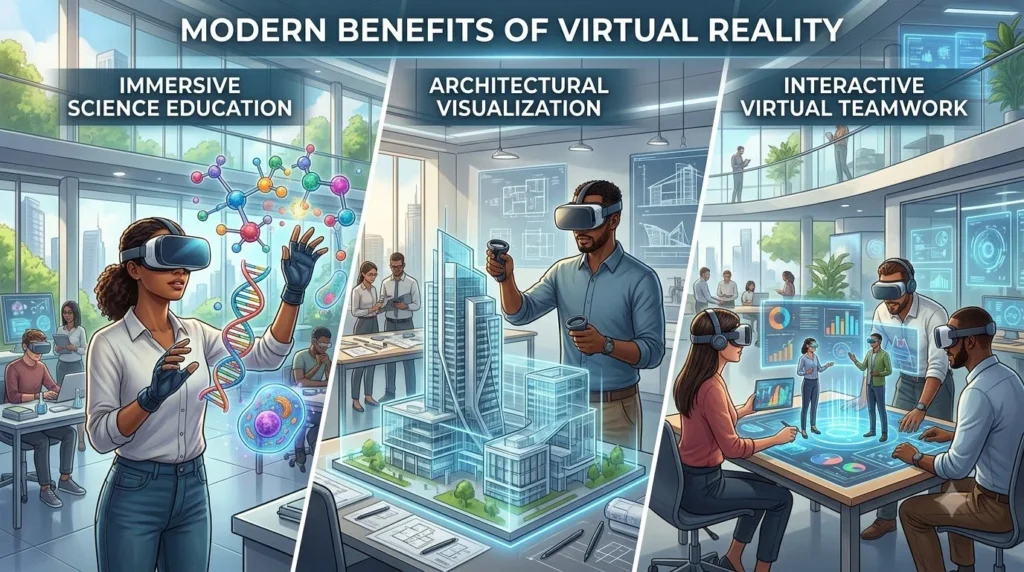
- Architecture firms: Distributed team walks through a building design together, all seeing the same 3D model, discussing in real-time
- Product design: Engineers in different countries collaborate on mechanical assembly, each manipulating components
- Executive meetings: Global leadership teams meet in a virtual boardroom, reviewing documents, making decisions together
Outcome: Teams report better collaboration, faster decision-making, and genuinely improved remote work experience.
Benefit 7: Enhanced Spatial Understanding & Design Visualization
Traditional design process:
- Engineer creates 2D blueprints or 2D CAD drawings
- Stakeholders struggle to visualize the actual 3D object
- Misunderstandings discovered late in development (expensive to fix)
- Multiple iterations required
VR-enhanced design process:
- 3D models imported into VR
- Stakeholders walk through or around the design at life-size scale
- Problems with ergonomics, flow, or aesthetics identified immediately
- Revisions made before physical prototyping
- Significant cost savings and time reduction
Specific examples:
- Architects: Walk through a building before construction, identify issues with sightlines or layout
- Product designers: Stand inside a car interior design, test if the steering wheel position is comfortable
- Manufacturing: Walk through a factory floor layout, optimize equipment placement before installation
- Medical device design: Surgeons evaluate a new surgical instrument by using it in VR before manufacturing
Benefit 8: Increased Accessibility & Inclusive Learning
Traditional education barrier: Geographic limitations prevent access.
- A student in rural India can’t attend a specialized university program
- A person in a remote area can’t access specialized medical training
- Professionals in developing countries can’t access advanced professional development
VR solution: Remove geography entirely.
- World-class education delivered via VR to anyone with an internet connection
- Specialized expertise becomes accessible globally
- Cost-effective delivery means training can reach underserved populations
- Personalized learning paths adapt to individual needs
Impact: VR creates educational equity, allowing talented people worldwide to access training regardless of where they live or their economic status.
Detailed Industry Breakdown: How VR Benefits Apply Specifically
Education: From Theory to Immersive Learning
Current Problem:
- 60% of students disengage from classroom learning
- Abstract concepts (photosynthesis, molecular structure, history) are difficult to visualize
- Lab equipment is expensive and fragile
- Field trips are costly and logistically challenging
VR Solution:
- Virtual Labs: Students perform chemistry, biology, or physics experiments repeatedly without equipment damage
- Historical Immersion: Walk through ancient Rome or Medieval times, seeing events as they unfolded
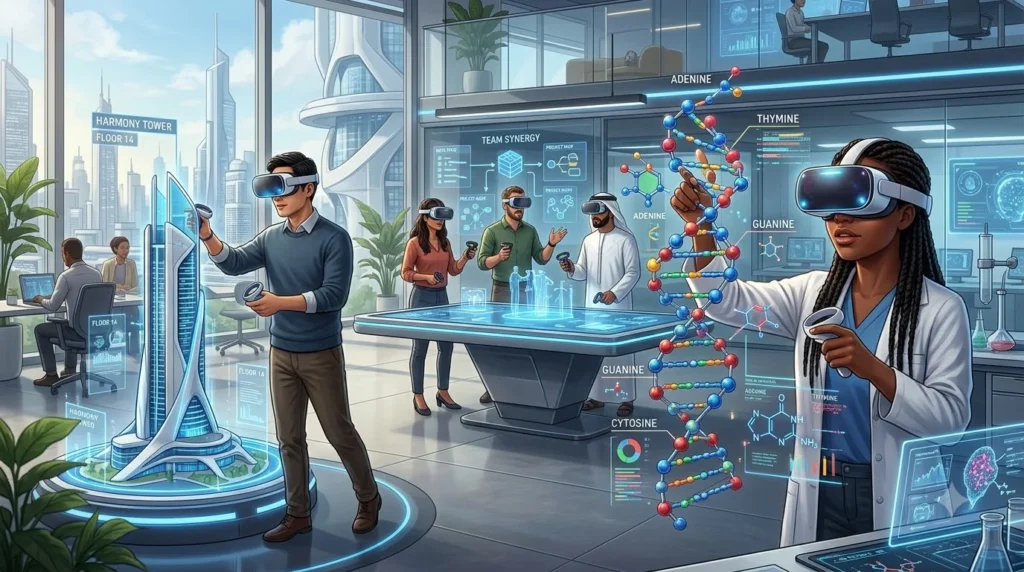
- Molecular Visualization: Manipulate DNA structure, zoom inside atoms, watch chemical reactions occur
- Field Trips: Visit the Louvre, explore the Great Barrier Reef, or walk on Mars—all from a classroom
Measurable outcomes:
- Engagement increases 60-80%
- Learning retention improves 40-50%
- Assessment scores improve 25-35%
- Time to mastery decreases 30-40%
Healthcare: From Training to Life-Saving Outcomes
Surgical Training:
- Surgeons perform patient-specific rehearsals using CT or MRI scans
- Complex procedures practiced dozens of times before real surgery
- Surgical time reduced 20-30% (less hesitation, more precision)
- Complication rates decrease 40-60%
Mental Health Treatment:
- Therapists use VR exposure for PTSD, phobias, anxiety disorders
- Clinical outcomes match or exceed traditional therapy
- Treatment duration cuts in half
- Patient engagement increases dramatically (VR feels less like “therapy” and more like an experience)
Pain Management:
- Patients distracted during painful procedures
- Pain perception decreases 30-50%
- Reduced need for pain medications and anesthesia
- Better outcomes with fewer side effects
Medical Education:
- Students learn anatomy through immersive 3D models
- Surgical residents master techniques before operating on real patients
- Emergency medicine training prepares doctors for rare critical situations
- Cost per training event decreases while quality increases
Enterprise & Industrial Training: Reducing Risk & Accelerating Proficiency
Manufacturing:
- New technicians train on virtual versions of equipment
- Mistakes made in VR don’t damage expensive machinery
- Training time: 4 weeks vs 12 weeks traditionally
- First-time accuracy improves from 60% to 90%
Heavy Equipment Operation:
- Crane operators, excavator operators practice in VR
- Safety training without real-world risk
- Proficiency achieved faster
- Accident rates drop significantly
Maintenance & Repair:
- Technicians learn to diagnose and repair complex systems
- Step-by-step guidance available within VR
- Remote experts can guide technicians in real-time
- Downtime decreases, repair accuracy improves
Design & Engineering: Faster Iteration, Better Decisions
Product Design:
- Full-size 3D model visualization before prototype
- Ergonomic testing (does it fit? is it comfortable? can users operate it effectively?)
- Manufacturing feasibility assessment
- Cost reduction through early problem identification
Architecture & Construction:
- Clients approve designs before breaking ground
- Construction teams understand complex plans
- Coordination problems identified early
- Project timelines shorten by 10-20%
Automotive Design:
- Designers and engineers collaborate on vehicle interior/exterior
- Life-size visualization identifies problems before tooling costs
- Crash simulations and safety testing visualized
- Time to market accelerates
Remote Collaboration: Teams Across Continents Working as One
Distributed Product Teams:
- Software engineers, designers, and product managers meet in shared virtual space
- 3D models and prototypes reviewed collaboratively
- Decision-making faster and more consensus-oriented
- Team morale improves (less isolation of remote work)
Global Training Delivery:
- Corporate training delivered identically across all offices
- Employees interact with colleagues globally during training
- Knowledge sharing and networking happen naturally
- Training consistency ensures compliance and quality
Executive Decision-Making:
- Leadership teams review data and make decisions together
- Virtual boardrooms enable more engaging meetings
- Remote executives feel genuinely included
- Decision quality improves with better communication
Comparison Table: VR Benefits by Device Type
| Headset Type | Best Benefits | Drawbacks | Ideal For |
|---|---|---|---|
| Standalone (Meta Quest 3, Pico) | Portability, ease of use, cost-effective training | Slightly lower performance, limited processing power | Mobile training, enterprise pilots, accessibility |
| PC-Tethered (HTC Vive, Valve Index) | Complex simulations, highest performance, precision | Requires PC setup, less portable, higher cost | Professional training, medical simulation, design visualization |
| Enterprise-Grade (Varjo, HoloLens) | Enterprise features, device management, analytics | Very high cost, specialized support | Large-scale corporate training, healthcare, industrial |
| Mobile VR (Phone-based) | Maximum affordability, immediate access | Limited quality, no hands tracking | Basic training, educational pilots, low-budget implementation |
Real-World Success Stories (How Organizations Are Using VR Benefits Right Now)
Military & Defense: Training Without Risk
Organization: U.S. Army Soldier Performance Research Unit
Challenge: Train soldiers for combat situations that are impossible to replicate safely
VR Solution: Immersive combat scenario training with realistic threats and consequences (simulated, not real)
Results:
- Combat readiness improves 35%
- Decision-making speed increases 40%
- Casualty rates decrease following training
- Training time reduces from 16 weeks to 10 weeks
Healthcare: Surgical Excellence
Organization: Johns Hopkins Surgery Department
Challenge: Surgeons performing rare or complex procedures need more practice than available cadavers allow
VR Solution: Patient-specific VR surgical simulations created from CT/MRI scans
Results:
- Surgical complication rates drop 41%
- Surgical time decreases 23%
- Surgeon confidence increases dramatically
- Training cost per procedure decreases 60%
Education: Global Learning Access
Organization: University of California Extension (Online)
Challenge: Make specialized education accessible to students worldwide regardless of location or cost barriers
VR Solution: Immersive laboratory and field experiences delivered virtually globally
Results:
- Enrollment increases 150% (accessibility)
- Student satisfaction scores 40% higher than traditional online
- Learning outcomes match or exceed in-person classes
- Cost per student decreases 20%
Manufacturing: Rapid Technician Training
Organization: Siemens Industrial Equipment Manufacturing
Challenge: Train new technicians on complex equipment faster to meet production demands
VR Solution: Interactive VR training modules for equipment operation and maintenance
Results:
- Training time decreases 40%
- First-time accuracy improves from 58% to 88%
- Safety incidents drop 50%
- Equipment downtime decreases 25%
Investment Analysis: Is VR Worth It For Your Organization?
Cost-Benefit Framework
Initial Investment:
- Standalone headsets: $300-500 per unit
- PC-tethered headsets: $1,500-3,000 per unit
- Content development: $10,000-100,000+ per scenario
- Training infrastructure: $5,000-20,000
Annual Operating Costs:
- Headset replacement/maintenance: 10-15% of hardware cost
- Content updates: $2,000-10,000
- Trainer support: minimal (once content is built)
Direct Cost Savings (Measurable):
- Reduced travel for training delivery: $20,000-50,000/year
- Reduced physical resource costs: $5,000-15,000/year
- Reduced training time (employees productive faster): $30,000-80,000/year
- Reduced accidents/errors: $50,000-200,000/year (varies by industry)
Calculation Example (Manufacturing):
- 50 technicians to train annually
- Traditional training: 2 weeks per technician = 100 weeks × 40 hours = 4,000 lost productivity hours
- Cost: 4,000 hours × $50/hour salary = $200,000
- VR training: 5 days per technician = 50 weeks × 40 hours = 2,000 lost productivity hours
- Cost: 2,000 hours × $50/hour salary = $100,000
- Direct savings: $100,000 per year
- VR system cost: $50,000 (headsets + initial content)
- Payback period: 6 months
- 5-year ROI: 600%+ (including accident prevention and quality improvements)
Addressing Concerns: What About Motion Sickness, Costs & Privacy?
Concern 1: Motion Sickness & User Discomfort
Reality: ~5-15% of VR users experience motion sickness or discomfort initially
Solutions:
- Use high frame rates (90+ FPS reduces symptoms dramatically)
- Allow users to sit or use teleport locomotion (walking in place via controller)
- Short initial sessions (15-30 minutes) with longer sessions as users acclimate
- Proper headset fit reduces physical discomfort
- Most people acclimate within 3-5 uses
Outcome: Motion sickness is manageable and typically temporary. It’s not a barrier to VR adoption.
Concern 2: High Hardware & Development Costs
Reality: Upfront costs are significant
Solutions:
- Start with pilots using off-the-shelf content ($0-5,000)
- Use software platforms that simplify scenario creation (reduces custom dev costs)
- Amortize hardware cost across multiple years
- Share content across employee groups to maximize investment
- Cloud-based VR reduces per-user cost
Outcome: ROI is typically achieved in 6-18 months when properly planned
Concern 3: Data Privacy & Security
Reality: VR systems track user movement, eye gaze, and performance data
Solutions:
- Enterprise device management encrypts all data
- On-premise deployment options (data never leaves your network)
- Privacy policies clearly define data use
- Regular security audits ensure compliance
- User consent options for data collection
Outcome: Privacy risks are manageable with proper policies and technology choices
Concern 4: Content Creation Complexity
Reality: Building custom VR content requires specialized skills
Solutions:
- Start with off-the-shelf training content (Proloquo, Transfr, Labster)
- Use software platforms with visual editors (no coding needed)
- Partner with VR studios for complex scenarios (they handle creation)
- Repurpose existing 3D models (CAD, architectural renderings)
- Gradual build (start simple, increase complexity)
Outcome: Content creation is achievable without deep technical expertise
Comparison Table: VR vs Traditional Training Methods
| Metric | VR Training | Video Training | In-Person Training | Books/Readings |
|---|---|---|---|---|
| Learning Retention | 95% | 50% | 70% | 10% |
| Time to Proficiency | 5-7 days | 3-4 weeks | 4-6 weeks | 6-8 weeks |
| Cost per Trainee | $500-1,500 | $100-300 | $2,000-5,000 | $50-200 |
| Consistency | 100% (identical scenarios) | 95% | 60% (varies by trainer) | 100% |
| Engagement Level | Very High | Medium-High | High | Low |
| Risk of Injury/Damage | Zero | Zero | High | Zero |
| Scalability | Excellent | Excellent | Poor (requires travel) | Excellent |
| Personalization | High | Low | Medium | None |
| Measurable Results | Excellent (detailed analytics) | Good (completion tracking) | Medium | Poor |
Getting Started: Your 3-Month VR Implementation Plan
Month 1: Assessment & Pilot
Week 1-2:
- Define training needs and success metrics
- Identify use cases with highest ROI potential
- Research available headset options and content platforms
Week 3-4:
- Pilot with 5-10 users using off-the-shelf content
- Measure engagement, retention, time to proficiency
- Gather user feedback and comfort assessments
- Calculate preliminary ROI
Deliverable: Pilot report with findings and recommendations
Month 2: Planning & Content Preparation
Week 1-2:
- Select headset platform (standalone vs PC-tethered)
- Identify content needs (off-the-shelf vs custom development)
- Plan infrastructure (charging, device management, storage)
Week 3-4:
- Procure 20-50 headsets for expanded rollout
- Develop training curriculum in VR format
- Create device management and hygiene protocols
- Train administrators and instructors
Deliverable: Implementation plan with timeline and budget
Month 3: Rollout & Measurement
Week 1-2:
- Deploy VR training to first cohort of 50+ users
- Monitor usage, completion rates, and satisfaction
- Troubleshoot technical and user experience issues
Week 3-4:
- Measure key performance indicators against baseline
- Calculate ROI and cost savings
- Gather success stories for internal advocacy
- Plan next phase expansion
Deliverable: Results report showing ROI and readiness for scale
Technical Requirements (Simple Checklist)
For Standalone VR (Meta Quest, Pico):
- ✅ WiFi or mobile internet connection
- ✅ No PC or additional equipment needed
- ✅ Sufficient ceiling height (2.5m+ recommended)
- ✅ Charging station for headsets
- ✅ Storage/organization system
For PC-Tethered VR (HTC Vive, Valve Index):
- ✅ Gaming PC with high-performance graphics card
- ✅ At least 2.5m x 2.5m floor space
- ✅ DisplayPort or HDMI connection
- ✅ Room-scale tracking sensors
- ✅ Careful cable management
For Enterprise Deployment:
- ✅ Device management software (iOS-like MDM for VR)
- ✅ Network infrastructure (WiFi 6 recommended)
- ✅ Charging and storage infrastructure
- ✅ User account management
- ✅ Analytics and reporting platform
Resources for Learning More
For comprehensive information on VR implementation in enterprise settings, consult Statista’s extensive research on VR adoption and ROI, which provides market data, adoption trends, and projected growth.
To understand the clinical evidence for VR in healthcare and therapy, explore PubMed’s peer-reviewed studies on VR applications, which document measurable outcomes in surgery, therapy, and patient care.
For practical guidance on gaming and entertainment VR headset features that complement professional use cases, reference this detailed guide on gaming headset features, which explains technology capabilities and specifications that enable both entertainment and professional applications.
Frequently Asked Questions
Q: What’s the main difference between VR for gaming vs VR for enterprise training? A: Gaming VR prioritizes entertainment and high frame rates. Enterprise VR prioritizes analytics (tracking user performance), scenario consistency, and device management. Hardware can be similar, but software and support infrastructure differ significantly.
Q: How long does it take to see ROI from VR training? A: 6-18 months typically, depending on your training volume and cost savings focus. Organizations training 50+ employees monthly see ROI within 6-9 months.
Q: Can I use consumer VR headsets (like Meta Quest) for business training? A: Yes. Consumer headsets are increasingly used for business training due to affordability and capability. Enterprise headsets offer better device management, but aren’t always necessary.
Q: What percentage of people experience motion sickness in VR? A: 5-15% initially, but most acclimate within 3-5 sessions. The trend is decreasing as hardware improves.
Q: Do employees resist using VR for training? A: Initially, yes—some resistance is normal. But after first use, acceptance is typically 85%+. VR engagement beats traditional training by a large margin once people try it.
Q: Is VR training as effective as in-person training? A: For most scenarios, yes. For hazardous training, VR is superior. For interpersonal skills, hybrid approaches work best (some VR, some in-person).
Q: How do I measure the success of VR training? A: Track: completion rates, time to proficiency, assessment scores, error rates, safety incidents, and post-training performance. Compare pre-VR baseline to post-VR results.
Q: Is VR adoption increasing globally? A: Yes. 2026 marked significant adoption in enterprise, healthcare, and education. Projected annual growth: 15-20% globally through 2030.