

Five years ago, only tech-savvy millennials used payment apps and digital wallets. Today, your grandmother pays her bills through her smartphone, and your local bank uses AI to approve loans in seconds.
Fintech didn’t replace banking—it transformed it.
Financial technology trends refer to the emerging technologies and business models reshaping how money moves, how credit decisions happen, and how people invest. In 2026, these trends have stopped being “future predictions” and become present reality.
The implications are massive. Banks are closing branches while hiring software engineers. Traditional payment networks compete with blockchain-based alternatives. Regulators struggle to keep up with innovation. Companies that understand these trends thrive; those that ignore them become irrelevant.
This guide explains the 7 most important financial technology trends shaping 2026, why they matter to your business, and how to prepare for the changes coming to finance and banking worldwide.
What Are Financial Technology Trends? (Simple Definition)
Financial technology trends are the major technological shifts, business models, and innovations that are changing how financial services work.
Think of fintech trends as the answer to questions like:
- How will people pay for things in 2026?
- What will banks look like when AI handles most decisions?
- How will cryptocurrency and blockchain affect regular banking?
- Who will control your financial data?
- How will regulations catch up with innovation?
Financial technology trends aren’t just interesting—they directly impact your money, your business, and your financial future.
Why Financial Technology Trends Matter (Real-World Impact)
Scenario 1: The Business Impact
Your company processes payments. In 2020, it took 3-5 days for money to settle. Today, with real-time payment networks, settlement happens in seconds. That’s the difference between having working capital available immediately versus waiting days.
That’s a financial technology trend that changed how business operates.
Scenario 2: The Consumer Impact
You want a small business loan. In 2020, you waited weeks for a bank to decide. In 2026, an AI system analyzes your business data and approves it in minutes. That’s automation powered by fintech trends.
Scenario 3: The Regulatory Impact
Your bank is flooded with money laundering compliance requirements. In 2026, RegTech (regulatory technology) automates most compliance work, saving millions in manual review. That’s how trends reshape entire departments.
Scenario 4: The Investment Impact
You want to own a fraction of a $50 million building instead of needing $1 million to buy a whole property. Tokenization (a fintech trend) makes this possible, opening investment opportunities previously restricted to the wealthy.
The 7 Major Financial Technology Trends Transforming 2026
Trend 1: Artificial Intelligence & Machine Learning in Finance

What It Is
AI and machine learning are automating financial decisions—credit scoring, fraud detection, trading, and personalized financial advice—at scale never before possible.
Why It Matters
- Speed: AI approves loans in minutes instead of weeks
- Cost: Fewer human analysts needed for routine decisions
- Accuracy: Machine learning detects fraud patterns humans miss
- Personalization: Each customer gets customized financial products and advice
Real-World Examples
- Credit Scoring: AI analyzes 100+ data points (payment history, spending patterns, social data) instead of just credit score
- Trading: Algorithmic AI executes millions of trades per second
- Fraud Detection: AI flags suspicious transactions in real-time (fraud prevented before it happens)
- Virtual Advisors: ChatGPT-style AI answers customer questions 24/7
Advantages
✓ Dramatically faster decision-making ✓ More accurate risk assessment ✓ 24/7 availability (no business hours) ✓ Reduced operational costs ✓ Better customer experience
Disadvantages
✗ AI bias (if training data is biased, decisions are biased) ✗ “Black box” problem (why did AI make this decision?) ✗ Job displacement for routine financial jobs ✗ Regulatory scrutiny increasing
Business Impact
Banks using AI report 40-60% faster processing times and 20-30% cost reductions. Companies adopting AI gain competitive advantage; those that don’t fall behind.
Trend 2: Real-Time Payments & Instant Settlement

What It Is
Money moving between accounts instantly instead of days. What used to take 3-5 business days now happens in seconds.
Why It Matters
- Cash Flow: Businesses get paid immediately (huge for small businesses)
- Customer Experience: Payments feel instant (like digital interaction should)
- Risk Reduction: Faster settlement = less counterparty risk
- Global Payments: Cross-border money moving in real-time
Real-World Examples
- Faster Payments System (FPS): Enables instant transfers between UK banks
- RTP Network (Real-Time Payments): Instant payments in the US
- SWIFT gpi: Fast global cross-border payments (now hours instead of days)
- Mobile Payments: Apple Pay, Google Pay settle instantly
Advantages
✓ Immediate cash availability ✓ Better cash flow for businesses ✓ Improved customer satisfaction ✓ Lower settlement risk ✓ Enables new business models
Disadvantages
✗ Fraud detection must happen in milliseconds (difficult) ✗ Infrastructure costs very high ✗ Banks must operate 24/7/365 (no downtime allowed) ✗ Interoperability challenges between systems
Business Impact
Companies using real-time payments improve cash flow by 20-40%, reduce borrowing costs, and improve vendor relationships through immediate payment.
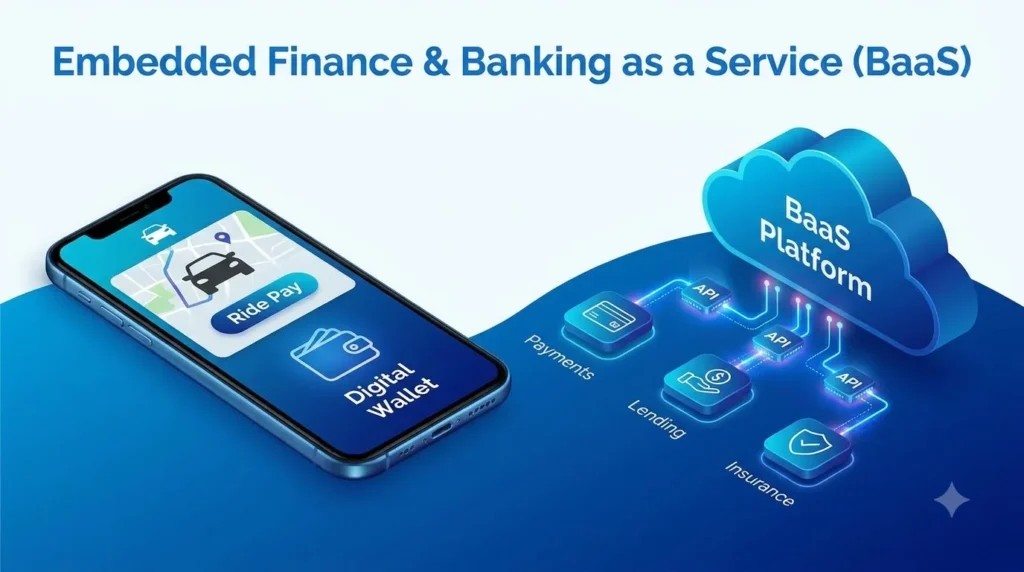
Trend 3: Embedded Finance & Banking as a Service (BaaS)
What It Is
Financial services embedded directly into non-financial platforms. Your e-commerce site becomes a bank. Your payroll system becomes a lending platform.
Why It Matters
- Seamless Experience: Customers don’t leave your app to access finance
- New Revenue: Non-banks monetize financial services
- Better Conversion: Frictionless checkout increases sales 20-40%
- Customer Retention: Customers stay in your ecosystem
Real-World Examples
- Buy Now, Pay Later (BNPL): Affirm/Klarna embedded in shopping apps
- Payroll-Linked Lending: Employees get loans from their payroll software
- Marketplace Finance: Uber/DoorDash offer insurance, lending, savings to drivers
- E-commerce Finance: Shopify embedded payments and lending
Advantages
✓ Seamless user experience ✓ Higher conversion rates (20-40% increase typical) ✓ New revenue streams ✓ Increased customer lifetime value ✓ Competitive differentiation
Disadvantages
✗ Complex regulatory compliance ✗ Dependency on BaaS provider ✗ Risk management complexity ✗ Customer support burden for financial products
Business Impact
Companies implementing embedded finance report 25-50% higher conversion rates and 15-30% increased customer lifetime value through additional financial products.
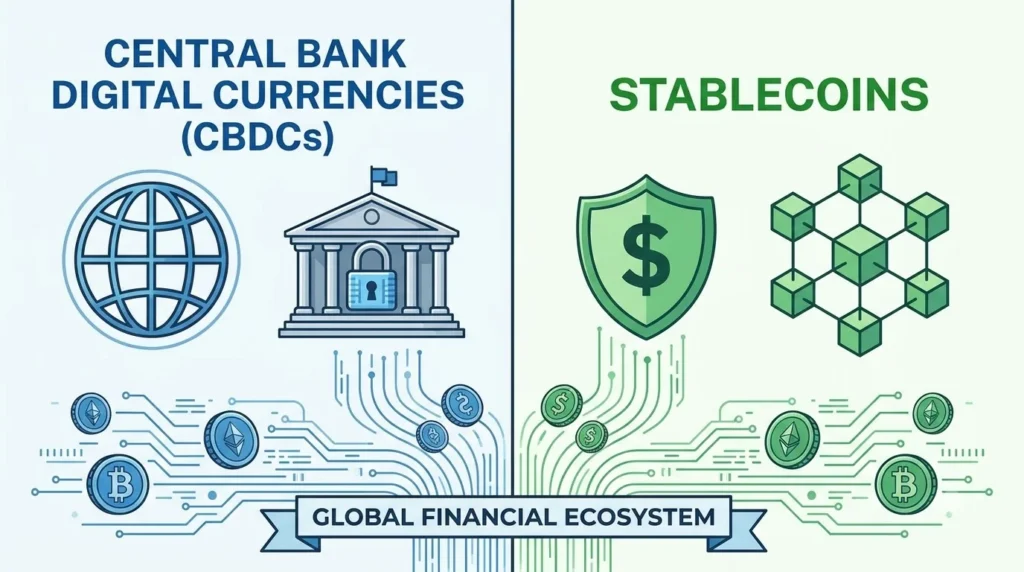
Trend 4: Central Bank Digital Currencies (CBDCs) & Stablecoins
What It Is
Digital versions of government currency (CBDCs) issued by central banks, plus privately-issued stablecoins pegged to government currency.
Why It Matters
- Modernization: Digital-native payments infrastructure
- Financial Inclusion: Unbanked populations access financial services via phone
- Programmable Money: Payments can include conditions (money only spendable on specific items)
- Reduced Cash Handling: Less need for physical cash (cost savings)
Real-World Examples
- Digital Yuan: China’s CBDC already in pilot across multiple cities
- Digital Euro: EU developing digital euro for 2026+ launch
- USDC: Stablecoin pegged to US dollar (widely adopted)
- Programmable Payments: Government benefits transferred directly to residents
Advantages
✓ Faster cross-border payments ✓ Better financial inclusion ✓ Programmable money (automatic features) ✓ Reduced counterfeiting ✓ Direct monetary policy transmission
Disadvantages
✗ Privacy concerns (government tracking all payments) ✗ Commercial bank disintermediation (less reason to use banks) ✗ Cybersecurity risks (single point of failure) ✗ Regulatory uncertainty
Business Impact
CBDCs will reshape payment infrastructure by 2027-2028. Businesses need to prepare for integration with digital currencies and understand implications for cash handling, settlement, and international payments.
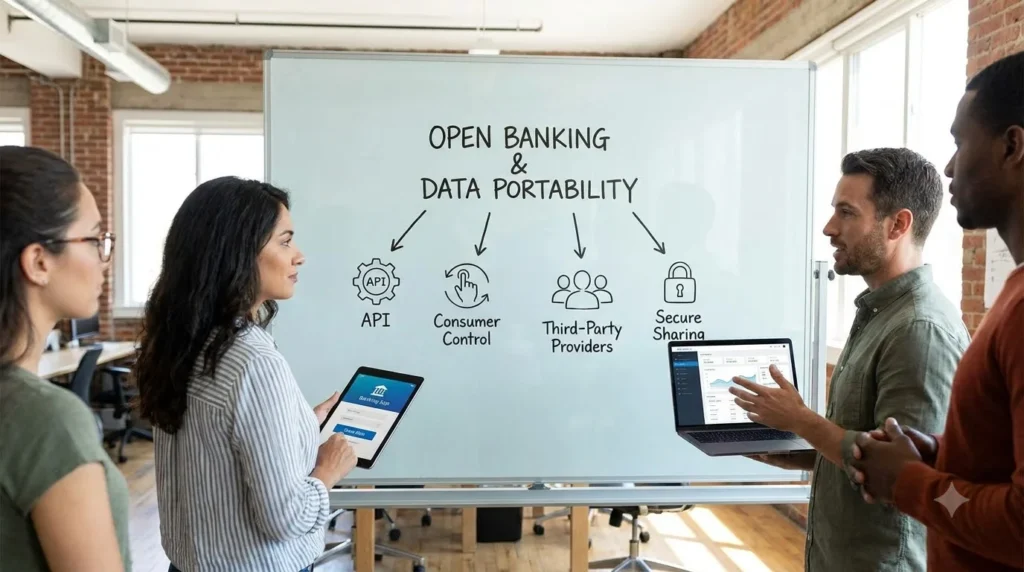
Trend 5: Open Banking & Data Portability
What It Is
Banks expose secure APIs (application programming interfaces) so customers can authorize third parties to access their financial data securely. Your bank’s data becomes an asset you control.
Why It Matters
- Consumer Choice: Better financial products for customers
- Innovation: New services built on banking data
- Transparency: You see your complete financial picture across institutions
- Competition: Banks compete on service, not data ownership
Real-World Examples
- European PSD2: Open banking mandate where customers control bank data access
- Plaid: Aggregator connecting to 11,000+ financial institutions
- Personalized Recommendations: AI analyzing all your accounts to recommend savings opportunities
- Consolidated Reporting: Single dashboard showing all accounts, investments, debt
Advantages
✓ More consumer choice and better products ✓ Increased innovation ✓ Better financial insights (all data in one place) ✓ Improved financial management ✓ Competitive pricing
Disadvantages
✗ Data security risks if APIs poorly secured ✗ Inconsistent standards across regions ✗ Privacy concerns (data shared with third parties) ✗ Fragmented customer experience
Business Impact
Open banking creates opportunity for fintech companies to build better products. Banks must adapt to data portability or lose customers to competitors offering better integration.
Trend 6: RegTech & Compliance Automation

What It Is
Technology automating regulatory compliance—Know Your Customer (KYC), Anti-Money Laundering (AML), transaction reporting, audit trails.
Why It Matters
- Cost Reduction: Compliance costs 20-40% lower with automation
- Speed: Customer onboarding takes minutes instead of hours
- Accuracy: Automated systems catch suspicious activity better than humans
- Scalability: Can comply with regulations at massive scale
Real-World Examples
- Automated KYC: AI verifies identity documents in seconds
- Transaction Monitoring: AI flags suspicious patterns in real-time
- Regulatory Reporting: Automated submission of compliance reports
- Sanctions Screening: AI checks customers against government sanctions lists
Advantages
✓ Dramatically lower compliance costs ✓ Faster customer onboarding ✓ More accurate risk detection ✓ Audit trails automatically maintained ✓ Consistent compliance across regions
Disadvantages
✗ Initial implementation cost is high ✗ False positives (flagging legitimate activity as suspicious) ✗ Integration with legacy systems difficult ✗ Regulatory guidance still evolving
Business Impact
RegTech adoption enables financial institutions to scale without proportionally increasing compliance staff. Cost per customer onboarded drops 50-70% with automation.
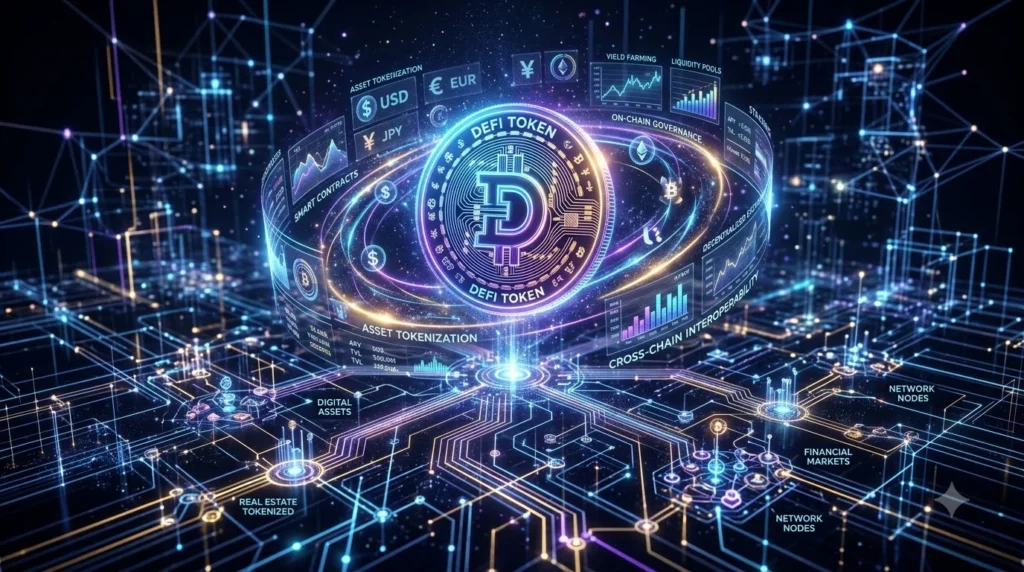
Trend 7: DeFi Integration & Tokenization
What It Is
Using blockchain technology to tokenize assets (convert ownership into digital tokens) and integrate decentralized finance protocols into traditional financial systems.
Why It Matters
- Liquidity: Assets previously illiquid (real estate, fine art) become tradeable
- Fractionalization: $1 million building can be divided into 1,000 shares
- 24/7 Markets: Blockchain operates 24/7 (unlike traditional stock markets)
- Programmable Assets: Smart contracts automate complex financial logic
Real-World Examples
- Tokenized Real Estate: Properties fractionalized and traded on blockchain
- Security Tokens: Stocks and bonds issued on blockchain
- DeFi Protocols: Lending/borrowing without traditional banks
- Asset Bridges: Crypto and traditional finance connected
Advantages
✓ Increased liquidity for assets ✓ Lower barriers to investment ✓ Fractional ownership opportunities ✓ Transparent transactions (blockchain record) ✓ 24/7 tradeable markets
Disadvantages
✗ Regulatory uncertainty (unclear if tokenized securities are legal) ✗ Custody and settlement challenges ✗ Smart contract risks (bugs can drain funds) ✗ Market manipulation easier with less regulation ✗ Consumer protection gaps
Business Impact
Tokenization creates new asset classes and liquidity opportunities. However, regulatory clarity remains unclear—businesses need to monitor regulatory developments closely.
Detailed Comparison Table: 7 Fintech Trends Analysis
| Trend | Current Maturity | Speed of Adoption | Business Opportunity | Regulatory Risk | Infrastructure Need | Best For |
|---|---|---|---|---|---|---|
| AI/ML Finance | High | Very Fast | Very High | Medium | High (but mostly ready) | Fast decisions, fraud detection |
| Real-Time Payments | High | Fast | High | Low (established) | Very High (expensive) | B2B payments, cash flow |
| Embedded Finance | Medium-High | Very Fast | Very High | High (evolving) | Medium | E-commerce, fintech apps |
| CBDCs/Stablecoins | Emerging | Medium | Medium | Very High (uncertain) | Very High | Government, international |
| Open Banking | Medium | Medium | High | High (region-dependent) | Medium | Data-driven services, aggregation |
| RegTech | Medium-High | Fast | High | Low (compliance-focused) | Medium | Large institutions, scaled ops |
| DeFi/Tokenization | Emerging | Fast | Very High | Very High (uncertain) | High | Alternative assets, liquidity |
Who Benefits Most From These Trends?
Consumers
- ✓ Faster payments (seconds instead of days)
- ✓ Better financial products (personalized, cheaper)
- ✓ More access (unbanked populations included)
- ✓ Better visibility (all financial data in one place)
Traditional Banks
- ✓ Automation reduces costs
- ✓ AI improves decision-making
- ✗ Losing retail customers to fintech
- ✗ Must invest heavily in infrastructure
- ✗ Regulatory burden increases
Fintech Startups
- ✓ Massive opportunity to capture market share
- ✓ BaaS enables scaling without building full infrastructure
- ✓ Open banking creates new business models
- ✗ Increasing regulatory requirements
- ✗ Competition from big tech companies
- ✗ Compliance costs add up fast
Big Tech Companies
- ✓ Huge customer base to cross-sell finance to
- ✓ Data capabilities help with AI/personalization
- ✓ Capital to invest in infrastructure
- ✗ Regulatory scrutiny increasing
- ✗ May face restrictions on certain activities
Regulators
- ✓ Better compliance tools (RegTech)
- ✓ Better fraud detection (AI)
- ✗ Innovation outpacing ability to regulate
- ✗ Cross-border coordination challenges
- ✗ Cybersecurity risks increase
Financial Technology Trends & Marketing
One crucial fintech trend often overlooked: how financial services companies market themselves. As financial technology becomes more competitive, traditional marketing approaches don’t work. Companies need innovative strategies to reach and convert customers.
For insight into modern marketing strategies that fintech companies use to grow virally and compete for customers, explore this comprehensive guide on viral marketing strategies, which covers how fintech startups build rapid growth through content, community, and strategic partnerships.
How Businesses Should Prepare for These Trends
Step 1: Assess Your Current Position (Week 1)
- Which trends affect your business directly?
- Are you leading (ahead of curve) or lagging?
- What infrastructure gaps exist?
- What regulatory risks exist?
Step 2: Develop a Strategy (Week 2-3)
- Prioritize which trends to address first
- Identify partnership opportunities (with fintechs, BaaS providers)
- Budget for technology upgrades
- Plan for regulatory compliance
Step 3: Build API-First Architecture (Month 1-3)
- Move toward modern, modular systems
- Enable data portability and integration
- Build security-first approach
- Prepare for embedded finance integration
Step 4: Invest in AI & Automation (Month 2-6)
- Implement AI for decision-making (credit, fraud, customer service)
- Automate compliance processes (RegTech)
- Use AI for personalization
- Monitor for bias in AI systems
Step 5: Strengthen Security & Compliance (Month 1 ongoing)
- Implement zero-trust architecture
- Encrypt all sensitive data
- Develop incident response plans
- Engage with regulators early
Step 6: Monitor & Adapt (Ongoing)
- Track regulatory developments
- Monitor competitor adoption of trends
- Assess impact on your business model
- Adjust strategy quarterly based on market changes
Comparison Table: Financial Technology Winners vs Losers in 2026
| Position | Companies | Characteristics | Advantage | Risk |
|---|---|---|---|---|
| Winners | Fintech startups, big tech | Fast, API-first, AI-driven, agile | Rapid iteration, customer focus | Regulatory backlash |
| Winners | Banks investing in tech | Balanced, traditional + digital | Regulatory trust + innovation | Slower execution |
| Losers | Traditional-only banks | Slow, branch-focused, no AI | Stability (short-term) | Obsolescence |
| Losers | Cash-dependent businesses | Offline, non-digital | Simple operations | Market disruption |
Security & Risk Considerations
Key Security Threats in Fintech Trends
AI/ML Risks:
- Model poisoning (corrupt training data = wrong decisions)
- Explainability (can’t explain AI decisions to regulators)
- Bias perpetuation (AI repeats human biases at scale)
Real-Time Payments Risks:
- Fraud detection challenges (milliseconds to decide)
- Irreversible transactions (can’t reverse after seconds)
- System downtime (no grace period for maintenance)
Open Banking Risks:
- Data breaches (consolidated financial data attractive to hackers)
- Unauthorized access (if API security poor)
- Account takeover (if authentication weak)
CBDC/Stablecoin Risks:
- Central point of failure (if CBDC system goes down, payments stop)
- Government surveillance (all transactions tracked)
- Bank disintermediation (customers pull deposits for CBDCs)
DeFi Risks:
- Smart contract bugs (code vulnerability = funds lost)
- Custody risks (who actually owns tokenized assets?)
- Market manipulation (less regulated than traditional markets)
How to Mitigate These Risks
- Implement Zero-Trust Security
- Verify every access attempt
- Encrypt data in transit and at rest
- Monitor continuously for suspicious activity
- Develop AI Governance
- Test models for bias before deployment
- Maintain explainability requirements
- Monitor performance continuously
- Require Strong Authentication
- Multi-factor authentication (2FA, biometrics)
- Device registration
- Continuous authentication
- Engage Regulators Early
- Participate in regulatory sandboxes
- Share threat intelligence
- Follow emerging guidance
Frequently Asked Questions
Q: Will AI replace financial professionals? A: AI will automate routine tasks (credit decisions, fraud detection) but won’t replace human judgment for complex situations, relationship management, or compliance decisions. Financial professionals will shift from routine decisions to higher-value strategic work.
Q: Is DeFi legal? A: DeFi legality varies by jurisdiction. In most places, it’s in a regulatory gray area. The US and EU are developing frameworks. Before participating in DeFi, understand your local regulations and tax implications.
Q: What’s the difference between CBDCs and stablecoins? A: CBDCs are issued by central banks and backed by government. Stablecoins are privately issued and typically backed by dollar reserves. CBDCs are more trustworthy but more government-controlled. Stablecoins offer more privacy but carry counterparty risk.
Q: How long until these trends are mainstream? A: AI and real-time payments are already mainstream (2026). Embedded finance is rapidly growing. Open banking is established in EU, emerging elsewhere. CBDCs will launch 2026-2028. DeFi remains niche but growing. RegTech is becoming standard for large institutions.
Q: What are the investment opportunities in fintech trends? A: Opportunities exist in fintech startups (high risk/high reward), established banks investing in innovation, software/infrastructure providers, and RegTech companies. Traditional financial institutions exposed to fintech disruption may underperform.
Q: How do I stay updated on fintech trends? A: Follow regulatory agencies (SEC, FCA, ECB), industry publications (TechCrunch, VentureBeat, CoinDesk), and fintech associations. Attend conferences like Money20/20, FinovateEurope, or Singapore FinTech Festival. Join fintech-focused LinkedIn groups and newsletters.
Authoritative Resources
For the most current regulatory guidance on emerging financial technology trends, consult Bank for International Settlements (BIS) research, which provides authoritative analysis of CBDCs, payments innovation, and fintech risks from central banks worldwide.
To understand how fintech trends affect financial inclusion and developing economies, explore World Bank’s digital financial services research, which covers how emerging markets are leapfrogging traditional banking infrastructure through mobile and blockchain technology.
For detailed analysis of fintech regulatory frameworks and policy implications, reference International Monetary Fund (IMF) fintech reports, which provide comprehensive assessment of fintech risks, opportunities, and policy recommendations for regulators globally.
Summary: Your Action Plan
Immediate (Next 30 Days):
- Assess which fintech trends affect your business
- Identify key competitors and their fintech strategies
- Evaluate your current technology stack and gaps
- Engage stakeholders on strategic direction
Short-Term (Next 90 Days):
- Develop fintech strategy and roadmap
- Identify partnership opportunities (with fintechs, cloud providers)
- Allocate budget for technology investments
- Begin implementation of priority initiatives
Long-Term (6-12 Months):
- Build API-first architecture
- Implement AI and automation for key processes
- Establish strong compliance and security programs
- Monitor regulatory developments and adjust strategy
- Measure and optimize based on results
Final Thought: The Fintech Future Is Now
Financial technology trends aren’t coming—they’re already here. The question isn’t whether these trends will affect your business, but when and how prepared you’ll be when they do.
Companies that understand and adapt to these 7 trends will thrive in 2026 and beyond. Those that ignore them risk becoming obsolete as customers move to more innovative competitors.
The best time to start preparing was last year. The second-best time is right now.