
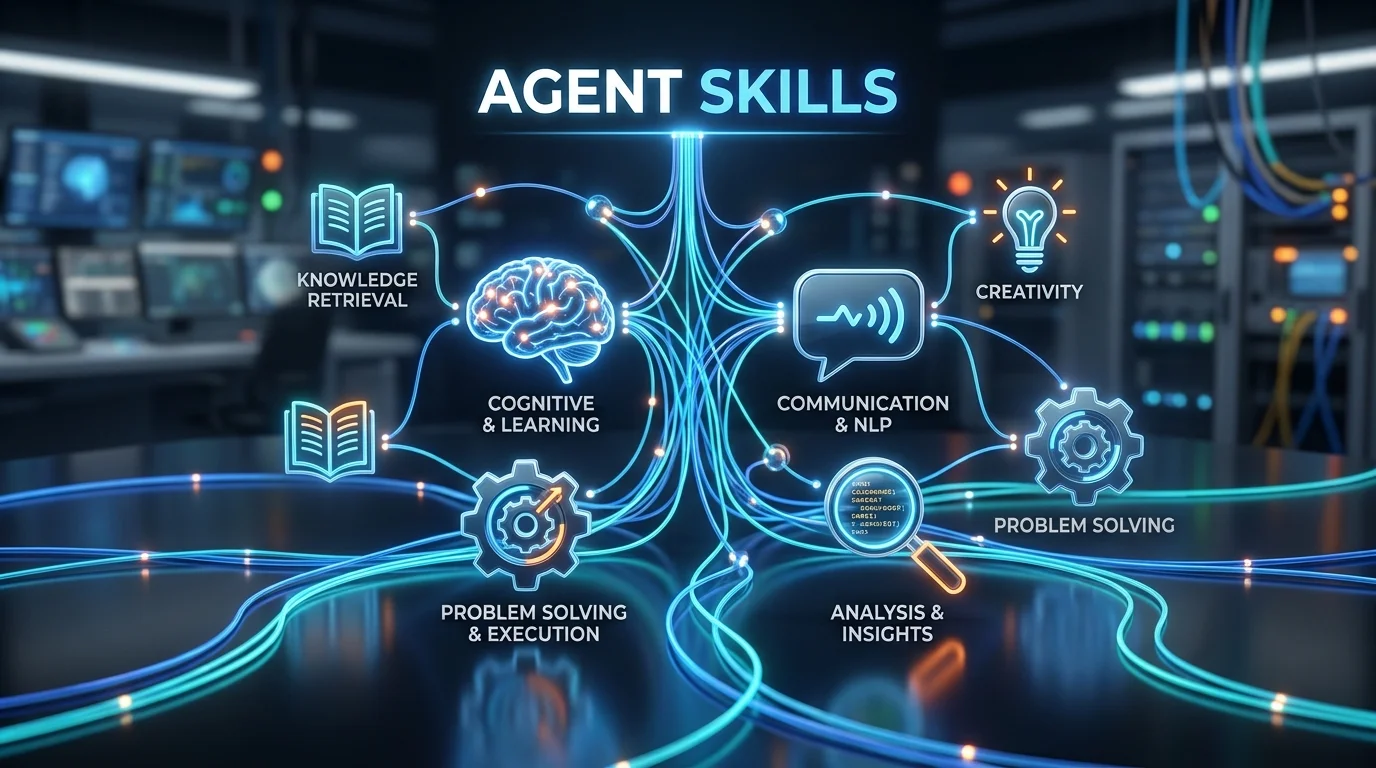
AI has moved past simple chatbots that just answer questions. In 2026, AI agents can actually do things — write and fix code, automate entire workflows, dig through research papers, and even manage parts of your tech infrastructure. This shift didn’t happen by accident. It happened because of a concept called agent skills.
If you’ve been hearing the term “agent skills” thrown around and wondering what it actually means for you as a developer, business owner, or curious tech user, this guide breaks it all down. We’ll cover exactly what agent skills are, the most valuable ones to learn right now, honest pros and cons, and how to build your own skill stack for maximum productivity.
By the end of this article, you’ll understand:
- What AI agent skills actually are (in plain English)
- The five major categories of skills worth mastering in 2026
- Real comparisons between different skill types
- Security considerations you can’t afford to ignore
- Where to start building your own agent skill toolkit
Let’s dive in.
What Are AI Agent Skills? A Clear Definition
AI agent skills are self-contained instruction packages that give an AI agent a specific, reusable ability — like running code, searching a database, or automating a multi-step task — instead of just generating a text response.
A helpful way to think about it: if an AI agent is like a smartphone, then agent skills are like the apps you install on it. A phone without apps can still make calls and send texts. But add a maps app, a banking app, and a camera app, and suddenly that same phone becomes far more useful for daily life.
Agent skills work the same way. On their own, AI models are good at generating language. But equip them with the right skill packages, and they can:
- Execute and debug real code
- Move information between different apps and platforms automatically
- Pull live data from databases and external APIs
- Search the web and ground their answers in current information
- Handle infrastructure tasks like deployments and server management
This is why 2026 is being called the year AI stopped just “talking” and started “working.”
Why Mastering Agent Skills Matters Right Now
The demand for professionals who understand how to configure, combine, and troubleshoot agent skills is climbing fast. Here’s why this matters for your career or business:
- Companies are shifting from “using an AI chatbot” to “running AI agents” that complete entire workflows independently
- Professionals who can set up and manage agent skill stacks are becoming as valuable as those who understand cloud infrastructure a decade ago
- Poorly configured or unsafe skills can introduce serious security risks, making skilled oversight essential
- Businesses that master agent skills early are automating tasks that used to require entire teams
Whether you’re a solo developer, part of a research team, or running a growing business, understanding this landscape gives you a real competitive edge.
The Top AI Agent Skill Categories to Master in 2026
Category 1: Development and Coding Skills
For developers, this is where agent skills deliver the most immediate value. Instead of manually reviewing every line of code or writing tests from scratch, specialized coding skills handle much of the heavy lifting.
Key skills in this category:
- Automated Code Review: Scans code for quality issues, inconsistent style, and potential bugs, then suggests or applies fixes automatically
- Structured Testing Enforcement: Requires a working test to be written and validated before any new feature implementation begins, catching problems before they reach production
- Advanced Debugging Assistance: Walks through error logs and stack traces methodically, isolating root causes instead of just patching symptoms
Why this matters: Teams using these skills consistently report cleaner codebases and fewer bugs slipping through to production, since the agent enforces good habits automatically rather than relying on individual developer discipline.
Trade-off to know: These skills need proper integration with your existing development tools and pipelines. Without that setup work upfront, they won’t deliver their full value.
Category 2: Research and Data Skills
Not every AI agent use case is about writing code. A huge and growing category focuses on helping people process information faster — pulling from academic sources, medical literature, or general knowledge bases.
Key skills in this category:
- Academic Paper Summarization: Monitors and condenses new research publications into digestible summaries, saving hours of manual reading
- Specialized Literature Retrieval: Pulls relevant, credible sources from domain-specific databases (medical research, legal precedent, scientific journals)
- General Knowledge Lookup: Searches and summarizes information from broad reference sources to answer factual questions quickly
Why this matters: Researchers, analysts, and students save enormous amounts of time when an agent can pre-filter and summarize relevant material instead of requiring manual searching through dozens of sources.
Trade-off to know: These skills are only as reliable as the external data sources and APIs they connect to. If a source API goes down or changes its structure, the skill’s usefulness drops until it’s updated.
Category 3: Productivity and Workflow Automation Skills
This category is where agent skills start feeling almost magical — agents that complete multi-step tasks across different applications without constant human supervision.
Key skills in this category:
- Cross-App Workflow Execution: Completes sequences of tasks spanning multiple tools (for example, pulling data from one app, formatting it, and delivering it into another)
- Communication Management: Drafts, organizes, and sends messages or emails based on context and prior instructions
- Document Processing: Extracts structured information from unstructured documents like PDFs or scanned forms and organizes it into usable formats
Why this matters: These skills eliminate the tedious, repetitive tasks that eat up hours of a typical workday, freeing people to focus on higher-value work.
Trade-off to know: Initial configuration can be complex, particularly when connecting multiple third-party applications with different authentication requirements and data formats.
Category 4: Security and Compliance Skills
As agents gain more autonomy, the risks grow too. This category has become non-negotiable for any serious agent deployment in 2026.
Key skills in this category:
- Supply Chain Monitoring: Continuously checks installed skill packages for signs of tampering, malicious code, or unauthorized modifications
- Regulatory Compliance Verification: Automatically checks whether agent actions and outputs align with relevant industry regulations and internal policies
Why this matters: As more businesses give agents access to sensitive systems, unmonitored skills become a genuine attack vector. A single malicious or compromised skill package can expose an entire organization’s data.
Trade-off to know: Security skills require ongoing updates and vigilance. A “set it and forget it” approach doesn’t work here — threats evolve, and your security tooling needs to evolve with them.
Category 5: Communication and Multi-Agent Collaboration Skills
The final major category involves agents that interact directly with live digital environments and coordinate with other agents.
Key skills in this category:
- Live Web Interaction: Allows an agent to navigate and interact with real websites and web applications, not just static information
- Multi-Agent Coordination: Manages handoffs and collaboration between multiple specialized agents working toward a shared goal
Why this matters: Complex tasks increasingly require more than one agent working together — one agent researching, another drafting, another executing. Coordination skills make this possible without constant human micromanagement.
Trade-off to know: Multi-agent setups introduce more points of failure. If one agent in the chain makes an error, it can cascade through the entire workflow unless proper checkpoints are built in.
Comparison Table: AI Agent Skill Categories at a Glance
| Skill Category | Best For | Setup Complexity | Key Benefit | Main Risk |
|---|---|---|---|---|
| Development & Coding | Software teams, individual developers | Medium | Fewer bugs, cleaner code | Requires platform integration |
| Research & Data | Analysts, students, researchers | Low-Medium | Faster information gathering | Depends on external API uptime |
| Productivity & Automation | Business operations, admin tasks | Medium-High | Saves significant time daily | Complex multi-app configuration |
| Security & Compliance | IT teams, regulated industries | Medium | Protects against threats | Requires constant maintenance |
| Communication & Collaboration | Multi-agent workflows, complex projects | High | Enables sophisticated automation | More potential failure points |
Pros and Cons of Building an Agent Skill Stack

✅ Advantages
- Significant productivity gains — routine, repetitive work gets handled automatically
- Expanded agent capability — turns a text-generation tool into an active task-completion system
- Reduced manual error — well-configured skills follow consistent processes every time
- Scalable automation — once configured, skills can run repeatedly without additional setup effort
- Competitive advantage — early adopters are automating work that competitors still do manually
❌ Disadvantages
- Real learning curve — properly integrating and configuring skills takes genuine time investment
- Security exposure — poorly vetted or unmonitored skills can introduce vulnerabilities
- Maintenance burden — skills connected to external APIs or data sources need regular updates
- Configuration complexity — especially for automation skills spanning multiple applications
- Over-automation risk — handing off too much without oversight can lead to errors going unnoticed
How to Start Building Your Agent Skill Stack
You don’t need to master every category at once. Here’s a practical approach to getting started:
- Identify your biggest time drain first — pick the single repetitive task costing you the most hours each week
- Start with one skill category — don’t try to implement coding, research, and automation skills simultaneously
- Verify sources before installing anything — only use skill packages from reputable, verified repositories
- Test in a low-stakes environment — run new skills on non-critical tasks before trusting them with important work
- Build in human checkpoints — especially for automation and multi-agent skills, keep a review step until you trust the output consistently
- Layer in security skills early — don’t treat compliance and monitoring as an afterthought once you’re already scaled up
This gradual approach lets you build real confidence in how these skills behave before expanding your reliance on them.
Related Reading
If you’re building out your AI skill stack, coding-focused skills are often the natural starting point. Explore essential codex skills for developers to see how prompt engineering, code auditing, and debugging techniques directly complement the development-focused agent skills covered in this guide.
Other helpful guides on Gloobia:
- 7 Essential Codex Skills Every Developer Needs to Learn
- How to Install Claude Code in 1 Minute
- Best AI Coding Assistants Compared for 2026
- AI Workflow Automation for Small Businesses
Frequently Asked Questions
Q: What exactly are AI agent skills?
A: AI agent skills are modular, reusable instruction packages that give an AI agent a specific executable ability — such as writing and debugging code, automating tasks across apps, or retrieving research data — rather than just generating a text response.
Q: Which agent skills matter most heading into 2026?
A: The most broadly valuable skills fall into coding and debugging, workflow automation, and security monitoring. These three categories tend to deliver the fastest, most measurable return regardless of your specific industry or role.
Q: Are AI agent skills safe to install and use?
A: They can be, but only when sourced from verified, reputable repositories. Unverified or third-party skill packages can potentially contain malicious code, which is exactly why supply chain monitoring has become such an important skill category in its own right.
Q: Do I need to be a developer to use agent skills?
A: Not necessarily. While coding-related skills obviously benefit developers most directly, categories like research summarization, document processing, and workflow automation are valuable for non-technical roles too, including operations, marketing, and administrative work.
Q: How is an “agent skill” different from a regular AI prompt?
A: A prompt is a one-time instruction you type into a conversation. A skill is a packaged, reusable capability that persists and can be invoked repeatedly — closer to installing a piece of software than typing a single request.
Q: What’s the biggest mistake people make when adopting agent skills?
A: Moving too fast without proper oversight. Trying to automate everything at once, without verifying skill sources or building in human review checkpoints, is the most common way organizations run into security or reliability problems.
Conclusion: Building Your 2026 Agent Skill Toolkit
AI agents in 2026 aren’t just conversational tools anymore — they’re active participants in coding, research, business operations, and security workflows. The professionals and businesses that thrive going forward will be the ones who understand how to thoughtfully select, configure, and maintain the right combination of agent skills for their specific needs.
Start small. Pick one skill category that addresses your most pressing pain point, verify your sources carefully, and build in oversight from day one. As you gain confidence, expand your skill stack methodically rather than all at once.
Mastering agent skills isn’t about chasing every new capability that comes along — it’s about building a reliable, secure, and genuinely productive toolkit that makes AI agents true collaborators in your work.
Authoritative References
- Microsoft Bing Search Quality Guidelines — Reference guidelines that help content creators understand how search engines evaluate and rank helpful, well-structured content
- OWASP Foundation — owasp.org — Industry-standard resource for understanding security vulnerabilities relevant to supply chain and compliance skill categories
- GitHub — github.com — Widely used platform for discovering and vetting open-source agent skill packages and integrations