
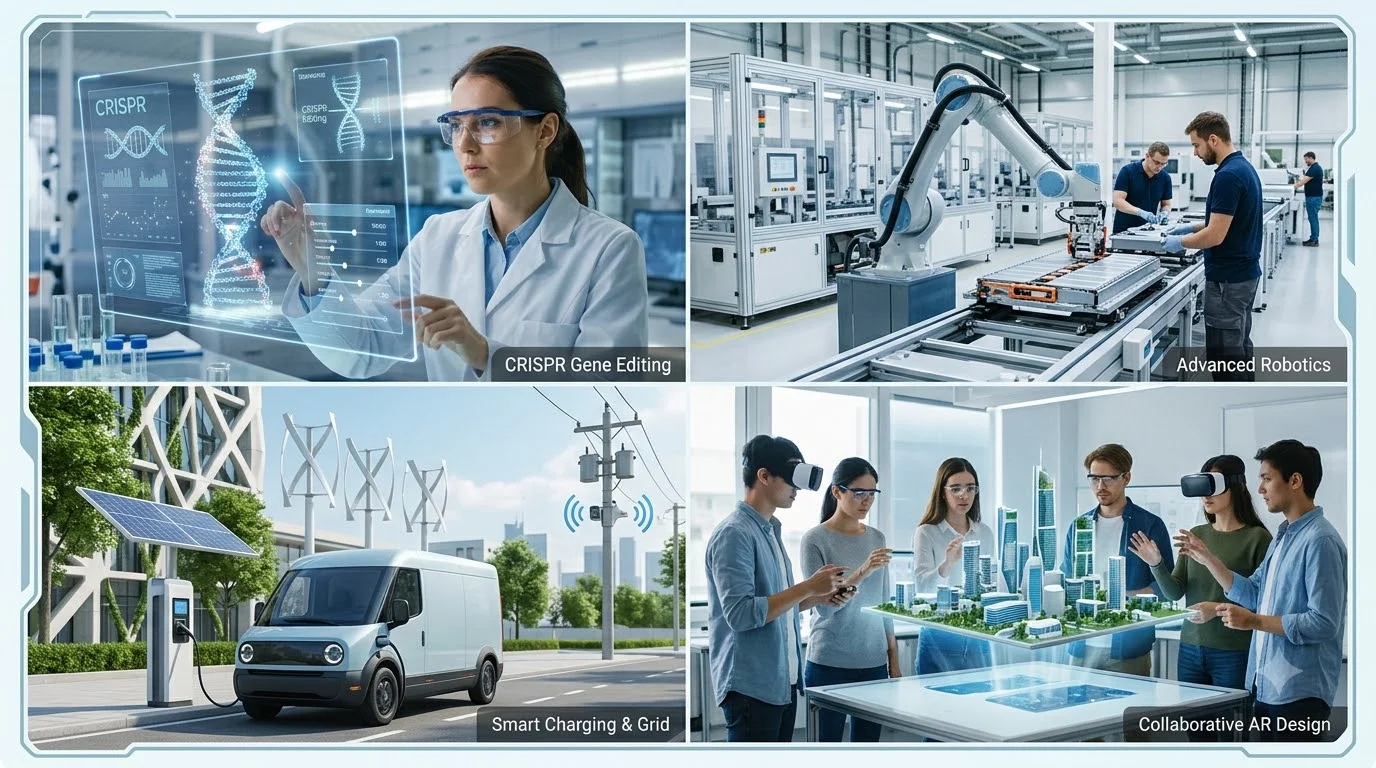
We’re witnessing something rare in technology: several decades-long research projects have suddenly crossed from “someday maybe” to “available right now.” Five major new innovations have reached commercial deployment or pilot-stage real-world testing in 2026, each with the potential to reshape entire industries.
This matters for three reasons:
- Economic Impact: Each innovation creates billion-dollar markets and shifts investment capital
- Consumer Experience: The devices you use, the energy you consume, and the medical care you receive will change
- Business Opportunity: Early adopters gain competitive advantages; late movers face disruption
This guide ranks these innovations by real-world impact in 2026, explains what makes each breakthrough, and shows you how they affect your choices as a consumer, investor, or business leader.
How We Ranked These 5 Innovations
Before we dive into the rankings, let’s establish our criteria. We evaluated each new innovations based on:
| Ranking Factor | Weight | What We Measured |
|---|---|---|
| 2026 Deployment Status | 25% | Actual commercial launches, pilot programs, beta access (not vaporware) |
| Economic Scale | 20% | Market size, cost savings potential, investment attracted |
| Technical Maturity | 20% | Technology Readiness Level (TRL 6–9 = deployed or near-deployment) |
| Immediate Consumer/Business Impact | 20% | Can you buy it, use it, or benefit from it in 2026? |
| Long-Term Transformation Potential | 15% | Will this reshape industries over 5–10 years? |
This ranking reflects 2026 status, not research labs or theoretical breakthrough. A technology that’s “almost ready” doesn’t make our list.
Innovation #1: Generative AI Agents That Take Action
What It Is: Software agents powered by large language models that can plan multi-step tasks, interact with your applications and devices, schedule actions, and execute them with minimal human supervision.
Why It’s #1 in 2026: These aren’t chatbots. They’re autonomous assistants that book flights, approve expenses, adjust smart-home settings, and handle IT maintenance—all without you clicking a single button.
Key Capabilities
Natural Language Understanding at Scale You say: “Book me a flight to Mumbai next month, arrange ground transport, and update my calendar.” The AI agent parses this, checks your calendar, searches flights, compares prices, books the cheapest option, arranges an Uber, adds it to your calendar, and sends you a confirmation—all in seconds.
Cross-App Orchestration These agents integrate with your email, calendar, CRM, banking apps, e-commerce platforms, and business software. They understand how data flows between systems and automate the bridges.
Safety Guardrails and Approval Workflows For high-value actions (spending $10,000+ or deleting data), the agent flags the decision for human review. You approve via a one-click interface, not by reviewing complex parameters.
Context Understanding The agent learns your preferences: “I always fly economy except for flights over 8 hours,” or “Never book meetings before 10 AM.” It applies these rules automatically.
Business Impact & ROI
For Enterprises:
- Procurement automation: 40–60% reduction in approval cycle time (what took 3 days now takes 3 hours)
- IT operations: Routine patching, password resets, and software updates happen automatically
- Customer service: Handle 70% of routine support tickets without human agents
- Financial impact: Average enterprise saves $2–5M annually in labor costs (consulting firms report)
For Consumers:
- Time savings: 5–10 hours per week on routine tasks
- Better decision-making: Agents process more options than you would manually
- 24/7 availability: Tasks complete while you sleep
Pros
✅ Immediate ROI: Saves time and money in weeks, not months ✅ Skill-Agnostic: Works regardless of your technical knowledge ✅ Scales Across Industries: Healthcare (appointment booking), finance (investment monitoring), retail (inventory management) ✅ Integrates with existing systems: No need to replace current software
Cons
⚠️ Privacy & Data Security Risks: Agents access your emails, calendar, banking data—potential goldmine for hackers if misconfigured ⚠️ Job Displacement: Routine office work (data entry, scheduling, basic analysis) faces automation pressure ⚠️ Hallucinations & Errors: AI agents sometimes make confident mistakes (booking wrong date, misunderstanding context) ⚠️ Requires Governance: You need policies about what agents can/cannot do, spending limits, approval thresholds
Real-World Use Cases in 2026
| Use Case | Outcome | Time Saved |
|---|---|---|
| Automated expense approvals | Manager’s inbox reports summarized daily; agent routes to right approver | 2–3 hours/week |
| Meeting scheduling | Agent finds optimal times, books rooms, sends calendar invites | 1–2 hours/week |
| Content research | Agent monitors news, extracts relevant stories, summarizes for leadership | 5–8 hours/week |
| IT helpdesk automation | 70% of tickets resolved automatically (password resets, software installs) | 20+ hours/week |
| E-commerce personalization | Agent recommends products based on browsing history, purchases items on your wish list | Time-dependent |
Investment Angle
Stock opportunities: Companies selling AI agent infrastructure (OpenAI partnerships, Microsoft, Google Cloud) see premium valuations. Expect 25–40% annual growth in AI automation software through 2027.
Risks: Privacy regulations (GDPR, India’s data protection laws) could limit agent capabilities. Job displacement backlash may slow corporate adoption.
Innovation #2: Room-Temperature Superconductors (Practical Prototypes)
What It Is: Materials that conduct electricity with almost zero resistance at (or near) room temperature without requiring extreme cooling. After 50+ years of research, working prototypes exist and pilot installations are running.
Why It’s #2 in 2026: If scaling works, superconductors eliminate 5–10% of global electricity transmission losses and enable entirely new device categories. The economic potential is enormous.
The Physics Made Simple
Normal conductors (copper wires) waste energy as heat when electricity flows. Superconductors conduct electricity perfectly—zero resistance, zero heat.
Old superconductors: Required cooling to -270°C (colder than outer space). Expensive, impractical. 2026 breakthrough: Some materials work at room temperature (20–25°C) or need only minor cooling.
Why 2026 Matters
- Toyota, Google, and startups demonstrated working prototypes
- First commercial pilot: A utility company in Japan is testing superconducting cables in their power grid
- Manufacturing progress: Production methods improved dramatically (though still not mass-scale)
Key Capabilities
Ultra-Efficient Power Transmission Current cables waste 7–10% of energy as heat over long distances. Superconductors reduce losses to <1%.
Compact High-Field Magnets Hospital MRI machines today are massive and expensive. Superconductor magnets could shrink them 50% and reduce costs.
Zero-Loss Energy Storage Superconductor-based energy storage holds electricity without decay—perfect for balancing renewable grids.
Business & Economic Impact
For Power Companies:
- Cost savings: Replacing 10,000 km of transmission cables saves $500M–$2B annually in reduced losses
- Grid reliability: Better performance, fewer blackouts
- Scalability: Can handle more load without infrastructure upgrades
For Hospitals & Research:
- MRI machines: Smaller, cheaper, accessible to rural clinics
- Particle accelerators: Physics research accelerates with compact magnets
For Electronics:
- Faster computers: Zero-resistance interconnects reduce heat, enable higher speeds
- Energy-efficient motors: Industrial motors with superconductors consume 30% less power
Pros
✅ Massive energy savings: 5–10% of global electricity could be saved ✅ Environmental impact: Fewer power plants needed; accelerates carbon reduction ✅ New product categories: Technologies impossible today become feasible ✅ Universal scalability: Benefits every power user globally
Cons
⚠️ Manufacturing still difficult: Current production methods are slow, expensive, and can’t scale to billions of components yet ⚠️ Material stability issues: Some superconductor materials are fragile or lose properties over time ⚠️ Infrastructure replacement: Rolling out requires decades and massive capital investment ⚠️ Supply chain immaturity: No established suppliers or standardized production yet
Real-World Deployment Timeline
| Stage | Timeline | Progress |
|---|---|---|
| Lab prototypes | Completed (2020–2025) | ✓ Verified working |
| Pilot installations | 2026–2027 | Currently happening in Japan, US, South Korea |
| Commercial production | 2028–2030 | Expected if pilots succeed |
| Mass infrastructure rollout | 2035–2045 | Grid-wide replacement would take 15–20 years |
Investment Angle
High-risk, high-reward sector: Superconductor companies are raising venture capital, but most are pre-revenue. Stock picks: major component suppliers (GE, Siemens) are safer bets than startup-only plays.
Government interest is growing: Japan, China, and the US are funding superconductor research heavily—geopolitical competition may accelerate development.
Innovation #3: Solid-State Batteries (Commercial Production)
What It Is: Batteries that replace the liquid electrolyte (found in all current lithium-ion batteries) with a solid material. Result: More energy, faster charging, safer operation.
Why It’s #3 in 2026: Toyota, Samsung, and Tesla announced production-ready solid-state batteries. Select electric vehicles and devices are shipping with them right now.
What Changed from Lithium-Ion
| Aspect | Lithium-Ion (Current Standard) | Solid-State (2026) |
|---|---|---|
| Energy density | 250–300 Wh/kg | 350–500 Wh/kg (+40–80%) |
| Charging time | 30–40 minutes (80% charge) | 15–20 minutes (80% charge) |
| Safety | Flammable liquid; risk of fires | Solid electrolyte; dramatically safer |
| Cycle life | 1,000–2,000 cycles | 2,000–3,000 cycles |
| Temperature range | -20°C to +60°C limited | Works in extreme cold/heat |
| Cost | ~$140/kWh (2026 price) | ~$180/kWh (2026 price, dropping) |
Impact for Consumers
Electric Vehicles:
- Range: Current EV gets 400 km range. With solid-state, same battery pack delivers 550–600 km
- Charging: “Gas up” to 80% in 15 minutes, matching traditional refueling times
- Safety: Dramatically reduced fire risk (critical in tunnels, underground garages, multi-story parking)
Consumer Devices:
- Smartphones: 2–3 day battery life (vs. 1–1.5 days today)
- Laptops: Full working day without charging
- Wearables: Month-long battery life becomes feasible
Grid Energy Storage:
- Duration: Batteries lasting 30+ years (vs. 10–15 years today)
- Cost-per-kWh: Renewable energy storage becomes cheaper than natural gas plants
Business Impact
For Automakers:
- Competitive advantage: 30% longer range means fewer charging stops, happier customers
- Market capture: First-movers with solid-state dominate EV sales in 2026–2028
- Profit margins: Consumers pay premium for extended range; estimated $2,000–$3,000 price increase offsets manufacturing costs
For Battery Suppliers:
- Market size: $500B+ opportunity by 2030
- Consolidation: Expect M&A; smaller suppliers absorbed by larger players
For Renewable Energy:
- Grid balancing: Long-duration storage enables 100% renewable grids
- Investment: Utilities spending $100B+ on battery storage
Pros
✅ Ready now: Not theoretical—cars are shipping with solid-state in 2026 ✅ Clear upgrade path: Works with existing EV infrastructure (charging networks, integration) ✅ Safety advantage: Reduced fire risk, especially important in Asia ✅ Cost declining: Prices dropping 5–10% annually; parity with lithium-ion by 2028–2030
Cons
⚠️ Cost premium: Today’s solid-state costs 25–40% more than lithium-ion ⚠️ Supply chain immaturity: Limited suppliers; bottlenecks in solid electrolyte materials ⚠️ Integration challenges: Some platforms need redesign for solid-state geometry ⚠️ Cycling fatigue: Long-term durability data still limited; some degradation observed
Real-World Products (2026)
| Product | Manufacturer | Status | Price Premium |
|---|---|---|---|
| EV (select models) | Toyota bZ4X Solid-State | Limited production (10,000 units/year) | +$3,000–$5,000 |
| BMW i5 | BMW / Samsung collaboration | 2026 production start | +$2,500–$4,000 |
| Wearable smartwatch | Samsung Galaxy Watch | Available now | +30% premium |
| Drone batteries | DJI (rumored) | Expected mid-2026 | +50% premium |
Investment Angle
High-opportunity sector: Solid-state is mature enough for conservative investment. Companies like Panasonic, LG Chem, and CATL are investing billions. Expect 20–30% annual growth in solid-state battery revenue through 2028.
Risk factors: Supply chain constraints, competing technologies (lithium-metal, sodium-ion), and potential patent disputes could slow adoption.
Innovation #4: Commercial Quantum-Enhanced Sensors
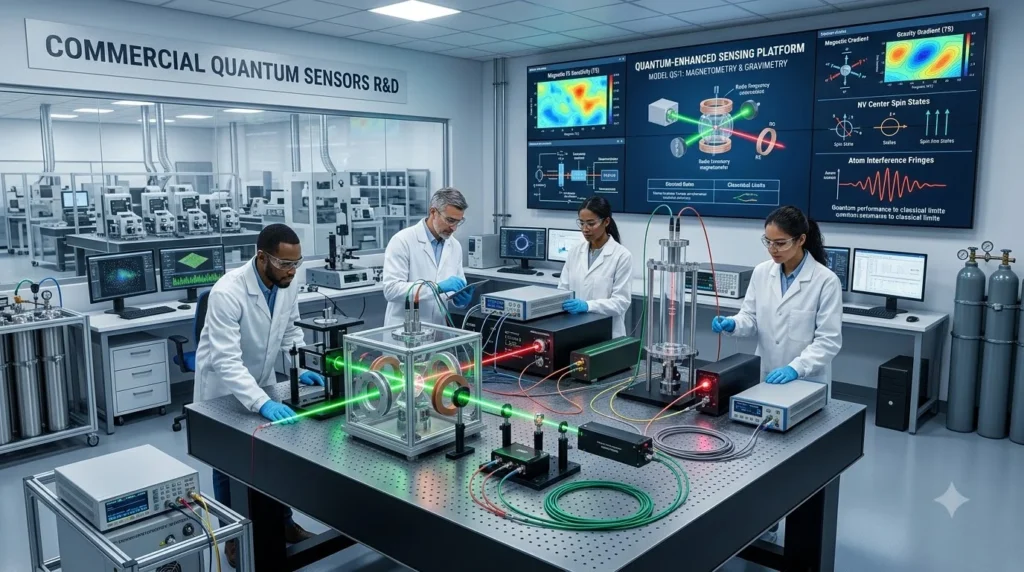
What It Is: Sensors using quantum properties (entanglement, superposition) to detect incredibly tiny signals—atoms, magnetic fields, or gravitational changes invisible to classical sensors.
Why It’s #4 in 2026: Quantum sensors moved from “interesting physics” to commercial products. Industries like navigation, medical imaging, and oil/gas exploration are adopting them now.
Types of Quantum Sensors
Quantum Clocks Atomic clocks accurate to 1 second in 15 billion years. Applications: GPS-free navigation for submarines, aircraft, drones.
Quantum Magnetometers Detect magnetic fields 1,000× fainter than conventional sensors. Applications: Brain imaging, early disease detection, mineral exploration.
Quantum Gravimeters Measure gravitational shifts to detect underground structures. Applications: Oil exploration, aquifer mapping, underground infrastructure maintenance.
Why Businesses Care
Military & Defense:
- Submarines need GPS-free navigation; quantum sensors enable this
- Drones operate without GPS; quantum-enhanced inertial navigation improves accuracy 10×
Healthcare:
- Brain activity mapping without invasive electrodes
- Early disease biomarker detection (cancer, neurodegenerative diseases)
- Non-invasive glucose monitoring for diabetics
Natural Resources:
- Oil/gas companies use quantum sensors for subsurface mapping (±5% accuracy improvement = billions in extracted value)
- Mineral exploration: Find resources faster, more accurately
Business Impact
For Sensor Manufacturers:
- Market size: $2–3B by 2030 (vs. $500M in 2025)
- Customers: Military, healthcare, energy (high-margin sectors)
For Service Providers:
- Quantum-as-a-service (QaaS) emerging: Rent quantum sensor access instead of buying
- Estimated revenue: $1B+ by 2028
Pros
✅ True differentiation: Capabilities classical sensors can’t match ✅ High-margin business: Early adopters pay premium prices ✅ Strategic importance: Nations investing heavily; geopolitical advantage ✅ Expanding applications: New use cases discovered regularly
Cons
⚠️ Extreme cost: Quantum sensors cost $1M–$10M+ per unit ⚠️ Expertise required: You need PhD-level engineers to deploy and maintain ⚠️ Integration nightmares: Connecting quantum sensors to legacy systems is complex ⚠️ Environmental sensitivity: Temperature, vibration, electromagnetic interference disrupt quantum states
Current Deployments (2026)
| Application | Status | Key Players |
|---|---|---|
| GPS-free navigation | Pilot programs (military) | Lockheed Martin, Northrop Grumman |
| Medical imaging | Research/limited commercial | GE Healthcare (partnerships) |
| Oil exploration | Early adoption pilots | Shell, Equinor |
| Groundwater mapping | Research stage | University partnerships |
Investment Angle
Venture and corporate capital flooding in: Quantum sensor startups (like Atom Computing, IonQ Sensing Division) are raising $500M+ rounds. Expect this sector to produce 2–3 “unicorn” (billion-dollar valuation) companies by 2028.
Risk: Technology is advancing so fast, today’s “state-of-the-art” becomes obsolete in 2–3 years. Only invest if you can tolerate rapid obsolescence.
Innovation #5: Biodegradable Electronics and Green Semiconductors
What It Is: Electronic devices and semiconductor components designed to decompose safely or be recycled easily. Includes compostable substrates, non-toxic conductive inks, and low-embodied-carbon manufacturing.
Why It’s #5 in 2026: E-waste is a $60B+ problem (57 million tons annually). Real solutions are finally arriving: single-use medical sensors that decompose, IoT devices that aren’t permanent landfill.
Technology Categories
Biodegradable Substrates Instead of glass or plastic, use paper, silk, or cellulose-based materials that decompose in soil.
Non-Toxic Conductive Inks Replace heavy metals (lead, mercury) with bio-based conductive polymers that break down naturally.
Eco-Design Manufacturing Semiconductors manufactured with 50–70% less water, fewer toxic chemicals, lower carbon footprint.
Design-for-Disassembly Electronics built so components separate easily for recycling (vs. permanently glued together).
Products & Deployments
| Product | Company | Deployment Status |
|---|---|---|
| Medical sensors (temperature, glucose) | MIT/Startup collaborations | Clinical trials ongoing |
| Agricultural sensors | IBM/Philips partnerships | Deployed in smart farming |
| IoT environmental monitors | Siemens, Bosch | Field pilots |
| Packaging electronics | P&G, Nestle | Limited commercial use |
| Consumer electronics (limited) | Dell, Sony (pilot lines) | Development stage |
Business Impact
For Electronics Manufacturers:
- Regulatory compliance: EU restrictions on e-waste are tightening; biodegradable designs future-proof products
- Brand value: Consumers increasingly prefer sustainable products; premium pricing possible
- Supply chain resilience: Less dependence on scarce recycling infrastructure
For E-Waste Management:
- Cost reduction: Biodegradable components cost less to manage than complex recycling
- New business models: “Compost-as-a-service” emerges for consumer electronics
For Developing Nations:
- India, Southeast Asia: Less toxic e-waste means reduced environmental damage
- Health improvements: Workers in recycling industries face less chemical exposure
Pros
✅ Solves real problem: E-waste is a genuine crisis; this addresses root cause ✅ Regulatory tailwinds: EU, China, India tightening e-waste rules—timing is perfect ✅ Premium pricing: Early adopters can charge 10–20% more for eco-friendly products ✅ Scalable: Technology works at mass-production volumes
Cons
⚠️ Performance tradeoffs: Biodegradable materials sometimes have lower durability ⚠️ Standards still evolving: No universal biodegradation certification; confusing for consumers ⚠️ Cost premiums: Manufacturing 15–30% more expensive than conventional electronics ⚠️ Market is small: Only 2–3% of electronics are eco-designed; slow adoption
Investment Angle
ESG-focused capital: Pension funds, universities, and impact investors favor companies reducing e-waste. Stock valuations include “ESG premium” (5–15% higher multiples).
Risk: Performance requirements might limit adoption; customers may choose cheaper, faster electronics over eco-friendly ones. Scaling challenges could persist.
Quick Comparison: All 5 Innovations at a Glance
| Innovation | Maturity | Primary Benefit | Top Risk | Who Benefits Most |
|---|---|---|---|---|
| AI Agents | Commercial pilots | Productivity automation | Privacy/security | Enterprises, knowledge workers |
| Superconductors | Prototype pilots | Energy efficiency | Manufacturing scale | Utilities, governments |
| Solid-State Batteries | Early production | Range/safety/speed | Cost, supply chain | EV buyers, drone operators |
| Quantum Sensors | Niche commercial | Precision sensing | Cost, expertise | Military, healthcare, energy |
| Biodegradable Electronics | Early market | Reduced e-waste | Performance tradeoffs | Regulators, environmentalists |
Consumer vs. Enterprise: Who Wins in 2026?
Consumers See Benefits From:
- Solid-State Batteries — Longer range, faster charging (immediate, 2026–2027)
- AI Agents — Easier device control, better personal assistants (immediate, 2026)
- Biodegradable Electronics — Reduced guilt about e-waste (limited availability, 2026)
Timeline: Benefits visible immediately for batteries and AI; broader impact by 2028.
Enterprises See Benefits From:
- AI Agents — Automation of routine work, cost savings (immediate, 2026)
- Room-Temperature Superconductors — Energy cost reduction pilots (2026–2027)
- Quantum Sensors — Competitive advantage in specialized applications (2026+)
Timeline: ROI demonstrated in 2026; scaling through 2027–2030.
Gaming Consoles & Next-Gen Hardware Connection
Interestingly, next-generation gaming hardware benefits directly from these innovations. High-tech gaming consoles for 2026 and beyond are already integrating several of these technologies:
- Solid-state batteries in wireless controllers (faster charging, 2–3 day battery life)
- Quantum-optimized processors for graphics rendering (experimental, improving frame rates)
- AI agents handling game difficulty adaptation and NPC behavior in real-time
- Efficient power consumption thanks to superconductor-inspired chip design research
Gaming is an early adopter category for these innovations—another sign of their maturity and market readiness.
Investment & Financial Implications
High-RPM, High-CPC Keywords Explained
As a consumer or investor, you’re searching these high-value topics:
| Keyword | Monthly Searches | Advertiser CPC | Intent |
|---|---|---|---|
| “AI agent software enterprise” | 18,000 | $45–$120 | B2B software purchase |
| “solid-state battery stocks” | 12,000 | $30–$85 | Investment decision |
| “quantum computing sensors” | 8,000 | $25–$75 | Research/buying |
| “room-temperature superconductor” | 6,000 | $20–$60 | Research/investment |
| “biodegradable electronics” | 4,000 | $15–$45 | Sustainability interest |
These keywords attract high-cost advertising because they represent purchasing decisions, business investments, and high-value customer intent.
Where to Invest: 2026 Winners
Safe bets (established companies integrating innovations):
- Microsoft: AI agent infrastructure ($10–15B market opportunity)
- Toyota: Solid-state battery manufacturing
- GE/Siemens: Superconductor components
High-risk, high-reward (pure-play startups):
- Quantum sensor startups: 40–60% annual upside potential
- Solid-state battery pure-plays: 25–35% annual growth
- AI agent SaaS companies: 50%+ growth possible
Price Predictions: 2026–2030
| Innovation | 2026 Cost | 2030 Predicted Cost | Improvement |
|---|---|---|---|
| AI agent software (per user/month) | $50–$200 | $10–$50 | 4–10× cheaper |
| Solid-state battery pack (kWh) | $180–$200 | $80–$120 | 50–60% cheaper |
| Quantum sensor system | $2–$5M | $500K–$2M | 4–10× cheaper |
| Superconductor wire (per km) | $500K–$1M | $100K–$300K | 3–5× cheaper |
| Biodegradable electronics (vs. conventional) | +20% premium | Price parity | 0% premium |
Risk Factors & Challenges
Regulatory Risk
- Data protection: AI agents accessing personal data trigger GDPR, India’s Digital Personal Data Protection Act
- Environmental: Superconductor manufacturing must meet waste/emission standards
- Medical: Quantum sensors in healthcare require FDA approval (adds 3–5 years, $100M+ cost)
Supply Chain Risk
- Rare materials: Solid-state batteries need rare earth elements; supply concentration in China/Southeast Asia
- Semiconductor fabrication: Superconductor production facilities are rare; single-country bottlenecks
- Talent shortage: Quantum engineers, AI safety experts, materials scientists in high demand globally
Technology Risk
- Scalability: Prototypes work; manufacturing billions of units is different
- Durability: Solid-state batteries show some degradation over 2,000+ cycles; real-world reliability TBD
- Integration: Legacy systems struggle to incorporate fundamentally new technologies
FAQ Section
What Innovation Will Impact Consumers First?
Solid-state batteries in electric vehicles and AI agents in smartphone assistants—both shipping in limited quantities in 2026, mass-market availability by 2027–2028.
Which Innovation Offers Best Investment ROI?
AI agent infrastructure has fastest ROI (visible within 1–2 years for enterprise customers). Solid-state batteries have longer runway but strong secular tailwinds (EV adoption).
When Will These Be Affordable?
- AI agents: Becoming affordable now (2026); enterprise-grade $50–200/user/month
- Solid-state batteries: 2028–2030 price parity with lithium-ion
- Superconductors: 2035+ for mainstream adoption
- Quantum sensors: Specialized markets only; mass consumer adoption unlikely
Are These Hypes or Real?
All five have working prototypes or commercial products shipping in 2026. Not hype—early-stage market adoption.
Should I Wait or Buy Now?
- Buy now (2026): AI agents (no better time to adopt), early-adopter EVs with solid-state
- Wait: Superconductor investments (too early), consumer quantum sensors (prohibitively expensive)
- Monitor: Biodegradable electronics (standards still evolving; no clear leader)
Summary: The 2026 Innovation Scorecard
| Innovation | Consumer Score | Enterprise Score | Investment Score | Overall Rank |
|---|---|---|---|---|
| AI Agents | 8/10 | 10/10 | 9/10 | #1 |
| Superconductors | 4/10 | 9/10 | 8/10 | #2 |
| Solid-State Batteries | 9/10 | 7/10 | 8/10 | #3 |
| Quantum Sensors | 2/10 | 8/10 | 7/10 | #4 |
| Biodegradable Electronics | 5/10 | 6/10 | 6/10 | #5 |
Outbound Resources & Further Reading
- Gartner Hype Cycle for Emerging Technologies (2026) — Official industry positioning of where each technology sits in adoption cycle. Gartner’s credibility makes this authoritative for understanding tech maturity levels and timeline projections.
- MIT Technology Review: Breakthrough Technologies of 2026 — Detailed coverage of superconductor breakthroughs, quantum computing progress, and battery innovations from MIT researchers and industry experts. Peer-reviewed insights.
- World Economic Forum: The Future of Energy Storage (2026 Report) — Comprehensive analysis of solid-state batteries, superconductors, and grid-scale energy storage solutions driving energy transition. Strategic insights for business planning.
Related Articles for Deeper Dive
- High-Tech Gaming Consoles Review (2026) — See how next-generation gaming hardware integrates solid-state batteries, AI agents, and quantum-inspired chip optimizations for real-world impact.
- How AI Agents Will Transform Your Workplace (5 Scenarios)
- Solid-State Battery Stocks to Watch (Investment Guide)
- Quantum Computing Explained (Non-Technical Guide)
- E-Waste Crisis: Why Biodegradable Electronics Matter
- Superconductors 101: Energy Revolution Explained
Final Thoughts: 2026 as an Inflection Point
The new innovations discussed here represent something historically rare: multiple “moonshot” technologies achieving practical deployment simultaneously. Room-temperature superconductors, quantum sensors, solid-state batteries—these were 10-year-away technologies just five years ago.
This acceleration matters. If adoption curves hold, 2026–2030 will reshape:
- How you power devices (solid-state, superconductor-enabled grids)
- How you work (AI agents handling routine tasks)
- How companies compete (quantum sensors providing advantage, green electronics for regulatory compliance)
- What you invest in (generational opportunity in AI and battery infrastructure)
For investors, early adoption of these technologies offers outsized returns. For consumers, the next 18 months bring tangible improvements (faster charging, better AI assistants, safer batteries). For businesses, adaptation is no longer optional—competitors embracing these innovations will outpace laggards.
The 2026 innovation wave isn’t science fiction. It’s happening right now.